
Zuheyra was freezing on the evening of September 5, even colder than usual because she was starving. The knife she used to slice fat off the endless slabs of raw beef lining up before her felt heavy in her cramped hands, and the frigid, sterile air in the meat-packing plant did nothing to quench the dryness in her mouth.
She had been standing there for four and a half hours, her 22-year-old body covered with the nearly twenty pounds of protective gear — a heavy jacket, hard hat, gloves — required for workers at the JBS Swift & Company plant in Greeley. The extra weight, combined with the empty pit in her stomach, made Zuheyra dizzy.
She was accustomed to the soreness in her muscles, the nightly routine of massaging her neck and shoulders to remove the ache in her knife-wielding arm. But this hunger was an extra burden, and it didn't change in spite of the bloody carcasses all around her. It was the holy month of Ramadan, when observant Muslims must fast from sunrise to sundown every day. Zuheyra, who didn't want her last name used in this story because she still works at Swift, hadn't eaten in fourteen hours. She was counting the minutes until her 7:30 p.m. break, when she could finally have some water and a snack.
Earlier in the week, her fellow Somali Muslim workers on the second shift had negotiated to have their regular break time moved to 7:30 p.m., to coincide with sunset and allow them to drink water and pray to break their fast. For two days, the routine had worked out fine. On the third day, some of the Hispanic workers at the plant protested because the time was earlier than the one spelled out in their union contract. Swift officials reached a compromise, moving the break time to around 8 p.m. But it was a last-minute decision, and the Somalis, many of whom don't speak English, didn't get word.
So at 7:30 p.m., crowds of Muslims tried to leave, but their supervisors wouldn't let them pass, blocking the hallways leading to the restrooms and water fountains. Zuheyra felt the panic rise in her chest. Her religion dictated that she had to pray exactly at sunset or all those hours of fasting would be wasted in the eyes of Allah. "If I don't pray, my fast is not going to be acceptable," she explains through a translator.
Zuheyra had been a Swift employee for about six months. In 2006, she'd left her family behind in a refugee camp in Egypt and flown to Houston, Texas, as part of the U.S. State Department's refugee resettlement program. She got a job at a clothing factory there but was laid off earlier this year. So friends already in Greeley urged her to move, telling her that Swift would double her earnings.
She joined 400 other Somalis who had flocked to the small farming town to take jobs at the plant. It was dangerous, exhausting work; a 2005 Human Rights Watch report said meatpacking has the highest rate of injury and illness in the manufacturing industry. Still, it allowed her to rent an apartment while still sending plenty of money home to her relatives. And she was surrounded by a supportive community of fellow Somali Muslims.
But now she was being forced to choose between this $12.10-an-hour job and her faith, the one unquestionable force in her wildly unstable life. In the end, it wasn't really a choice at all. She joined more than 200 of her fellow Muslim workers and walked out.
Somali refugees have been coming to Colorado for at least ten years — some by choice, many by chance. Most East African refugees, when trying to escape camps in Kenya or Ethiopia, don't get to pick where they land in America. Unless they have family in a specific town, the U.S. government selects a city for them based on the availability of resettlement agencies and resources such as jobs and transportation.
In 2007 there were 1,800 Somalis living in Colorado, primarily in Denver, where they receive housing, Medicaid, and several months' worth of cash assistance from resettlement agencies like Lutheran Family Services, says Paul Stein, director of the Colorado Refugee Services Program. Because refugees are automatically considered legal workers, many find jobs cleaning hotel rooms, driving cabs or serving burgers at Denver International Airport. Over the years, they have formed communities in neighborhoods in Aurora, opening restaurants and shops tucked into strip malls around Mississippi and Florida avenues and Havana Street.
Many people who have spent more than a decade in refugee camps must learn how to cook, use electricity, obey traffic lights. It's not an easy transition, particularly for Muslim women. Employers often hesitate to hire people who look so foreign, with their long dresses and head scarves, says Rashid Sadiq, president of the Somali Organization of Colorado in Denver. Somalis may speak five or six languages, but their religion and culture set them apart.
"They don't have a lack of knowledge, but they have...a cultural barrier," Sadiq says. Still, living in a city with Ethiopian nightclubs, Vietnamese soup joints and Russian Jewish shop owners helps. At least Somalis can see that they will eventually find their niche.
By contrast, Greeley feels like an insular farming town. Its main drag, 8th Avenue, is lined with sagging, single-story storefronts, hand-painted signs and dusty drive-thrus. The western suburbs have country-club lawns and sweeping mountain views. The east side of town gets the manure-scented breezes. The city is filled with taco joints and cheap apartment complexes where many immigrant workers live.
Hispanics have been in Greeley for years, attracted by the many factory and agricultural jobs. But their numbers have swelled in recent decades, and they now make up at least 30 percent of the city's population of 89,000, according to the U.S. Census.
This is an equation that makes many longtime residents uncomfortable. In November 2007, the city voted out Mayor Tom Selders, who was painted as too soft on illegal immigrants. He was replaced by Ed Clark, an ex-cop who linked illegal immigrants to a rise in gang activity and violent crime.
Then came the ICE raids.
In December 2006, federal Immigration and Customs Enforcement officials descended on the Swift plant, arresting and deporting hundreds of illegal workers as their families sobbed outside. The raid was part of a national crackdown that shook the meatpacking industry and left Swift desperate for a new source of cheap labor.
Refugees — those who fear persecution in their native countries and have been screened by the Department of Homeland Security for resettlement in America — are both cheap and legal. After the raid, some Somalis say, Swift sent recruiters to African restaurants in Denver, offering them cash to work in Greeley. The word spread quickly among Somali refugees from Denver to Kansas City to California, as friends and relatives talked up the job openings and the larger paychecks to be earned at the Swift plant.
Swift added a night shift to its assembly line and hired hundreds of Somalis to fill the posts. Suddenly, Muslim women in head scarves were standing in line at the Greeley Wal-Mart, and African workers who spoke very little English were competing for jobs with the more assimilated Hispanic population that make up the union rank and file.
"I think there is a tension because these are all newcomers who may have limited English skills," says Amber Tafoya, public-policy coordinator for the Colorado Immigrant Rights Coalition, a non-profit, statewide alliance that advocates for immigrants and refugees. "I think there is a misperception that they're asking for special treatment."
On the assembly line, Zuheyra's supervisors and co-workers talked in Spanish but used only basic hand signals to speak with her — lift this, cut this, no you can't go to the bathroom right now.
Meanwhile, the Greeley community outside the factory did its best to adjust. In August, officials with Weld County School District 6 rushed to help Somali parents enroll dozens of their kids in school. Many of the 35 Somali children now enrolled speak better English than their parents, says district communications director Roger Fiedler. "We're thrilled to have them with us in our schools; they're wonderful students," he says.
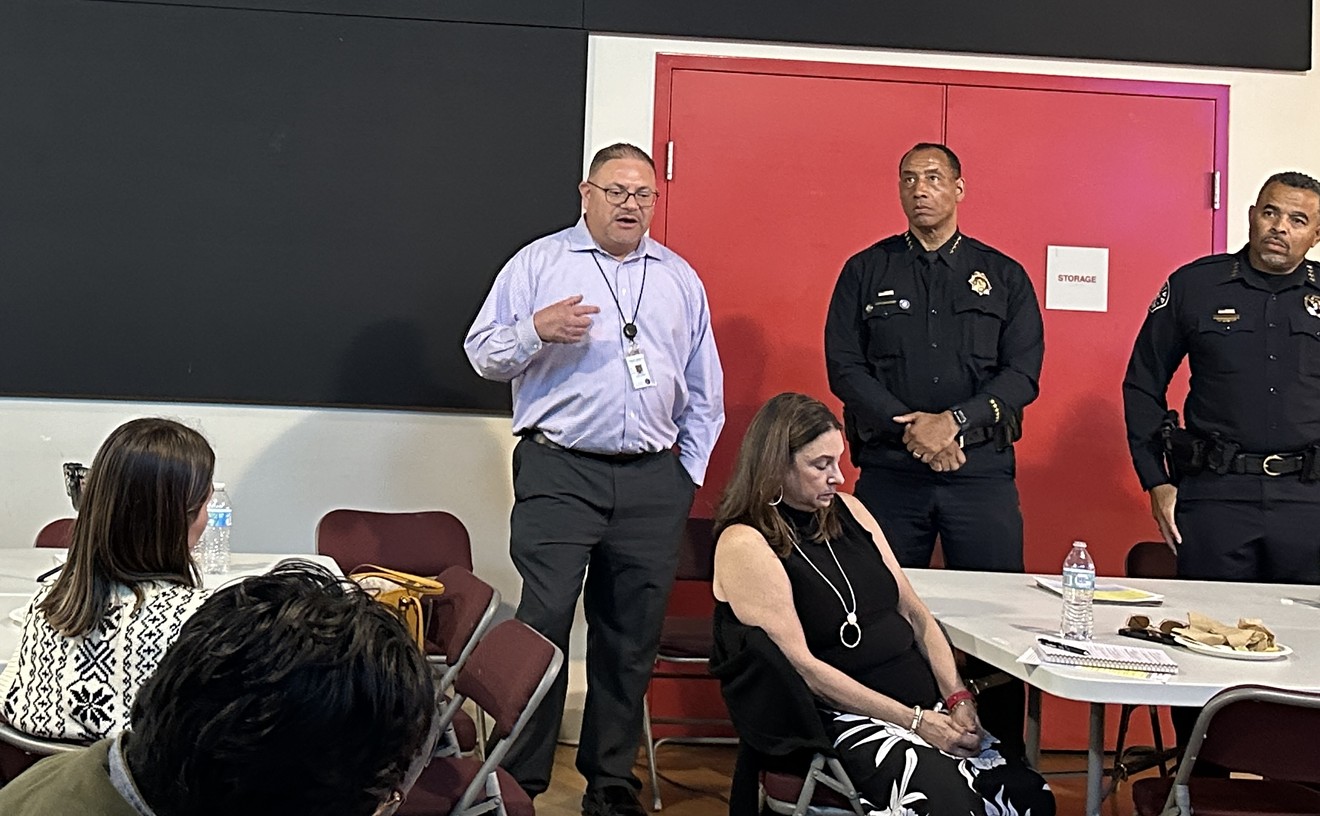
But working with the adults is an ongoing challenge. To help the Somalis — as well as Mexican, Burmese and other immigrants — integrate into the town, the University of Northern Colorado is running a program called Realizing Our Community (ROC), which has established an adult literacy program and holds monthly meetings with leaders of the Somali community, trying to educate them about how to enroll kids in school, take advantage of health care and social services and find jobs.
The university is using a $300,000 grant provided by the Colorado Trust, a non-profit foundation that is trying to set up similar groups in nineteen cities across the state. (Denver's version, called the Denver Coalition for Integration, is a collaboration between city government, schools, non-profits and religious groups.)
In Greeley, recent talks have focused on what the schools should do with Muslim kids during Christmas and what adults should do to avoid getting so many traffic tickets.
"I believe as long as they're here and working at JBS, then we would want them to integrate more into the community," says Christine Marston, an economics professor at the University of Northern Colorado and chairperson of ROC.
At the beginning of November, representatives from ROC, the school district and a Somali group called East Africa Community traveled to Minneapolis to see how a state with an estimated 40,000 Somalis handles things. They learned about the Confederation of Somali Community in Minnesota, which runs after-school and sports programs for kids, and also helps explain cultural and religious differences to employers. "Minneapolis is way ahead of us," says Maria Sanchez, director of ROC. "They're very welcoming and prepared...while we're just starting that process."
Perhaps no one illustrates this difference more than Greeley mayor Ed Clark. He notes that the Somalis "look different than people that usually live here in Greeley," and he wishes they would "learn how to speak English." But, he adds, "They seem to be good people, working hard, trying to etch out a life for themselves like everybody else."
As for whether he wants them in Greeley permanently, Clark doesn't mind much either way. "I don't blame 'em if they leave if they don't have work," he says. "But do I want them to leave? Well, no."
After the walkout in September, Swift executives held intense negotiations with a handful of English-speaking representatives of the Muslim workers and worked out a deal to establish an earlier break time. The company ordered those who walked out to return to work on Tuesday, September 9. While the workers who had gathered to wait out the negotiations in Lincoln Park in downtown Greeley got the word that afternoon, others had gone home to prepare food and break their fast. Some of them received phone calls from the union; others did not. The result was that more than a hundred workers failed to return to the plant until the following day and were promptly fired.
A spokeswoman for JBS S.A., the owner of the Swift plant, wouldn't comment on the controversy. However, in a written statement released in September, the company explained its actions this way: "Union leadership was notified and employees were told that, pursuant to the terms of the collective bargaining agreement, failure to report to work when recalled would result in their immediate termination. A majority of the suspended employees returned to work last night and those that did not, approximately 100 employees, were notified this afternoon (9/10) of their termination."
Suddenly, Greeley had a different problem: Scores of Somalis, out of work and worried about making their rent. Within weeks, the fired workers began leaving town for jobs at packing plants in Fort Morgan, Nebraska and Minnesota. They emptied out the Greeley Islamic Center mosque, left vacant apartments, even shut down the only African restaurant in town, creating a massive rupture in the community.
"We keep pushing our community: Stay and work...here in Colorado, you can find your way," says the Somali Organization's Sadiq. A professional interpreter who moved from Utah eight years ago, Sadiq is convinced that if his countrymen study English while taking temporary jobs at the mall or hotels, they can prosper. "I think anyone can adjust for any life," he says.
But that's not always the natural inclination for refugees accustomed to nomadic lives — first in refugee camps, then in America, constantly searching for a better job and a bigger paycheck.
"It's hard, because people are so used to being on the move," Tafoya adds. "People lived for years and years with war and being displaced, but eventually that wears on you. When there are challenges, it's best to stick it out because that's the way we create community."
Graen Isse, a local Somali leader, understands these conflicting impulses well. In his fourteen years in America, he's bounced between three states. Now he's trying to figure out how to help Greeley's Somali community survive, even if he's not sure how long he'll stick around himself.
Slim and amiable, the 27-year-old Isse is constantly in motion — knee tapping, cell phone wire hanging from his ear, eyes scanning the room. He was born in the Ogaden region of Ethiopia, a place that has been fighting off foreign invaders for more than a century. Its nomadic inhabitants identify themselves as Somali and Muslim, yet the region has been controlled by Ethiopia since the 1950s. In the late '70s, the Ogaden people resumed their battle for independence and have never given it up, despite news reports of Ethiopian soldiers killing and gang-raping civilians and of widespread famine in the region. Many of the Somali refugees in Greeley are from Ogaden, Isse says.
When he was a year old, Isse and his family moved across the border to Somalia. But when the civil war began eight years later, he and his younger brother and sisters returned to Ogaden to stay with relatives. They were separated from their parents for nearly two years and forced to wait without any news of their family as the war raged on.
One day, Isse's older brother appeared and announced that their parents had escaped to neighboring Kenya. As his family was reunited, another of Isse's brothers, who had been injured in the war, made it to California as a refugee. He told the government about his family back home, clearing the way for Isse and several members of his family to apply for refugee status and move to San Diego.
So Isse grew up as an American teenager, running track and playing high school football. After he graduated from high school in Minneapolis, where his mother had moved, his globetrotting continued. He took college classes in California, then completed his degree in Kenya before ending up back in San Diego. There he worked for a transportation tracking company, drove a taxi, even took some law school classes.
Isse moved to Greeley last summer because a friend from California, Aziz Dhies, was working as a nurse there and suggested that Isse might like the town as well. Isse was hired as a translator at Swift and had only been on the job for about a week when the Ramadan controversy began. He was thrust into the midst of the problem as he negotiated on behalf of hundreds of people whom he had only just met. He, too, was fired because he went home to eat and rest on the day the dispute was resolved instead of returning immediately to work. But he quickly found a new job, working part-time as a translator at the Weld County courts. And he and Dhies dedicated themselves to community organizing, forming the East Africa Community, which aims to be "the middleman between the leaders and our community," Isse says.
The elder Somali men in Greeley elected seven people to be part of the group; Dhies is chairman, Isse the spokesman. With donations gathered from the community, they found an office space and began translating for their fellow refugees, helping them fill out paperwork for jobs, food stamps, subsidized housing. They talked of starting English classes that weren't held in a church, and after-school programs for the kids. But there was little they could do to get people back on the assembly line.
In the days following the mass firings, John Bowen, a lawyer for the United Food and Commercial Workers Local 7, announced at a public meeting that he had filed grievances on behalf of at least ninety workers. But he declined to comment for this story. UFCW spokesman Dave Peterson also declined, saying negotiations with Swift were still ongoing. Fernando Rodriguez, a leader in the union's Greeley office, didn't respond to repeated phone calls.
JBS Swift spokeswoman Tamara Smid refused, via e-mail, to comment as well, saying, "We don't have any updates to provide." Dhies, however, believes that at least sixteen of the fired Somalis were hired back at Swift.
(And Swift has other, more pressing problems to address. Its owner, Brazil's JBS S.A., is fighting the U.S. Justice Department and attorneys general in thirteen states, including Colorado, who sued to prevent the company from acquiring National Beef Packing Company, which would make JBS the largest beef processor in the United States. Colorado Attorney General John Suthers worried the merger would concentrate control of the industry in just three companies and increase the price of beef.)
But Swift isn't the first company to struggle with how to accommodate Muslim prayer breaks. In 2005, about thirty Somali Muslims walked off the job at a Dell Inc. computer packaging plant in Nashville, Tennessee, because the company refused to allow them a sunset prayer break. The dispute was resolved within days, thanks to mediation by the Nashville Metro Human Relations Commission. The workers were allowed to return to work and promised a sunset prayer break.
The next year, at Gold'n Plump Poultry chicken processing plants in Cold Spring, Minnesota, and Arcadia, Wisconsin, Somali Muslim workers filed a federal lawsuit alleging that they were fired for taking prayer breaks. The suit was settled earlier this month when the company agreed to provide two daily breaks for all workers at the plants.
And at a Swift plant in Grand Island, Nebraska, more than 100 Somali workers quit in May 2007 because they were denied an evening prayer break. Many later returned to the assembly line, but tensions continued to build, and a few months later, the Washington, D.C.-based Council on American-Islamic Relations (CAIR) filed a charge with the federal Equal Employment Opportunity Commission alleging that dozens of Grand Island workers were fired or harassed for trying to pray at sunset.
Christina Abraham, civil-rights director for the Chicago chapter of CAIR, says her group tried for months to work out a solution with Swift and the UFCW in Nebraska with no success. Muslim employees had proposed a "tag" system, where a few workers could quickly leave the assembly line to pray, then come back and tap the next person on the shoulder to take a break. This way, the line is not interrupted, the breaks are unpaid, and non-Muslim workers' schedules don't need to change.
"There are very viable and reasonable solutions that...for whatever reason, the company is not implementing," Abraham says of Swift.
Somali workers continue to be treated differently than other workers, she says, and denied promotions. This September, just days after the conflict in Greeley ended, another one erupted in Grand Island. Mass protests by Somalis led Swift to institute new break times during Ramadan. However, the breaks would have been unpaid, and would have shut down the entire assembly line — a situation the non-Muslim workers were upset about. So the company rescinded the deal. Then, more than eighty Somali workers who still wanted to pray were fired for repeatedly walking off the line without permission.
Abraham, whose group is now filing more EEOC discrimination charges on behalf of the newly fired workers, blames the union for not helping to unify all the employees — Hispanic, Muslim and everyone else — and find a solution. "The union has been very inadequate at basically unionizing the workers," Abraham says.
Meanwhile, Denver attorney Diane King is filing EEOC charges on behalf of more than eighty Greeley Swift workers. While she wouldn't reveal the details, she says they involve allegations of discrimination and harassment based on race, national origin and religion. "There's a hostile work environment, there's differential treatment between the Somali workers and the other workers...pay issues, all kinds of stuff," she says.
One of the most important issues when it comes to the future of the Somali community in Greeley is whether prayer breaks will be included in next year's union contract with Swift. Dhies and Isse were told that the East Africa Community would be involved in the contract negotiations. But those talks have yet to begin.
King says it's her understanding that the union is not even trying to resolve the prayer issue. "We are," she says.
By the end of October, the firings had started to take a visible toll. Imam Omar Mussa, of the Greeley Islamic Center on 8th Avenue, estimated that 70 to 100 Somalis had left his mosque. "Not by choice," he wrote in an e-mail to Westword. "They left the mosque because they had to leave the city in order to make a decent living."
The only African/Middle Eastern restaurant in town had closed too. Dhies and a Somali business partner, Mohamed Farey, had bought a restaurant on 8th Avenue called the Burrito, where they served a mix of burritos, chicken shawarma, spicy basmati rice and sweet, milky tea. But it only lasted five months.
Isse and several current Swift workers say that Swift officials, while hiring some new employees, have stopped hiring Somali applicants. "Nobody stays here if they don't have jobs," Dhies says. "It's hard to get a job here in Greeley."
At the Aspen Apartments on 29th Street Road, the mood is warm but subdued. The two-story complex, with balconies designed for chatting across the courtyard, had been completely filled a few weeks earlier. But six of the 24 apartments were vacated after the firings, according to the manager, who identifies himself only as David. He expects two more to be empty soon. "It's just been tough," he says. "We were full, and then, after all the firings and stuff like that, people just couldn't afford to pay their rent."
A lanky, grinning sixteen-year-old soccer fiend named Hajir Abdi bounds out onto the balcony to join the conversation. He's a junior at Greeley West High School and moved here a year ago from Kansas City. But both his mom and dad were fired from Swift, and their lack of English skills made it nearly impossible to find another job in Greeley, so this morning, he had to say goodbye to his dad, who left to work at a Tyson Foods plant in Nebraska. Hajir stayed behind with his mother, hoping to finish school.
Mary-Ann Adow, Hajir's nineteen-year-old classmate, is in an even worse predicament. She grew up in a crowded Kenyan refugee camp, sleeping in a hut made of tree branches and plastic covering, standing in endless lines for food and water. There were no jobs in the camp, so her parents sold wood to earn money. Still, it wasn't enough to pay for school for their fourteen children.
When they finally made it to America in 2005, her family was resettled in Minnesota. Adow didn't speak any English and found school to be a constant challenge. In July, she moved to Greeley to live with her uncle and try the schools here. She's since become the de facto mayor of the Aspen apartment complex, strutting around in a red, white and blue headscarf, chatting with everyone and proudly showing off her English skills by translating stories. She talks of going to college and becoming a lawyer to help people like the Swift workers, and "to show the people the right thing; they have to do it."
But even Adow's future in Greeley is uncertain. When her uncle was fired from Swift, he moved to Denver to look for a new job. Adow wanted to stay in Greeley and finish school, so she tried to apply for a subsidized apartment. But there were none available, and she couldn't find a part-time job to earn more money. So now she's planning to apply for subsidized housing in Denver and transfer to a school there.
This is far better, she believes, than working at a meatpacking plant. Her friends who still work at Swift have almost nothing good to say about it.
"[It's] very screwed up, a lot of shit going on there," says a neighbor named Jamal. He works the late shift at the plant while also taking pharmacy classes at Aims Community College and doing part-time translation work. He believes that new non-Somali workers are being hired daily at Swift while Somalis are being told there are no jobs. "This is very wrong," he says. "It is against the law."
Muna, a tiny, shy woman who keeps wrapping her scarf more tightly around her head as she talks, says that Somalis have to ask permission to use the bathroom, while other workers can just leave. Once, when one of her friends was praying on her knees with her head on the floor, someone put a foot on her friend's head, Muna says. Zuheyra says that one day a Hispanic woman hit a Somali woman in the face with a piece of meat.
"If I find another job, I will leave," Muna says through Adow's translation.
On the first truly cold night of the year, several Somali women gather in a friend's apartment, trying to keep warm. Adow introduces them all as her aunties and cousins. They are relaxed here, out of view of the men, sprawled on colorful rugs, some without their head scarves.
Zuheyra looks especially young in her gold earrings and gray sweatpants, her auburn-streaked hair exposed. She is one of the Somalis who returned to Swift the Tuesday after the walkout, so she still has a job. But it's not one she enjoys. There are nights when cries at the thought of going back to work the next day, and times when she feels as if she's still fasting because the lunch breaks are so short — barely fifteen minutes, she says — so that by the time she removes her safety gear she doesn't have time to eat.
Back home, Muslim women aren't even allowed to work. Here, only the desire to earn money to support her family keeps Zuheyra motivated. "I see the check and [think], 'Maybe it's easy tomorrow.' But it's not easy still," she says.