
A river runs through the heart of Denver, this city's most liquid asset. But the South Platte River wasn't always regarded that way.
"We came to the shallow, yellow, muddy South Platte, with its low banks and its scattering of flat sand-bars and pigmy islands — a melancholy stream straggling through the centre of the enormous flat plain, and only saved from being impossible to find with the naked eye by its sentinel rank of scattering trees standing on either bank," wrote Mark Twain in Roughing It, his book that describes his trip across the Great American Desert to the Nevada silver mines, including an encounter with the river in what is now northeastern Colorado. "The Platte was 'up,' they said — which made me wish I could see it when it was down, if it could look any sicker and sorrier."
The Platte didn't look much better a century later. In fact, as a kid growing up in South Denver, Jeff Shoemaker didn't think about it at all — not as a place to explore, not as a place to save — until 1965, when the river overflowed its banks.
"My dad was in the state Senate in 1965," Jeff remembers. "We were back on the family farm in Iowa when my dad got a phone call — and a long-distance phone call was a heckuva thing back then — and we had to go get our dad out of the field, and he said, 'I have to fly home.'" That was a heckuva thing, too, because the family had driven east to Iowa, with four kids in a '63 station wagon. So almost-eleven-year-old Jeff asked his father why he had to go back to Colorado, leaving the kids to drive home with Mom.
"The river flooded," his father replied.
"And I said, 'What river?'" Jeff remembers. "Meaning, I didn't know there was a river in Denver. The Platte was so bad and so rejected and such a non-part of the city. It was just a dump site."
But that would soon change.
Joe Shoemaker ran for mayor in 1971, and although he didn't win that office, he found a cause: pushing for the cleanup of the Platte. Jeff was just back from his freshman year in college in June '74 when his father said that Mayor Bill McNichols had asked him to head an effort to restore the river and was giving the Platte River Development Committee $2 million for the cause.
"I just remember thinking my dad was fifty and that was such a cool thing...but what did it mean?" Jeff recalls.
Fifteen months later, he found out when Confluence Park opened, the first of two targeted projects; the other was Globeville Landing Park. Confluence was at the juncture of the Platte and Cherry Creek, close to the very spot where Denver had gotten its start when gold was found just upriver in 1858. And now the Platte, and the park around it, was turning into liquid gold.
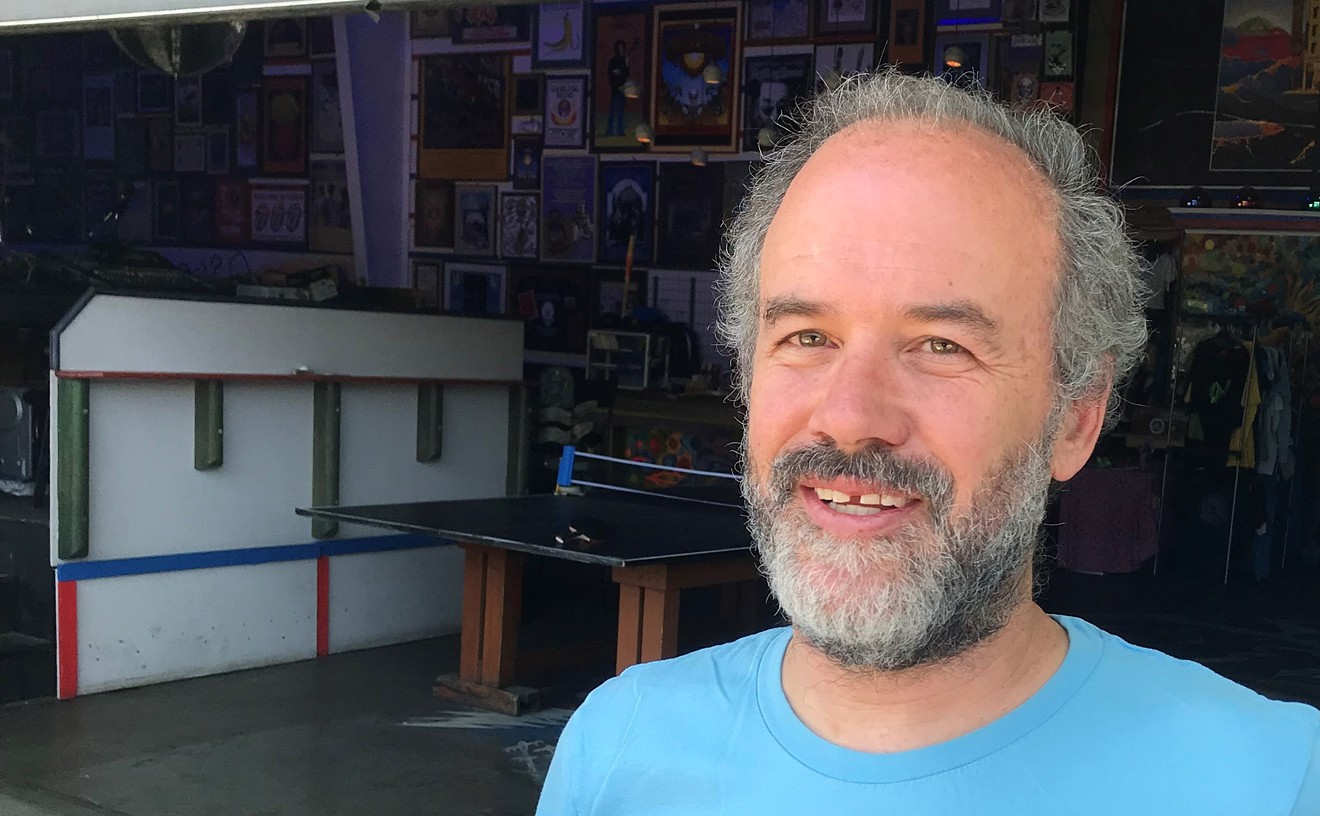
By 1982, Jeff was mining that gold. He was looking for something beyond his job as a schoolteacher, and after turning his dad down three times, he finally accepted a spot as executive director of the Greenway Foundation, the nonprofit that evolved from the PRDC, on a six-month trial basis.
Thirty years later, he's still there. So is his almost-88-year-old father, in spirit if not in day-to-day operations. "There's a difference I want to make clear," Jeff makes clear. "This is and this remains my job, but my father has been a volunteer from day one. He's not only never made a nickel off this, he's donated six-figure money to the cause. He's had opportunity after opportunity — but he's avoided any conflicts. It's not that we're purists; it's just that we're realists."
Not just realists, but visionaries. Mark Twain looked at the Platte and saw a melancholy trickle. Jeff Shoemaker looks at it and sees the future. The Greenway Foundation has already poured more than $100 million into environmental and recreational improvements, turning the river from a cesspool into an urban oasis, the focus of more than twenty parks and natural areas, and more than a hundred miles of hiking and biking trails. "I'm pleased and proud of what we've accomplished," he says, "but so much work on this river still needs to be done."
What's next? — Patricia Calhoun
Video: Take a fast-forward ride down the South Platte River trail
******
Johnson-Habitat Park
I-25 and South Santa Fe Drive
It's 7:37 a.m., and a somewhat grizzled man is peeing through the hole in his tattered cut-offs — directly into the middle of the South Platte River. The fact that he's being watched doesn't seem to bother him. When you have to go, you have to go.
Behind him, a few steps away on the concrete trail that cuts through the center of Johnson-Habitat Park, a mostly full can of Busch Classic is still cold. It wasn't his, he insists, but it is now. He takes a sip.
Johnson-Habitat, located near the intersection of I-25 and South Santa Fe Drive between rows of west Denver warehouses, is used mostly for foot traffic between other parks, says Jolon Clark, associate director of the Greenway Foundation. Most of its visitors ignore the park's steep river slopes and half-gravel trail in favor of Vanderbilt Park's fish ponds just to the southeast. Here the green water grows narrow and shallow, drawing attention to the algae in the river bed and the weeds surrounding it. For most of the stretch, the bottom of the river lies, at most, a couple feet below the muck.
But all of that will change, at the earliest, in 2014, when the city, in conjunction with the Greenway Foundation and the Environmental Protection Agency, plans to turn the fly-over park into a stay-overnight park. Tiny red flags poked into the grass mark the potential sites of features that will transform the park into an urban campground for kids. Behind the project is the idea that not all of Denver's youth have park passes or easy access to the mountains, but they, too, should learn to pitch a tent.
The concept isn't new: Before Greenway championed the charge, the Boy Scouts applied for an exception to the city's 11 p.m. park curfew that would allow them to experience the great outdoors past their bedtime. The exemption was approved, but the scouts moved out of their headquarters in the park before they ever got a chance to camp there. Greenway has since taken over the group's lease from the city — and its goals.
The words "urban camping" have a bit of a stigma to them right now, however, and not because of cookouts and campfire stories. The city is currently considering an "urban camping" ban targeting a different demographic: the homeless. A vote on the ban is set for May 14. But that won't affect Johnson-Habitat.
"This is never going to be a spot where you can just apply for a permit and do whatever you want," Clark says. Only children and their families — about thirty small groups at a time — will be allowed to light fires, cook s'mores, flip rocks, search for crawfish, tell scary stories, go mountain-biking, paddle canoes, climb rocks, catch frogs, put the frogs back and slowly, gradually, grow into adults. Earlier this year, organizers applied for an $8 million grant from Great Outdoors Colorado that, if approved and matched by federal donors, will funnel nearly $3.2 million to Johnson-Habitat. (Between $250,000 and $350,000 will benefit the urban camping project directly, says Gordon Robertson, director of park planning, design and construction for Denver Parks and Recreation.)
"We want a place where an urban kid, a kid living right in the city, can walk or ride their bike to get here and then connect to the river that runs through the heart of the city," Clark says. "Everyone deserves that experience."
Although not all of the preliminary plans will prove possible, organizers are brainstorming ways to revitalize the park with an amphitheater, training center, fire pit, rock wall, zipline system, pond and ropes course. Soon, a rope bridge will connect the two halves of the one-acre space to each other across the Platte for the first time, giving previously useless space next to the on-ramp a purpose. But the key word here is "urban" camping; these children will fall asleep and wake up to the sounds of cars passing by.
The area where geese are now bugling (and pooping) will in two years follow the model of its sibling, Ruby Hill Park, where families ski and sled in a snowscape created annually with help from both Mother Nature and mankind. Those kids don't have to go to Aspen, and these kids won't have to trek to Estes.
It's a good deal, unless Johnson-Habitat happens to be your preferred pissing ground. In that case, you have roughly two years until a security guard shines a flashlight on you.
"We'll have bathrooms for that," jokes Clark. "This river has better uses." — Kelsey Whipple
Video: Take a fast-forward ride down the South Platte River trail
******
Lakewood Gulch
Decatur Street and West Howard Place
Five years ago, on a mid-May evening when the sky quickly darkened with thunderclouds, the swollen river took two-year-old Jose Matthew Jauregui Jr.
His mother, Elsha Guel, was pushing him in his stroller along Lakewood Gulch, a normally trickling tributary in Sun Valley that feeds into the South Platte River. The path next to the gulch was paved, but it wasn't pretty: Weeds choked the tiny strip of green space on one side; on the other, a thigh-high concrete wall separated pedestrians from the gulch, which city planners had attempted to corral between manmade walls.
But the walls proved no match for the water that night. Just after 7 p.m., the sky opened up and dumped so much rain and hail that the river rose nearly three feet in less than an hour. According to news reports, Guel ducked into a narrow concrete tunnel along the path to escape the deluge. The water came after her, flooding the seven-by-seven-foot tunnel near the intersection of Decatur Street and West Howard Place. The force of it knocked her off her feet and pried the handles of Jose's stroller out of her hands.
Rescuers found her clinging to a concrete barrier. Firefighters told the media that Guel repeatedly asked if her baby had been found. When rescuers told her no, she let go of the barrier, saying she didn't want to live. Rescuers eventually pulled her out of the water, but there was no sign of baby Jose. His body was found two days later.
Today, the spot where the tunnel once was looks completely different. The bleak concrete walls are gone, and the entire area has been returned to a more natural state. There's still a paved path, but now what separates it from the gulch are grass, rocks and newly planted trees and berry bushes. A gently sloping hill leads from the street down to the water, providing an easy way to escape to higher ground in a rainstorm.
Not that the ground in the surrounding Sun Valley neighborhood, where Guel lived, could be considered that much higher. One of Denver's poorest neighborhoods, Sun Valley consists primarily of housing projects and has always had problems with crime and a lack of amenities. But things are supposed to be looking up.
The Regional Transportation District is building a twelve-mile spur — the West Rail Line — that will eventually run past Decatur and Howard on its way from Golden to Union Station. Neighbors hope it will bring people and jobs and a higher quality of life.
Before it started building, though, RTD wanted improvements to Lakewood Gulch to ensure that its train tracks wouldn't be flooded in the event of heavy rain. But the project was on the city's to-do list long before that, says Jim Potter, an engineering supervisor with Denver Public Works. However, there was a big obstacle in the way. A city building known as the Decatur Street Facility, which was part office complex, part garage for street-sweeping vehicles and the like, had been built in the middle of Lakewood Gulch, which was re-routed around it via those concrete tunnels. To return the gulch to its natural path, the city first had to relocate and demolish that facility. RTD contributed $12 million toward its removal.
The rest of the project cost about $16.2 million and was paid for with city money and funds from the independent Urban Drainage and Flood Control District. It included widening Lakewood Gulch and deepening where it flows into the Platte River, among other improvements. Whereas the previous configuration was equipped to handle what's known as a ten-year flood event, the banks of the new Lakewood Gulch can handle a 100-year flood. The whole thing wrapped up two weeks ago, with just a few finishing touches on the agenda.
On a recent afternoon, the spot, just two blocks from Sports Authority Field, was serene. The water in the gulch was no more than ten feet wide and two feet deep, moving at a pace that would be perfect for an inner tube. Ducks and spandex-clad bikers provided the only activity on the path, rolling past a cascading water feature surrounded by rocks just big enough to serve as a picnic spot for two.
The Greenway Foundation hopes these changes are just the beginning. Organization head Jeff Shoemaker has envisioned $17.5 million worth of improvements to the area that include returning Weir Gulch, which is south of Lakewood Gulch, to a more natural waterway, building a path alongside it and erecting a playground nearby.
Construction on some of those projects is expected to begin this fall, but the neighborhood's future is still difficult to read. "I don't know what Sun Valley is going to be in ten years, but it's going to be something very different," Shoemaker says.
Different, and safer.
— Melanie Asmar
Video: Take a fast-forward ride down the South Platte River trail
******
River North
Arkins Court and 36th Street
One minute, the only sound is a red-winged blackbird trilling from a tree next to the South Platte River bike trail. In the next, the motors of two eighteen-wheeled Pepsi trucks followed by an RTD bus, all three of them flying at more than forty miles per mile down Arkins Court, drown out every other sound.
River North isn't like the rest of the city; there's no constant urban drone from people, cars, office-building action or even dogs. Instead, the sound levels in this changing neighborhood oscillate between the near silence of nature and the cacophony of heavy industry — one just as startling as the other. But this quirkiness is what drew some of the first urban pioneers back to what was once a hidden part of Denver.
"I love how much nature there is here. We've seen eagles, and there is a family of chipmunks that lives right over there," says Tracy Weil, who in 2003 turned an old garage just steps from the river into a stunning art studio, gallery and home — and helped to create a hot new art district, RiNo, along the way. But at the same time, "RTD uses Arkins, which fronts the river on the east side, as a shortcut from I-70 to its facility, and I get fifty buses going by here sometimes at five in the morning."
Still, he loves the area: "Where else in Denver can you own land along the river?"
This part of the river, however, is one of the most unkempt and least used of any stretch within Denver limits. After heading north along the edge of downtown, the Platte plunges beneath a busy railyard, reappearing between a contaminated old landfill and RTD's sprawling maintenance facility and hub. It is bordered on the west by the popular Taxi development and a concrete plant, and on the east by a massive Pepsi warehouse and a long series of vacant or nearly vacant buildings and lots. After that, the river winds beneath I-70 and then past the National Western Stock Show complex.
Because this part of the city has been devoted to heavy industrial purposes for more than a hundred years, it was always a popular place to dump unwanted refuse. It still is. A few blocks from Weilworks, someone has upended a couch onto the embankment. Down below, in a culvert along the bike path, a homeless couple listens to a portable radio while they wash their feet and rinse out their clothes in the water spilling from a drainage ditch.
The other side of the river isn't as easy to explore on foot — not unless you want to take your life into your own hands. There is no path, not even a thin shoulder to separate the pavement from the steep hill that tumbles down to the river. Instead, there are dirt footpaths and a couple of staircases that lead to nowhere.
Kyle Zeppelin would like that to change. Eleven years ago, his father, Mickey Zeppelin, bought the former Yellow Cab terminal next to RTD and has since turned it into Taxi, one of the most intriguing developments in the city: a mixture of living and working spaces that have retained an edgy, industrial feel. Now the neighborhood is in the family's blood, and Kyle Zeppelin has chosen it for a project of his own — the Source, a combination market/restaurant/brewery/beer garden slated to open in 2013 — because of its defining feature. "The river," he says. "It creates opportunity."
But it also creates problems. "It's a work in progress in terms of improvements," Zeppelin explains. "There are plenty of relics of the way the river used to be, relics of a time when cities dumped their waste into their rivers."
And Taxi is somewhat isolated — by its neighbors, by the railroad tracks and by the South Platte itself, which cuts the complex off from RiNo and Kyle Zeppelin's own Brighton Boulevard project. There are crossings at 31st and 38th avenues, but they don't make walking or cycling easy. To change the feel of RiNo, Zeppelin would like the city to close Arkins and Ringsby and reroute them, opening the river up to parks and people who could enjoy them.
He'd like to build a bridge — one that would sew the two sides of RiNo together. The city and the Greenway Foundation would also like to build a bridge; in fact, the Greenway's $14.6 million plan for the area calls for a pedestrian "art bridge," art park, sculpture garden, community garden and boat launch. Zeppelin likes the concept, but he's tired of waiting.
"The river looks exactly the same as it did ten years ago when we started talking to them. We want to realize that thing sooner rather than later," he says. So Zeppelin is pricing out his own bridge, something that could cost just $250,000.
"There is a hundred million dollars of investment going on right here," he explains, describing several other large mixed-use developments currently under construction in RiNo. "You can't find any part of the city where there is this level of investment around the river." But he's worried that the city isn't keeping up: "There is a lack of political will, and influence is being exerted in different directions. No one is watching the ball."
The state is currently considering options for what to do with the nearby I-70 overpass. The National Western Stock Show wants to expand — or leave town altogether. The city should be coordinating plans for all of these areas, he says, but instead it's focusing on other places. "They just spent another $6 million on Confluence Park, and that's great," Zeppelin notes. "But there's an area here where they could get a lot more done for a lot less."
There has always been a lot of heavy lifting in RiNo. But it looks like more will be needed to reshape the neighborhood into all that it could be. — Jonathan Shikes
Video: Take a fast-forward ride down the South Platte River trail
******
Metro Wastewater Reclamation
East 64th Avenue and York Street
On the western edge of Commerce City, where a Metro Wastewater plant discharges treated effluent into the South Platte River, the bloated carcass of one sorry critter bobs in the foamy backwash like a junebug in a creamy, cinnamon-flecked latte. It could be a raccoon or an opossum or possibly a mutant life form, but finding out would mean poking at it, and it appears to have already endured quite enough.
Just how much abuse the South Platte itself can take is an open question. North of downtown, the river winds through an increasingly grimy and aromatic wasteland. It's a sacrifice area, the legacy of a bargain struck long ago, a place where the rudiments of nature are subjugated to the demands of industry. For the beehives of commerce along its banks, the river isn't a resource but a long-suffering appendage — and a handy dumping ground.
Looming over this stretch of the Platte is the Cherokee coal-fired power plant. Built between 1955 and 1968, the plant burns up to 5,600 tons of coal a day, creating steam with water drawn from the Platte and a Denver Water recycling plant, and generating enough electricity to power more than half a million homes. But Cherokee is one of the more benign neighbors. According to a recent report by Environment Colorado, the South Platte is the most polluted waterway in the state, absorbing almost 250,000 pounds of toxic chemicals a year.
One longtime contributor to that devil's brew is the Suncor Energy oil refinery, a sprawling complex of tanks and machinery and railway sidings that hems in Brighton Boulevard on both sides. Contamination of groundwater at the site, which processes 90,000 barrels of crude oil a day, dates back decades. Suncor has been involved in cleanup efforts since it purchased the operation from Conoco in 2004, but the results have been something less than spectacular.
Four years ago, state health officials approved what was supposed to be a final phase of cleanup. But last fall, a carp fisherman reported a plume of gunk in Sand Creek behind the refinery, not far from where the creek empties into the Platte. An EPA investigation discovered that the plume was a blend of benzene, toluene, xylene and various hydrocarbons associated with petroleum products.
Suncor has dug trenches, built walls and blasted the carcinogenic muck into the air. After six months of remediation measures, the level of benzene in samples taken from the Platte is higher than it was when the project started — between fifty and eighty times the allowable level for drinking water. But then, this stretch of the Platte doesn't have to meet drinking water standards. Despite the fact that Thornton, Westminster and Aurora all draw water (and treat it) from wells downriver, state health officials figure the river and the creatures in it and on it can handle benzene in doses well above what Suncor is dishing out. The company isn't facing any fines for its plume.
Last month, Suncor did agree to shell out up to $2.2 million in fines and do-gooder donations for past air-quality transgressions — while not conceding any violation of law. At the confluence of Sand Creek and the Platte, just before the river slips under I-270, the meaty odor of the dog-food plant down the road gives way to an acrid tang of sulfur, a stench somewhere between rotten eggs and freshly ignited gunpowder.
It's all part of the deal, the bargain that underlies a fossil-fuel-dependent world. Cyclists and power walkers cruise along the sunny greenway, paying no mind to the tainted air or what might be lurking in the water. Two women pedal by, discussing men who won't commit. Ducks and geese paddle their way above and below the confluence, indifferent to the plume below. They don't care which side of the river they're on.
The humans aren't too particular, either. — Alan Prendergast
Video: Take a fast-forward ride down the South Platte River trail
******
Elaine T. Valente Open Space
104th Avenue
On a quiet, cloud-covered afternoon just around supper time, Tim Baker stands on the northern shoreline of the east pond at Elaine T. Valente Open Space with a fishing pole in his hand. Clad in salmon-colored shorts, a blue T-shirt and with a tattered, green mesh trucker's hat with a Mountain Dew emblem stitched on the front, the forty-year-old Colorado native looks intent behind his camouflage sunglasses. A slight gust howls and pushes ribbons of waves against one another, and he reels in his line.
Aside from a few cyclists and another man and his young son, who are set up with rods and reels of their own downshore a couple hundred yards, Baker has the place to himself, which is fine by him. He's not here for the company; he's here for the fishing, and he's been fishing here for years, long before this 125-acre parcel of former farmland was acquired by Adams County in August 2002. "Before this was a park, I used to sneak in here and go fishing," says Baker, who was raised in Englewood. These days, he comes up after work to unwind and get back to his center.
It's not hard to see why he chose this place. On a clear day the park boasts some spectacular sightlines. To the southwest, you can catch the outline of the Denver skyline traced ever so faintly against a sprawling mountain-vista backdrop. Nestled on a stretch of road on East 104th Avenue between McKay and Brighton Roads, Elaine T. Valente Open Space comprises three fishable ponds that are linked together by an assortment of arterial bike and hiking trails that wind around the park and snake their way along the South Platte River. Motorists making their way down East 104th are most likely unaware of the wildlife and recreational activity taking place here. From the road, it looks like nothing more than a quaint roadside lake with a picnic shelter. Last Friday, a host of local politicians, led by Secretary of the Interior Ken Salazar and Governor Hickenlooper, announced that they had formed a partnership that will create uninterrupted trails and links that will connect Rocky Mountain National Park, Rocky Mountain Arsenal National Wildlife Refuge, Rocky Flats National Wildlife Refuge and the numerous trail systems in between; Baker's fishing hole will be part of that plan.
But those efforts — called the Rocky Mountain Greenway Project — are politicians' dreams. Today is Baker's reality.
On most days, the parking lot is dotted with cars, most of their occupants jogging, walking or pedaling down one of the bike paths. Today it's rather sparse. That's okay. More fish for Baker — even if he mainly catches and releases them (he's wary of the magnesium chloride they use on the roads somehow working its way into the water system). And Baker hasn't done too badly for himself. One time he pulled out a fourteen- or fifteen-inch bass, and two years ago, he saw a guy on the other side of the shore pull one that was two and a half pounds.
Yessir, the fishing is good here — so good, in fact, that he's lost the better part of entire days in his float tube and flippers. And for a guy who's been fishing since before he could walk, hooked from the first time his dad took him fishing at Dillon Lake, Baker can hardly imagine a better way to spend an evening.
— Dave Herrera
Video: Take a fast-forward ride down the South Platte River trail
******
Jeff Shoemaker will start his 31st year at the Greenway Foundation on June 15. He's thirty years younger than his father, which means that he and his team should have plenty of time to push the River Vision Implementation Plan, which the foundation worked on with the Denver Department of Parks and Recreation and Urban Drainage and Flood Control, merging the River North and River South plans into one grand plan; it calls for $75 million in improvements over the next decade, with $20 million of those recommendations targeted for the next few years.
The RVIP, which has been endorsed by Denver City Council, calls for short-term projects at RiNo (the Art Bridge), Sun Valley, Vanderbilt and Johnson-Habitat Park and the Grant Frontier/Overland Regional Park, as well as a renewed vision for Confluence Park, including a revitalized Shoemaker Plaza — a space so named in the mid-'80s, much to the family's surprise. "There should be a Confluence Park up and down the river," says Shoemaker. And while the Greenway pushes that master plan, the foundation will continue to emphasize its youth education program, SPREE, as well as host a variety of cultural and community events.
With all that on his Platte plate, Shoemaker still found time to accept the Champion of Change award he was given in late April by the White House, for his work spearheading the efforts of the Greenway Foundation. "Jeff is a visionary in our community who has dedicated great passion and resources to transforming Denver's South Platte River and its tributaries," says Mayor Michael Hancock.
"It's very important to me personally that it's made clear that the only way we've been able to do anything is through the remarkable partnerships we've had with countless organizations and entities...none better than the City and County of Denver," Shoemaker responds. "We have no mandate-able authority that requires everyone to work with us. I consider us to be a minority partner in a four-legged stool: public, private, political and philanthropic. All four have to be in place for you to have a maximized success."
And all four were out in force at the Rocky Mountain National Wildlife Refuge last Friday, when Secretary of the Interior Ken Salazar and Governor John Hickenlooper announced the next steps in implementing conservation and recreation projects throughout the Denver area and along the South Platte River — with several shout-outs for the Greenway Foundation.
But after that, it was back to work. "A master plan is only as valuable as its ability to be implemented," Shoemaker points out. "We're asked all the time: When are you going to be done? My longstanding, somewhat completely tongue-in-cheek answer is when the Denver Art Museum needs no more art, when the Denver Public Library needs no more books. There is no done." — Calhoun