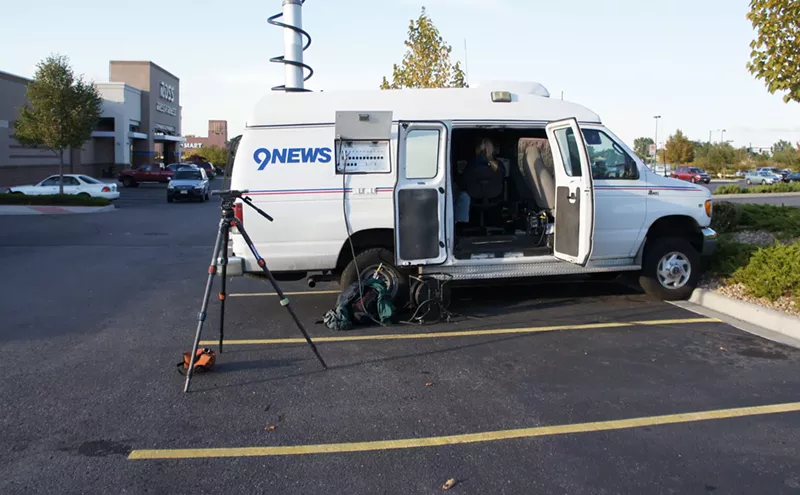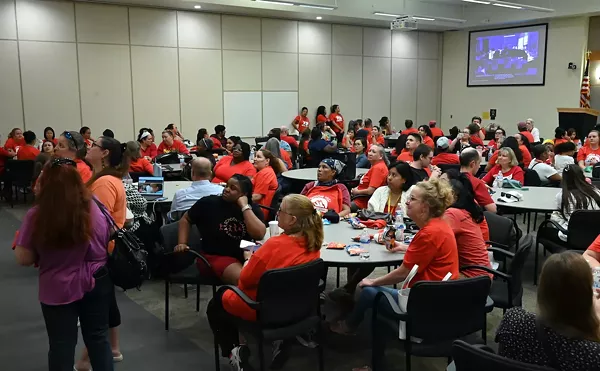


More than $1.1 million of the money has gone for public relations.
The PR spending spree began in 1992, when the health department awarded the first of two "community relations" contracts for the study to the Fort Collins firm ENSR Consulting and Engineering. That $519,000 assignment expired in 1993; the second contract, worth $634,000 for two years of work, is held by the Denver PR firm of MGA/Thompson.
The hired help from MGA/ Thompson, who often attend health department meetings in groups of three and four, are charging up to $160 an hour each for such services as polishing the speaking styles of health department consultants and arranging presentations for luncheon meetings of Kiwanis clubs and Rotarians. Their job description also calls for writing guest newspaper columns and letters to the editor signed by health department officials. The health department pays for all of the expenditures with funds funneled to it by the federal Department of Energy.
Taxpayers also have paid to fly the members of an independent panel set up to monitor the study to meetings held out of state--and to fund three separate seminars at which those same watchdogs were given training in "community relations." That training included advice on how to look good on camera and how to respond when environmentalists butt into presentations with annoying questions.
Despite the million-dollar PR campaign, few members of the public appear to have paid much attention to the Rocky Flats health study, whose first-phase findings were released in October 1993. The quarterly meetings of the Health Advisory Panel (HAP), the twelve-member watchdog group composed of health officials, scientists and average citizens--all selected by the health department and appointed by the governor--often draw only a few dozen people who aren't being paid to attend. Responses gathered from audiences at other public presentations made by HAP members show that "over 90 percent of upper-middle-class business community members are unaware of the study," says one panel member. And the handful of environmental activists who have followed the study question both the project's validity and the sincerity of the health department in seeking public input.
But according to MGA/Thompson, there's nothing but good news to report about the "Historical Public Exposure Studies on Rocky Flats." After a year on the job, MGA/Thompson says it is cheered by an uptick in attendance at public meetings concerning the study--a trend that died a quick death in February when attendance at the group's quarterly meeting fell from about 100 people to less than fifty. And MGA/Thompson is not deterred by attendance rosters showing that about half of the interested faces in the audience belong to attorneys and consultants being paid by government agencies or Rocky Flats contractors to be there. Firm president Jeff Julin says he believes that the percentage of average community members attending the meetings has increased since his company took the reins of public involvement and argues that "the mix of people at the meetings makes it work; almost everyone is getting some valuable information or imparting valuable information."
The news from MGA/Thompson is just as upbeat on the scientific front, where the California firm that conducted the study's first phase has turned up nothing that would alarm the public. Yes, it was learned that deadly plutonium routinely and accidentally wafted, washed and gusted away from the plant through its 37 years of operation. But computer models constructed by the health department's hired experts show there's little cause for worry. Even those residents who lived within a few miles of the plant for half a lifetime face only a 1-in-100,000 chance of getting cancer from plutonium, according to the study. The risk involved in living a few miles from Rocky Flats while it was in the nuclear-weapons business is roughly equivalent to smoking a single cigarette, says Jim LaVelle, a former Environmental Protection Agency toxicologist who serves on the HAP and is the panel member most often referred to reporters by MGA/Thompson and health department officials.
"Risk communication"--the art of translating statistical hazards into terms the average person can understand--is a specialty of MGA/ Thompson. It is a skill acquired the hard way by firm chairman Michael Gaughan. As a PR prodigy of the early 1970s, Gaughan helped craft a positive public image for giants of the extractive industries such as AMAX, Inc., as those companies battled early environmental groups.
Gaughan seems to have discovered early one of the verities of the PR business: Good news does not come cheap. For its health department work, Gaughan's firm fields a trio of risk-communication specialists. Jeff Julin himself heads the team, billing $160 per hour for duties that include sitting through daylong sessions of the HAP. (The panel members themselves are paid $65 an hour for perusing research reports and listening to the oft-conflicting testimony of experts.)
To help him keep his head above water at quarterly HAP meetings, Julin brings along account manager Lisa Sigler ($110 per hour), technical consultant Katherine Hunninen ($100 per hour) and account executive Marty Schechter ($85 per hour). A second technical consultant, Diane Short, who punches in at $75 an hour, attends monthly meetings of a HAP subcommittee. And when the MGA/Thompson team members drive to HAP meetings, they faithfully charge the state 20 cents a mile.
"We need to be there listening very carefully," Julin explains. "We have to understand what is being said so we can communicate it to the public."
But MGA/Thompson hasn't been eager to communicate everything about the health study to taxpayers. When Westword asked to see how much the firm's employees were billing per hour, MGA/Thompson urged the health department to keep the information secret, arguing that the information was "proprietary." State officials refused.
The Rocky Flats health-study contract is just the latest in a series of lucrative assignments MGA/Thompson has received to help adjust public attitudes about its clients' environmental woes.
The PR firm helped put the best face on the pollution of Denver's Globeville neighborhood by a century of smokestack fallout from an ASARCO smelter. When asbestos manufacturer Manville Corporation found itself beset with a potentially ruinous spate of liability suits, MGA/Thompson helped engineer damage control. Aerospace giant Martin Marietta called on the firm to train its public relations department in the art of dealing with outraged citizens after its Waterton Canyon plant came under fire for allegedly contaminating the drinking water of thousands of residents in the southwest metro area.
The firm continues to work on behalf of petrochemical giant Shell Oil at the Rocky Mountain Arsenal, where Shell's pesticide operation helped turn the Army facility into one of the most polluted pieces of ground in the country. During a convention of PR firms held last fall in Denver, the company touted its success in "winning public acceptance" for a toxic-waste incinerator at the Arsenal. (Citizens who opposed the incinerator say the firm is taking credit for something that never happened. "Nobody was won over. People were steamrolled by the health department and the [EPA]," says Adrienne Anderson, a longtime local activist who now teaches a class in "environmental ethics" at CU-Boulder.)
Greg Marsh, an environmental chemist in Arvada who also serves as president of a citizens' watchdog group called the Rocky Flats Cleanup Commission, terms the information given to the public by MGA/Thompson "watered down statements written by slick-talking liars." Marsh's charge provokes the slightest wrinkle in Julin's composure. "I absolutely disagree," Julin says.
In public Julin does not raise his voice. He does not squirm or fidget. His gaze is level. "We don't do `happy news' material," he says. "We do material from the study. It is what it is. To call it `happy news' is inappropriate." In fact, Julin readily admits that the study he's been hired to promote has been plagued by significant gaps in technical data--a position echoed by several HAP panel members. "The data's not flawed," says Julin. "It's missing."
The HAP "doesn't know how much plutonium was released in accidents at the plant," says panel member Niels Schonbeck, a chemistry professor at Metro State University. "There are data gaps, but that's the nature of the beast. There was a lot of bad record-keeping at the plant and many documents were classified and unavailable to us in Phase I." Still, Schonbeck says the study's first-phase finding that hazards posed by the plant were extremely minimal is accurate, "as far as we can tell from the news we have at this point."
HAP member David Albright, a physicist and veteran anti-nuclear advocate with the Federation of American Scientists, faults an estimate made by the study's Phase I contractor--ChemRisk of Alameda, California--of the amount of plutonium released during a massive building fire in 1957. The blaze began when plutonium ignited in a glove box one night and burned uncontrollably for thirteen hours. The building's billboard-sized bank of filters, dusty with a four-year accumulation of plutonium particles that had escaped from processing operations, were completely burned away. ChemRisk concluded that while as much as thirty grams of the potentially deadly radioactive metal may have escaped, it is also possible that a mere fraction of a gram got out.
"That wasn't a good answer," says Albright. "There are photos of the whole filter plenum gone. Intuitively I felt there's got to be more than a gram that got out. And if you want to say that exposure offsite from that fire was that low, you've got to prove it."
In the meantime, however, the full HAP has formally approved the Phase I findings. And MGA is doing its utmost to publicize them.
In an article on risk communication he wrote for a public-relations magazine, Jeff Julin noted the usefulness of "third parties" in delivering a chosen message. Interaction in a small group setting builds familiarity and trust, his firm observed in its proposal to the health department. And Julin acknowledges that MGA/Thompson is now using HAP members as "third parties" to spread the word about the health department study.
Late last year the firm began contacting Kiwanis, Optimists, Rotarians and other civic organizations and offering to provide panel members as guest speakers at the groups' meetings. Since January, about a half-dozen organizations per month have been asking to schedule presentations. While Julin maintains it's essential for HAP members to meet with the public and explain the study and its importance, responses from audience members indicate that people often leave the presentations unsure of just what the study's about. Often questions come up about Rocky Flats that HAP members can't answer, such as "What have they done to clean it up?" or "How do you put out a plutonium fire?" Pondered one Kiwanis member, "What's that mineral in Iceland that shoots into the air and explodes?"
The steadfast composure of Jeff Julin is sorely tested by Paula Elofson-Gardine, head of a local environmental group called the Environmental Information Network. Elofson-Gardine accuses MGA of participating in a "whitewash" of the Rocky Flats health study, and she and her sister, Susan Hurst, have become the HAP's--and MGA/Thompson's--biggest PR headache.
At a quarterly meeting of the HAP held last month at the Denver Marriott Southeast, Hurst clashed with Bini Abbott, a sixtyish Arvada horse rancher who serves as the panel's "citizens' representative." "Are you calling me a liar?" Hurst demanded of Abbott during an argument over a public presentation Abbott had given a neighborhood group in Jefferson County. "I am," Abbott shot back from her seat at the panel's U-shaped meeting table. "I was there. You were not."
"Let's take a moment to review the Rules of Civility," intervened HAP chairwoman Ellen Mangione, who heads the state health department's division of disease control and environmental epidemiology. An obedient rustling of papers and a prayerful quiet followed as HAP members, their support personnel and the few citizens in attendance bowed their heads. Hurst bolted from her chair and left the room.
Critics such as Hurst and EIN have taken issue with the health department's study almost since it began in 1990. The study is split into two phases, with the work being contracted out to independent research firms. Phase I, completed by ChemRisk in 1993, consisted of an investigatory probe into plant and DOE records. The second phase is intended to review and possibly supplement the initial findings. But unlike the HAP and MGA/Thompson, EIN charges that the data gaps in the study have rendered it worthless.
"They're relying on screwed-up data and records that are missing or falsified," says Elofson-Gardine. "Having partial data is worse than having no data. There's just enough truth there to spin-doctor it and mislead people."
Elofson-Gardine isn't the only one who's gone nuclear over problems with the study. Jim Stone is a former supervising engineer at Rocky Flats who in the late 1980s blew the whistle on plutonium buildup in the air ducts of production buildings and is suing former plant operator Rockwell International in U.S. District Court on allegations that the company is guilty of defrauding the federal government. As an officer for the Rocky Flats Cleanup Commission, Stone reviews technical papers concerning the plant, including Phase I reports issued by ChemRisk.
"There's not a prayer in hell of anyone proving anything that happened at that plant forty years ago," says Stone. "The records have been sanitized by people out there trying to protect their tails. The purpose of the health department's studies, I think, is to limit offsite liability for the state and DOE." Funds being expended on the past exposure study and the PR efforts on its behalf would be better spent on cleanup, Stone argues.
The Cleanup Commission's Marsh complains that the health department and the HAP merely give lip service to groups like his. "They take our input only so they can say they are listening. But to date they're still too arrogant to take what we are saying seriously," says Marsh, who adds that he's speaking for himself and not the commission.
But HAP chairwoman Ellen Mangione says critics like Marsh are misrepresenting the group's public dealings. "I don't think we've ever denigrated citzen input," says Mangione. The agency went along with EIN's request that a court reporter be present at HAP meetings to record what's said, Mangione points out. Approved as well, she adds, was Greg Marsh's request that transcripts be made available to the public on computer discs. The purpose of the study is to give the public all the information available about contaminant releases from Rocky Flats, she says, and "we want people to know what the truth is."
John Till, whose company, Radiological Assessments Corporation, began research for Phase II of the study in the fall of 1992, recently met with EIN, Stone, Marsh and a handful of other observers who have assailed the study. After listening to a deluge of sometimes angry complaints, Till admitted to feeling overwhelmed. "We'll follow up on everything we can," he told the group, but cautioned the critics on budget limitations. "As a scientist I've always been an optimist," he said. "I feel we can find the records that are missing."
Typical of the sniping between the HAP and its critics was the group's January meeting, at which Elofson-Gardine and panel members squared off over a batch of overhead slides to be used in the presentations to Rotarians and other groups. Elofson-Gardine took issue with the visuals that had been prepared by MGA/Thompson because they based estimates of cancer risks to the metro population on one incident: a plutonium release from the 903 Pad, an area used in the 1960s as a storage area for drums containing waste oil laced with plutonium. The waste ate through the metal drums and leaked into the soil, some of which was blown offsite by strong winds that often blast down from the mountains. ChemRisk concluded that plutonium from the 903 Pad created the greatest hazard to populated areas during the years the plant operated but said that hazard was small.
Elofson-Gardine argued that plutonium releases from fires in 1957 and 1969 were far greater than ChemRisk concluded and faulted the presentation's emphasis on the 903 Pad releases to the practical exclusion of other information. The minuscule cancer-risk estimates portrayed on the slides were inaccurate to boot, she claimed, having been based on inadequate data.
Julin's team jettisoned the controversial slides. However, the content of the overall presentation remained essentially the same. The cancer risk figures were included in printed material to be handed out to civic groups and other audiences.
Not all of the HAP's public-relations budget has gone to the professionals at MGA/ Thompson. The health department also has gone to great expense in an effort to teach HAP members how to be effective publicists themselves.
In 1993, a few days before a news conference was held to announce the study's Phase I findings, HAP members were sent by the health department's Mangione and Norma Morin to the Keystone Resort near Dillon to have the rough edges taken off their on-camera delivery and get straight what they wanted to say to the media. HAP member Niels Schonbeck says he first opposed the training as well as the news conference on the grounds that the panel had nothing concrete to report at that point.
"The study wasn't complete," he says. "I didn't know how I'd get up and tell the public about this thing that was ambiguous and unfinished." However, the Metro State chemistry professor says he was persuaded by the argument that the panel needed to explain what it had been doing for the last three years. "We felt we owed it to the public after all the money we spent on Phase I to learn how to say what we need to say in thirty-second sound bites," Schonbeck says. "It was role-playing, getting up in front of the camera and seeing how you look, and the first time I did that I was absolutely shocked."
The training allowed "those of us who had difficulty speaking before the camera to be able to talk to the media and say what we thought the conclusions of Phase I were," adds Mangione.
Morin, the health department's project director for the Rocky Flats study, says the state also brought in media consultant and "risk communication specialist" Leonard Roller, who charged $10,000 for two and a half days he spent helping the panel come to consensus on major issues. "We needed to translate ranges of numbers on risks for certain incidents like the 903 Pad releases and figure out how we were going to interpret that," explains Morin.
The communication tuneup didn't come cheap. In addition to Roller's $10,000 fee, taxpayers picked up a $5,400 tab for food, lodging and a meeting room, not to mention the $65-per-hour wages for panel members. And to the consternation of HAP critics, the group's seminars on how to interact with the public were closed-door sessions.
Jim Stone and Bill Kemper of the Rocky Flats Cleanup Commission tried to get in the door to observe the proceedings but were turned away. "I thought their mission was to encourage public participation," says Stone. "Given their history of lack of progress, they should have insisted we attend that meeting."
"That wasn't a meeting, that was a training session," corrects Norma Morin. "I think we have the right to be able to come together when we have a difficult decision to make and there's some disagreement, to come together and decide."
HAP member Abbott says she found the training at Keystone helpful. "Leonard Roller was nice enough to listen to us--how do we sound, do we stutter, do we mumble--and work with us on how we talk to the media," she recalls. Though Roller could offer her no specifics on how to improve her presentation, says Abbott, "I definitely benefited." HAP members were asked to "make ourselves available for interviews after the news conference," continues Abbott, who never got a chance to address the assembled media. However, she says she did an interview with the Arvada Sentinel afterward, and "possibly I did make a better presentation."
HAP member Hank Stovall already was accustomed to dealing with the public and the media in his role as a Broomfield city councilman. But training in those areas was thought necessary by health department officials, he says, "because based on the ChemRisk findings that the risks from exposure from Rocky Flats were small, there was concern that some activists would revolt and say, `You've been co-opted, blah, blah, blah.'" The taxpayers benefited from the HAP's media grooming because the panel's message "got out in a coherent, organized form," Stovall says.
And by 1993 HAP members already had been to public-relations class. The panel received earlier training at the health department during separate two-day sessions in October and December of 1990. The topic: how to effectively deal with the concerns of the public. HAP members were each given a binder of course materials, and the workshop's tone was captured by a cartoonish drawing illustrating "the community relations process." Over a gameboard-like pathway of loops and curves, a chubby pickup truck loaded with data putted its way from "Information Gathering" to "Analysis" to "Interaction" with a group of smiling and appreciative citizens.
At the 1990 sessions, health department officials also provided tips to HAP members on how to handle activists intent on bending the ears of the panel and commandeering public discussions. The community relations seminars even included role-playing sessions during which Bini Abbott took the part of a pesky environmentalist--basing her character, she says, on a local activist she'd seen in action.
"I had a toothpick in my mouth, and every other word was a four-letter word," Abbott recalls. "I broke in, I was awful, I was more than rude. I even made up some signs like some I'd seen him put up at a meeting. One was, `Romer and Skaggs sniffed plutonium.' I tried to portray him realistically."
The point of the exercise, says Abbott, was for discussion leaders to "learn how do you shut a person like me up" diplomatically.
Other helpful advice was also offered during the training sessions, including this suggestion: "Avoid secret meetings." And the trainers warned against holding meetings that weren't accessible to the public.
Health department records, however, show that on two occasions the HAP has held full panel meetings in cities out of state and that its various subcommittees have met outside of Colorado four times. In at least one of those instances, the main item on the agenda was EIN and its criticism of the panel's actions.
Norma Morin defends the out-of-state meetings on "logistical" grounds, explaining there were other meetings in those cities at which HAP scientists were participating. "The majority of people were in, say, Columbus [Ohio], attending the Health Physics Society meeting, so rather than bringing them all back to Denver it seemed more logical to hold that particular meeting there," she says.
The subject of the June 1992 meeting in Columbus, according to Morin's travel records, was "EIN issues." But the health department insists the meeting wasn't held out of state to avoid the indelicate input of Elofson-Gardine and Hurst. "EIN has been very devoted to raising a lot of different issues and we've spent a lot of time working on responses to their concerns," says Mangione. "We've never been afraid to discuss their issues in front of them meeting after meeting after meeting." To suggest the panel was trying to somehow evade scrutiny by EIN or anyone else "would be a gross misrepresentation of what we've been doing," Mangione maintains.
But as recently as January 17 of this year, HAP members who sit on the panel's Citizens Environmental Soil-Sampling Committee met privately at the Denver offices of Camp, Dresser, McKee to discuss "EIN Comments," according to health department records. Panel member Jim LaVelle works at Camp, Dresser, an environmental consulting firm. Elofson-Gardine and Marsh, both members of the committee, say they weren't notified of that meeting or of a similar one held at LaVelle's office in January 1993.
"What we were doing [at the most recent meeting] was discussing some appropriate reponses to written comments submitted by EIN concerning the public outreach presentation," explains LaVelle. Present were Norma Morin and Ann Lockhart of the health department, Jeff Julin and Lisa Sigler of MGA/Thompson, and HAP members Stovall, Abbott and Schonbeck, says LaVelle. The former EPA toxicologist defends the meetings as "not technically closed-door meetings, because anybody could have come." However, LaVelle acknowledges that the meetings weren't publicized and "some people wouldn't know about them."
MGA/Thompson's Julin says occasional meetings are scheduled at Camp, Dresser, McKee out of convenience. "There's no effort to exclude anybody," he adds. "There's an effort to be efficient and effective."
So far, Julin and MGA/Thompson have steered clear of any direct clashes with EIN. But judging from a confrontation the firm had with Adrienne Anderson, the activist it encountered in the Rocky Mountain Arsenal case, it isn't afraid to play hardball when necessary.
Last spring Margaret Staub of MGA/Thompson's client ASARCO was invited to address Anderson's environmental ethics class at CU and took exception to what she described as the "moblike behavior" of some of the students. The PR firm's vice chair, Kyla Thompson, took up Staub's claims by writing a letter to university president Judith Albino, an acquaintance of Thompson's who has called on the publicist for image-repair work during her own battles with CU deans. In her letter, Thompson called Anderson's presence on campus "an outrage to many industries and other professionals in the environmental field." Disparaging the ethics class as Anderson's "very own breeding ground of junior activists," Thompson suggested a meeting between university officials and representatives of ASARCO and other companies "to discuss her continued employment."
Today Thompson denies trying to get Anderson fired. "This accusation that we're doing something sinister is just not true," she says. However, Thompson says Anderson's employment at the university is inappropriate because the activist is "teaching ideology" and because her class lacks "an open-minded atmosphere."
Anderson was backed by university officials and is teaching the class during the current semester. She describes the Thompson letter as "just one example of the tactics in the bag of dirty tricks that PR firms like MGA/Thompson use to try to thwart effective public scrutiny of their clients' polluting practices."
Jeff Julin, though, says taxpayer funds devoted to his firm's work for the Rocky Flats study qualify as money well-spent. In addition to its other duties regarding the study, MGA/Thompson has produced newsletters, "placed" news stories in the media and arranged one-on-one meetings between study experts and reporters to "educate" journalists, he notes. Adds Julin, "The most important benefit to taxpayers is they're getting a very proactive and comprehensive public involvement effort that includes much more than the quarterly HAP meetings.