
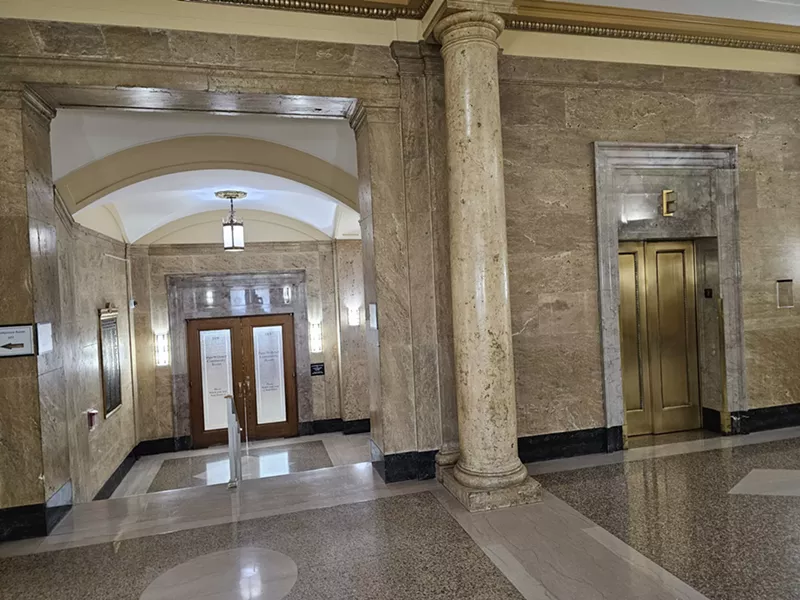

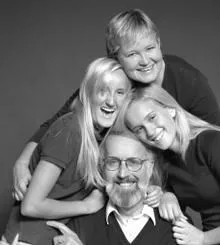
Sandy Widener, a co-founder of Westword and our original managing editor, went on to great things — but the greatest might have been the very extended family she created with John Parr, a civic leader; together, they influenced every corner of Denver and beyond. In December 2007, Sandy, John and their daughter Chase were killed in a car accident while driving through Wyoming to visit Sandy's parents; their second daughter, Katy Parr, survived. On June 30, Sandy, John and Chase will be remembered when the Parr-Widener Conference Room is dedicated on the third floor of the Denver City and County Building.
Here's my original remembrance, "Remembering Sandy Widener," published two weeks after her death:
Weeks later, I find myself driving down the street and, inexplicably, something will remind me of him — something so simple as a tree — and I'll find myself blurring with tears.
It's not easy to let somebody go.
In December 1984, Sandra Widener, one of Westword's co-founders, wrote a stunning piece for the Denver Post, the paper where she was then working, on the death of a friend, lawyer Jonathan Olom. Reading through "The Death of a Friend," I'm reminded of several things. That Sandy was a hell of a writer, and that she did a remarkable job of capturing the spirit of a man who died way too early. A job so good that Jonathan lives on through her words. And now she does, too.
It's not easy to let somebody go.
I met Sandy the very first day of our freshman year at Cornell University, where we were both assigned to the second floor of Dorm 4, a hideous cinderblock building at the bottom of an even more hideous hill. Since the other four floors were filled with boys, our floor bonded fast. Sandy was fresh from Texas, a tiny blonde in even tinier hot pants, with a big personality. She could be feisty and fierce — particularly when people didn't take a tiny Texan in hot pants seriously — but she was also a hell of a lot of fun. She loved to laugh — everything from a piercing shriek to a raucous hoot to a tee-heeing titter when she was particularly tickled. She would laugh so hard that she'd hug herself and cry, her eyes shining like stars.
It was Sandy who got me into journalism — she joined the Cornell Daily Sun, an independent daily in Ithaca, New York, and encouraged me to do the same. By our junior and senior years, we were spending endless nights in a ramshackle building downtown, listening to the old AP machine, drinking wretched coffee and talking — sometimes about politics, but often about nothing so high-minded — with other Sun addicts.
And I got Sandy to Denver: After graduation, fellow Sun alum Rob Simon and I started a newspaper on Long Beach Island, New Jersey, then fled after one smelly, exhausting summer, leaving that paper to another friend and coming to Denver to start a free weekly because when I'd been here to ski, I thought the state seemed so much more interesting than the media made it look. Sandy, who'd spent the summer in Indonesia, signed on to join our harebrained adventure.
John Parr was a major reason that Colorado was so very interesting, but we didn't know it at the time.
We started Westword with little money and less sense. For the first issue — most of whose copies never made it out of our garage because we hadn't quite finished setting up a circulation system — we reported on TV weathermen and the energy boom and Star Wars, still packing them in on Colorado Boulevard. Sandy wrote about Pop Rocks — isolated Denver was a big test market before the Internet started blurring boundaries — and a migrant food fund that was running out of money. She was a serious journalist, but she was also an unstoppable force of nature. She'd streak across the office, leaving chaos in her wake. She was like a comet, Rob said.
And then the comet found her orbit. John Parr had made a name for himself as the smart-growth strategist who'd stopped the Olympics from coming to Colorado, then helped Dick Lamm get elected governor of Colorado. By the late '70s, he was heading Lamm's Front Range Project, looking at the future of the metropolitan area. Sandy went to interview him.
"I love him," she said when she returned to the Westword office, tittering and hugging herself, her eyes crinkling into stars. And for almost thirty years, her life would revolve around the world they created together. The tough cookie had crumbled.
"It's not the end of everything, but whatever happens next does not take the form of these goofy little bodies and personalities we're stuck with now. I don't think we'll come back to Earth; there are too many other interesting places to be. Why would you think that the best thing would be to come back here and be on Earth again? It's kind of like saying, I'm afraid to go up the block, afraid to leave the neighborhood."
After a few years, Sandy left Westword to join Rocky Mountain Magazine and, when that folded, the Denver Post, where she covered everything from rough-and-tough mining towns to the death of a friend. When John moved to New York City to head the National Civic League, Sandy worked for Newsday, covering crime stories while she was hugely pregnant (but still tiny). And then, when John moved the National Civic League's office to Denver, she started writing textbooks so that she could work at home while taking care of their two daughters, Chase and Katy.
The Parr/Widener home in Cheesman Park became a non-stop salon, always full of interesting people. Friends of the girls from grade school and then East High School. Visiting foreign students. National political figures and policy analysts who were working with John as he continued his civic involvement through the University of Denver and the non-profit Civic Results. Sandy, who was a truly awful cook in the early days, had applied the same stubborn determination to cooking that she had to writing, and was now a star both in the kitchen and at the dinner table. "She was sparkly," remembers one regular. She could toss off a great one-liner even as she was placating a crying neighborhood kid with a homemade cookie. And as Chase and Katy grew up, it was clear that they had inherited the best of both Sandy and John: a profound spunkiness and an unquenchable spirit.
On December 22, Sandy, John and their two daughters were driving through Wyoming to be with Sandy's family for the holidays. The car skidded on ice, setting in motion a horrific crash that instantly took Sandy, John and nineteen-year-old Chase, and sent seventeen-year-old Katy and the family dog to the hospital. Katy is now with her relatives in Boise.
The family's friends in Colorado and across the country are left with an immense black hole, a bottomless sadness that sucks your spirit.
It's not easy to let somebody go. In fact, you hang on to every memory you can. Driving down Colfax, I see the Satire, where we first ate Mexican food — "This plate is hot!" — and the club where we went country dancing before it was cool. (In Boston, Sandy once pogo'd with I.F. Stone, an equally tiny and feisty journalist.) With each reminiscence — of the insane college capers, of those sleep-deprived and lunatic-laden early days of Westword, of a night just a few weeks ago when we laughed so hard that a friend passing by the restaurant swore he could hear us inside — I keep wanting to reach for the phone to call Sandy, to utter a few words and be rewarded with a shriek. I'll get several numerals into the call before I suddenly remember that she's gone. That John's gone. That Chase is gone, and that Katy will have to cope with what remains.
For all the conversations we had, Sandy and I never really talked about death — just those friends we'd lost. But she did talk about it with Jonathan, who left her his leather jackets — because she was the only person small enough to fit into them.
"The universe is a perfect system, from the smallest plants and animals to the structure of the Earth and the solar system," he told her. "Everything that happens is part of that perfection. Like Einstein said, 'God would not play dice with the world.' Death is enormous, but it's possible to be comfortable with it."
In some bitter, ironic way, Sandy concluded, his life and death almost seemed designed for the friends he left behind, to remind us that even someone like Jonathan could die, that we should pay attention to life because it is fragile.
It is impossible to imagine this town without Sandy and John and Chase. They represent the very best of Denver, a city where people are inspired to follow their dreams and make things happen — whether it's stopping the Olympics or starting a paper or electing a governor or electing a mayor. In 1982, John was instrumental in convincing Federico Peña to run for mayor. During one planning session, Sandy and Rob Simon were locked in a room until they came up with Peña's campaign slogan: Imagine a great city.
Sandy and John helped create that city. They are this city. And it will not be easy to let them go.
The day after the crash, as the news of the tragedy was streaking across the country, East High School students organized a candlelight vigil for Katy, a remembrance for Chase and her parents. There was a full moon over Cheesman that night, and right by it, a bright star I'd never seen before.
It sparkled.