
Bennito L. Kelty

Audio By Carbonatix
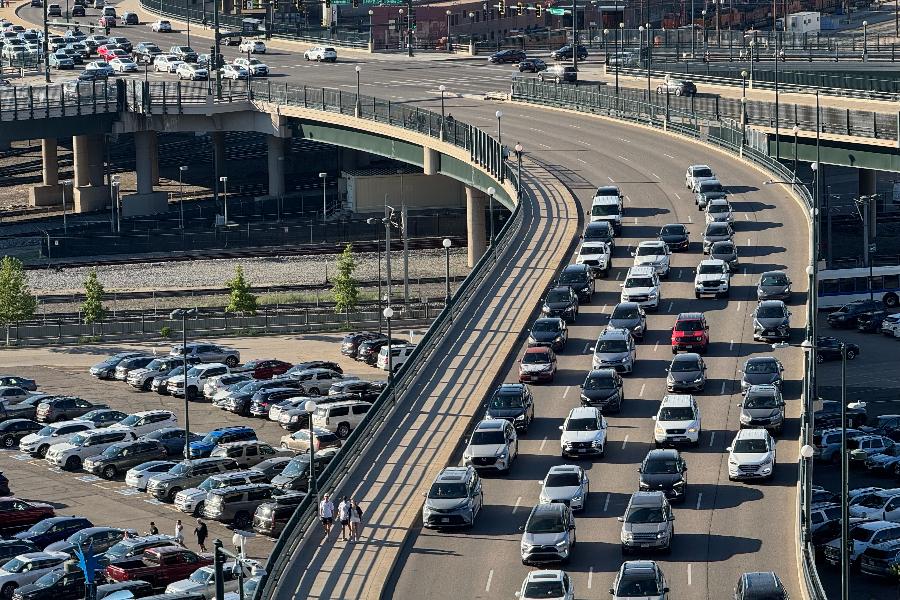
Activists and other residents are fighting proposals to widen major metro highways and thoroughfares as the Denver Regional Council of Governments considers how to use federal transportation funding for the next 25 years.
Local governments and agencies, including the Colorado Department of Transportation and Denver’s suburban counties, are asking DRCOG for dozens of widening projects in the face of growing population expectations, according to Jacob Rigor, director of the DRCOG Transportation Planning and Operations Division.
“We are adding a significant number of people by 2050 over a significant geographical area,” Rigor says. “We do think of all of our projects as really optimizing the use of these dollars. …That looks different in an outlying suburb than it does in the middle of Denver.”
According to DRCOG, about 3.4 million people live in the area it serves. That number is expected to grow to more than 4.4 million metro Denver residents by 2050.
DRCOG hasn’t broken down how much is being proposed for road widening or adding extra lanes. Some would be standalone projects while others include widening as a part of a larger plan. When combining the projected cost of all DRCOG proposals that include widening, the total is more than $4 billion.
CDOT is asking DRCOG for $562 million in federal funding to widen the stretch of Interstate 25 located between interstates 70 and 270, which would include a bit of north Denver around Globeville, from 2030 to 2034. The state transportation department also proposed a nine-year, $900 million widening of I-270 starting at the northern edge of Denver and ending at U.S. Highway 36 in Welby.
Neighboring jurisdictions are asking DRCOG to widen their most important thoroughfares, too. Adams County wants to widen Colorado Boulevard, Quebec Street and Tower Road, along with a half dozen other streets. Arapahoe County wants the same for Arapahoe Road, Broncos Parkway and ten other roads, while Douglas County is seeking more lanes on Lincoln Avenue, Parker Road and a couple other roads.
The City of Denver is not asking DRCOG for any highway widening. Instead, the city wants safety improvements on major thoroughfares like Sixth, Alameda and Evans avenues, including traffic signals to alert pedestrians and drivers of approaching buses, as well as bicycle overpasses, a pedestrian bridge near Broadway and Interstate 25, and the conversion of one-way downtown streets into two-ways.
Road widening can be a touchy subject in Denver, however, as evidenced by the East Alameda Avenue road diet snafu. And there is a vocal sector of residents who are unhappy with the highway proposals, as well.
“We have decades of data that show widening highways is a complete waste of money,” says Jill Locantore, the executive director of the Denver Streets Partnership. “It doesn’t even solve the problem of congestion. It just induces more driving.”
WTF Is DRCOG?
Along with CDOT and RTD, which handles public transportation, DRCOG is one of three agencies that funds the metro area’s transportation infrastructure. DRCOG coordinates planning across 59 jurisdictions in a broad definition of metro Denver that stretches from Georgetown to Bennett and from Boulder down to Douglas County.
DRCOG also helps Denver-area cities and counties with federal funding for energy, retired populations and government performance. Meanwhile, metro residents interact with the agency’s work on regional transportation every day.
“You see a lot of the influences, whether you realize it or not,” Rigor explains. “You see it on Bike-to-Work day. Every year, you see it in our Way To Go program. You see it in the approximately $500 million we fund every year through our transportation budget.”
Denver residents can look to Federal and Martin Luther King Jr. boulevards to get a sense of DRCOG’s roadway widening projects. DRCOG completed the $23 million widening of Federal Boulevard from West Sixth Avenue to Howard Place by adding a sixth lane. A mile-long stretch of MLK Jr. from Havana to Peoria streets was recently widened from two lanes to four with a $15 million DRCOG project, as well.
DRCOG was also instrumental in the Transportation Expansion project also known as TREX, a $1.67 billion widening of nearly twenty miles of interstates 25 and 225 along the corridors where they connect Denver, Aurora and Castle Rock.
2050 Metro Transportation Plan
In 2026, DRCOG will finish updating the 2050 Metro Vision Regional Transportation Plan, which lays out how the state and local governments hope to spend federal transportation funding during the next quarter century. As one of nearly 400 federally designated metropolitan planning organizations, DRCOG has to update its regional transportation plan every four years.
In October, DRCOG member governments submitted 133 major transportation projects worth a combined $11.4 billion for consideration. According to DRCOG, it only has about $7.8 billion in promised federal funding so far.
According to Rigor, the plan “really articulates what are this region’s multi-modal — which means all modes of transportation — investment priorities through 2050.” However, it’s also “a statement of what’s important in this region,” he says.
The DRCOG Regional Transportation Committee and its advisory committee heard presentations of the proposed project list on December 15 and December 16. According to Rigor, DRCOG is expecting to trim the list down.
DRCOG will have a draft plan by summer 2026, with a shortlist of projects and a proposed timeline. Fall 2026 will be the last chance for the public to give feedback, Rigor says; after that, the plan will go to the DRCOG Regional Transportation Committee for approval.
Cure for Common Congestion
Locantore and the Denver Streets Partnership want residents to ask themselves if widened roads actually feel uncongested.
“It is counterintuitive as a user of the transportation system. You’re stuck on a roadway behind a bunch of other cars, and you’re like, ‘Geez, if there was just another lane, traffic would be flowing so much faster and smoother,’” she says. “That seems logical on the surface, but the data shows again and again that’s not true.”
In November, the Texas A&M Transportation Institute updated its Urban Mobility Report and found that metro Denver drivers spend an average of 76 hours a year stuck in traffic, up from 62 in 2019, the seventeenth-worst in the nation. The report also estimated that congestion costs individual drivers more than $1,700 a year in lost productivity and wasted gas, which is 16 percent worse than other cities of the same size as Denver.
In a December 12 letter to DRCOG, the Denver Streets Partnership pointed to a 2021 CDOT analysis that found that highways return to pre-widened traffic levels within three to five years after completion of the project. Locantore says the TREX project is “the iconic example” of the shortcomings of highway widening projects, because it returned to pre-widening congestion levels in just two years.
According to Locantore, governments keep widening highways because of “partially, inertia. We’ve been doing it for long, it’s what we’re used to.” But the real solution, she says, is congestion pricing, similar to tolls; cities like Manhattan have already implemented electronic, camera-enforced systems that charge people more than $9 to drive in the New York metropolis during peak congestion hours.
My Way or the Highway?
Both DRCOG and the Denver Street Partnership want as many people as possible to provide feedback on proposed projects. Some of that feedback was shared at the mid-December meetings.
For example, metro resident Andy Janes had written to DRCOG, warning that road widening could backtrack efforts to save the environment. “We know that widening highways are only temporary solutions to traffic delays and can actually reduce the safety of those roads, ” Janes said. “Highway expansions do not meet the moment and are going in the wrong direction if we want to have any chance of keeping global temperatures reasonable.”
During the December 15 meeting, resident Elizabeth Simons said that highway widening plans go against regional goals.
“I find that highway widening is not really in support of the transportation system of the future that I think we want to see in Denver and the surrounding areas,” she said. “I would like to see more emphasis and support given for alternate transportation methods, less towards cars.”
The topic will come up at DRCOG committee meetings again on January 20 and 21.
Both CDOT and RTD are going through similar feedback processes right now. RTD is looking for comments on FasTracks, a $5.5 billion plan to expand commuter rail lines throughout the metro area. (In October, Boulder County residents told the RTD board that they’re tired of waiting for their major rail projects, despite paying taxes on them for two decades.)
CDOT is working on a Ten-Year Vision Plan and a proposed $1.7 billion worth of transportation projects. Locantore says that CDOT’s draft plan similarly emphasizes roadway expansion, in particular for highways.
“Right now is the time for people to speak up and have an influence on those decisions,” Locantore urges. “CDOT and DRCOG need to hear from residents right now to influence both of these plans.”