

Brandon Marshall

Audio By Carbonatix
Reader support matters more than ever
We're in the final stretch of our summer campaign. Our goal is to raise $25,000 by August 9 to support the journalism our community relies on. Reader support is helping shape the future of local news.
Denver bicycle, pedestrian and transit advocates just gave Mayor Mike Johnston a “D” on his Transportation Safety and Access report card, citing mounting traffic deaths and favoring car-friendly projects during his first two years in office.
“Denver’s streets are becoming more dangerous and inaccessible,” wrote the Denver Streets Partnership, in a January 26 letter to Johnston delivering the poor grade. “The current administration is falling behind on its commitments to protect people’s lives and provide safe, accessible and sustainable transportation choices…this report card is a collective call to course-correct.”
According to the report card, Denver’s record level of traffic fatalities in 2025 reflects a lack of investment in transportation safety. This, and the removal and rejection of bike infrastructure, were the main reasons for Johnston’s D grade. The report card also compares the mayor’s transportation policies to his campaign promises made in 2023 to the Denver Streets Partnership and the Denver Bicycle Lobby.
“Johnston has fallen short on his commitments as a candidate to improve mobility, access and transportation safety in Denver,” his report card reads. “While he entered office with clear plans, strong voter mandates and urgent safety needs, progress has slowed.”
The mayor is more than halfway through his first term since taking office in July 2023. In a response to the barely passing grade, Jon Ewing, a spokesman for the mayor, argues that Johnston’s administration has made “significant improvements” that are “saving lives and making travel easier.”
“Mayor Johnston remains steadfast in his commitment to make Denver a safer city for cyclists, pedestrians and drivers,” Ewing says. “A vibrant city is one where people can move freely without fear.”
The coalition that authored his report card is made up of four local groups that advocate for alternative transportation to cars: the Denver Streets Partnership, the Denver Bicycle Lobby, Pedestrian Dignity and Greater Denver Transit. The report card was endorsed by nine local groups, including the West Washington Park Neighborhood Association, the Colorado Cross-Disability Coalition and Bicycle Colorado.
This was the coalition’s first mayoral report card on transportation safety and access, according to Jill Locantore, the executive director of the Denver Streets Partnership. Under former mayor Michael Hancock, the Denver Street Partnership published report cards for progress on Vision Zero, a national campaign among major cities to eliminate traffic fatalities by 2035 that the City of Denver joined a decade ago.
On January 22, Johnston released a 2025 “scorecard” evaluating how well he met goals in areas like safety, homelessness and affordable housing. According to his own measure, the mayor met nine out of his eleven goals, falling short in targets for homeless residents moved into permanent housing and the number of affordable units opened. Still, he gave himself a better score than bike, pedestrian and transit advocates in the city.
Bennito L. Kelty
More Traffic Deaths Than Homicides
According to the report card, Johnston told the Denver Street Partnership that “Denver can’t simply give lip service to Vision Zero” in a 2023 candidate questionnaire, but he’s moving in the wrong direction.
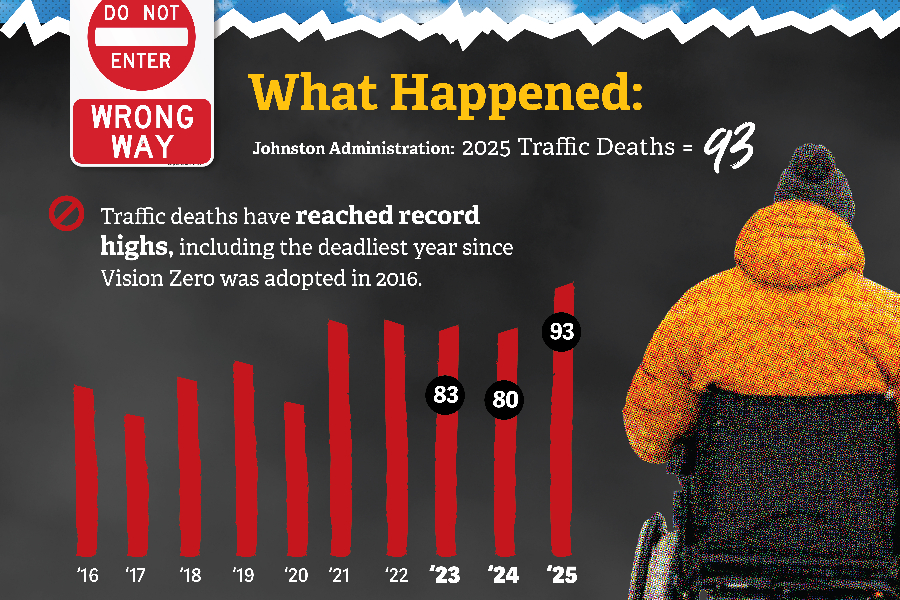
In 2025, the City of Denver recorded 93 traffic deaths, the deadliest year on record. People who weren’t in motor vehicles were disproportionately impacted, the report card notes, as the deaths of 34 pedestrians, five cyclists and nine people on e-scooters in 2025 marked an increase in each category from previous years.
A full report explaining the grade notes that “more Denverites are killed in violent traffic crashes than homicides.” Denver recorded 37 homicides last year, per Denver Police Department data.
“This level of human loss is not inevitable, and it is not acceptable,” Locantore wrote in the announcement of the report card. “Traffic violence is a public policy failure, and it demands urgent leadership.”
Locantore said that Johnston left traffic deaths out of his own 2025 scorecard. He also acknowledged on Monday, January 26, that it was absent from his 2026 goals, but said that it was a priority for the Department of Transportation and Infrastructure (DOTI)
Ewing touted the mayor’s efforts to combat traffic deaths with the System Providing Evidence-Based Enhancements in Denver (SPEED), a $2 million program tested last year on Alameda Avenue and Federal Boulevard and expanding this year to Colorado Boulevard; the program relied on retuning traffic lights to rest on red longer and installing more enforcement cameras and speed limit signs. Alameda Avenue, which only saw four deaths in 2023 and 2024 combined, didn’t record any traffic deaths last year, Ewing noted, but traffic deaths on Federal Boulevard increased by one in 2025.
The report card tries to raise an alarm about the Transportation and Mobility Special Revenue Fund, created in 2022 with revenue from parking meters for pedestrian, bicycle and transit safety improvement projects. According to the report card, the fund “no longer invests in any infrastructure projects at all, and instead mostly funds an appeals system for parking tickets.”
According to Ewing, the Johnston administration plans on “allocating hundreds of millions of dollars in infrastructure improvements” through the Vibrant Denver bond. However, biking advocates have called out the lack of bike projects in the bond list, and the report card charges that the “bond fails to invest any significant funding in Vision Zero.”

Bennito L. Kelty
Car-Friendly Moves, Bicyclists Upset
Johnston “weakened” and “slowed” multimodal and safety projects, his transportation report card reads, naming the Alameda road diet plan in particular.
In October, residents and advocates raised a fit when the city watered down a plan to take away two car lanes on a section of East Alameda Avenue near Washington Park. The “road diet” was meant to slow traffic and make it safer to cross and bike alongside the thoroughfare.
Residents felt like the Johnston administration kowtowed to Jill Anschutz, the daughter-in-law of Colorado’s richest man, after she opposed the road diet and successfully lobbied the city to keep at least one lane.
“The city scaled back plans for a road safety project on East Alameda Avenue in response to concerns about relatively minor vehicular delays and diversion,” the coalition’s report reads. “The city has prioritized signage and minor operational changes rather than proven safety treatments like road diets or physical separation.”
The report card doesn’t specify which “physical separation” measures the authors are upset about losing, but it does have graphics showing Market and Blake streets, downtown roads where flex posts were removed last year. The Denver Bicycle Lobby and other activists were angry with the city’s decision to remove the small white bollards that cyclists say offer them extra protection.
The city is “working closely with neighborhood and community groups” to add diverters, or infrastructure to separate cars from non-motorized traffic, according to Ewing. Johnston has said the city plans to install more Ziclas, which are small, heavy bumps that separate bike lanes, but hasn’t said what kind of other diverters could be installed.
Ewing adds that the mayor “is committed to building 38 new miles of bike lanes over a two-year period,” and Johnston has “partnered with council to eliminate parking minimums,” which allows developers to build fewer parking spots — and, in theory, leaves more room for cyclists and pedestrians.