Bennito L. Kelty

Audio By Carbonatix
Advertising Can't Do It Alone
The challenges facing local news organizations are very real. That's why reader support matters more than ever. If you believe independent journalism matters, make a contribution today and help us reach our summer fundraising goal of $25,000 by August 9.
Residents of the West Washington Park neighborhood are demanding the city reverse course on its plan to scale down pedestrian and bicycle safety measures along a portion of East Alameda Avenue.
The West Washington Park Neighborhood Association (WWPNA), a registered neighborhood organization, delivered a petition to Mayor Mike Johnston on December 11 asking the city to reverse course. Some residents, emboldened by records from the Department of Transportation & Infrastructure that show a safety study was skipped before the decision was made, are even calling on DOTI executive director Amy Ford to resign.
But first, the neighbors are focusing on safety.
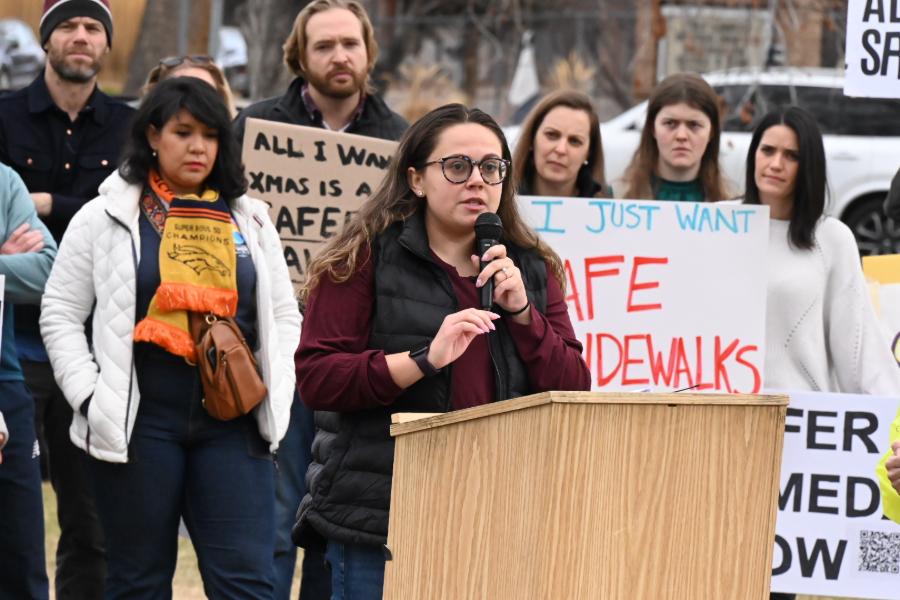
“Denver broke its promises to residents to build this life-saving street,” WWPNA member Christina Noto said during a December 11 protest at East Alameda Avenue and South Marion Street Parkway. “Neighbors live in fear of the dangerous conditions just outside their door.”
For five years, DOTI has been working on a “road diet” that would eliminate car lanes along a one-mile section of East Alameda from South Franklin to South Logan streets. The project extends slightly into the larger Washington Park neighborhood next to Wash Park West, with construction of the road diet scheduled to start in November 2026 and finish in September 2027.
However, DOTI suddenly slowed its roll a few weeks ago, cutting the number of lanes it will eliminate despite strong support for the road diet as it was. The original plan was to narrow a one-mile stretch of East Alameda from four lanes to three lanes. Currently, the street has two eastbound and two westbound lanes; the original road diet plan would have reduced it to single eastbound and westbound lanes, with a two-way turning lane in the center. The transportation department’s revision keeps both eastbound lanes, so the road diet would simply convert one westbound lane into a dedicated turn lane.
According to DOTI spokesperson Nancy Kuhn, the changes will “reduce the risk of congestion, cut-through traffic on nearby side streets” and “improve conditions for people walking and biking.” However, WWPNA members are still calling for the elimination of one eastbound lane to make East Alameda safer for cyclists and shorter to cross, and to force drivers to slow down.
Wash Park West residents blame pressure from Jill Anschutz, the daughter-in-law of Colorado’s richest man, Phil Anschutz for the switch. According to Noto, Jill Anschutz began her campaign against the East Alameda road diet in June, when she started emailing and meeting with city officials and Wash Park West residents. Anschutz is also accused of hiring a lobbyist to quash the city’s original designs, which were announced at a community meeting on December 2.
“A five-year planning process was changed in about four months,” Noto said at the protest. “Please give this community the same courtesy you gave Jill Anschutz. Restore the safer original design for Alameda Avenue. Mayor Johnston needs to step up and do what’s right.”
“We believe the direction we are headed will also increase safety for pedestrians and people on bikes,” DOTI says in a statement issued after the protest. “Our team, including our executive director, met with the WWPNA last week, answering their questions about our changes to the Alameda Lane Repurposing project publicly and transparently. We made a decision to revise our design using a data-driven approach that also considered public feedback on both sides of the issue. We’ll go back to the RNOs next year as we work through the design.”
Johnston appointed Ford to head DOTI in December 2023.
According to WWPNA member Amy Kenreich, Wash Park West residents met with Anschutz in September as she was gathering signatures to scale back the Alameda road diet; Anschutz ultimately turned in about 300 signatures. Noto says that a petition to restore the original road diet plan gathered about 1,000 residents from both Wash Park neighborhoods and Platt Park, which starts about a mile south of East Alameda. WWPNA delivered that petition to City Hall a few hours after the protest.
Kuhn says DOTI’s revised plan will reduce traffic accidents, particularly left-turn and rear-end crashes; pedestrians and bicyclists will be safer, too. DOTI will continue to work with Wash Park West residents on the project, she adds.
Getting Billionaires on the Same Diet
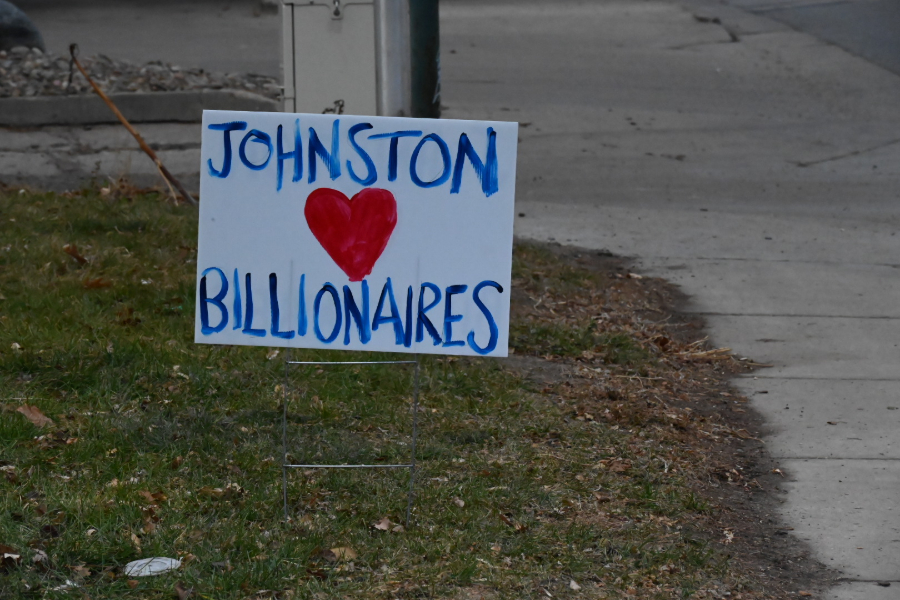
Wash Park West residents, local RNO members, advocates from nonprofits like the Denver Street Partnership and the Colorado Cross-Disability Coalition, and city board advisors attended the protest, which started with comments to the media followed by sign-waving along East Alameda. The signs had slogans like “Alameda Deserves Better,” “All I want for Xmas is a Safer Alameda” and “Johnston hearts Billionaires.”
The press conference and protest were organized after WWPNA members received public records from DOTI, which it had requested in November. According to Noto, the documents revealed DOTI nixed a study that would have looked into how a scaled-back road diet would affect pedestrians and cyclists.
According to WWPNA, residents attained a copy of a September 24 email between DOTI engineers in which they agree to skip an analysis into the potential rate of pedestrians and cyclists getting hit by cars because it would cost $50,000; the department opted to ook at how much the revised plan would slow down East Alameda Avenue traffic instead. Some Wash Park West residents are certain that an analysis “would have shown the safety differences between the original road diet and the city’s downgraded plan,” according to Noto.
“If they conduct a safety analysis, they’re going to learn that their new plan is not going to be as safe,” she said. “You need to conduct a safety analysis if you’re going to make the claim that it’s just as safe. …We want the original plan restored, because we know it’s a safer plan. You cannot eliminate a safety review and then insist there is no loss in safety.”
Bennito L. Kelty
Denver City Councilmember Flor Alvidrez, who represents Wash Park West, stood behind residents as they demanded that the original road diet plan be restored. According to Alvidrez, she’s never seen a city planning process “happen in this way ever.”
Alvidrez said that she met with Anschutz “early on, before she reached out to DOTI” in June, but Alvidrez didn’t offer any details on the interaction. The councilmember did say she believes “the city gave in to a lobbyist” despite strong community support for the original road diet.
According to Alvidrez, Ford and Johnston didn’t keep her in the loop about the controversial project in her district. “When the city was collecting feedback and doing outreach for this project, my office was flooded with emails thanking the city for considering this road diet,” Alvidrez said. “To get a press release as a councilperson instead of an actual conversation about my views or the residents of my district is extremely disappointing.”
Alvidrez told the crowd at the protest that “I don’t know that there’s any recourse” for councilmembers to undo a city planning process or remove mayoral appointments like Ford.
City Transportation Advisors Hurt by “Betrayal”
Residents who volunteer for city advisory boards, which are supposed to have the ear of city policy makers, said they support the upset Wash Park West residents.
June Churchill, a member of the Mayor’s Bicycle Advisory Committee and the DOTI advisory board, said Wash Park West is dealing with a “breach of public process,” and that she sees the new road diet as a plan to “spend more money to downgrade safety.” Like Alvidrez, she’s frustrated with a lack of city transparency.
“I shouldn’t, as a DOTI advisory boardmember, learn more about a project from [public records requests] than I do from the department talking to me directly,” Churchill said. “That’s frankly ridiculous. That’s not how public processes should function.”
As a member of the MBAC, Churchill has been vocal about how hard it was to get the mayor to attend a bicycle policy meeting. Fellow MBAC member Joe Sak, who will chair the committee next year, said he is worried about the city’s communication, too, and hopes the city will work to patch things up with angered advisors and residents.
“When projects like this get overturned like this because of one person’s influence over an entire community, I think it sends a mixed message,” Sak said. “It’s hard to know where we really stand, but we’re striving to have a good, mutually beneficial relationship.”
Wash Park West residents are also dealing with the installation of traffic circles south of Alameda along East Dakota Avenue, but they’re more divided over that topic. Some residents feel that DOTI sprang that project on them after putting it off for five years, while others support the installation and are optimistic that the concrete circles will slow cars.
Jamie Lewis, a Colorado Cross-Disability Coalition advocate, left his seat on the DOTI transportation advisory board in response to the department’s changes to the planned road diet. At Thursday’s protest, he said that Ford should resign over the Alameda situation, but also suggested that someone may have “told her” to water down the planned changes.
“They’re not listening to the DOTI advisory board. Second, they’re not listening to this community,” Lewis said. “This has got to stop. She should step down, and we should get the mayor to hire somebody who can make these things happen for your community. She can fall on the sword for who told her to do it, or she can tell us who told her to do it.”