
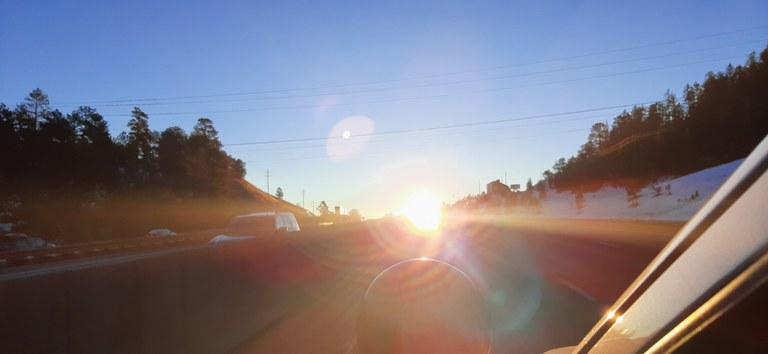
Colorado State Patrol/Sergeant Don Enloe

Audio By Carbonatix
Independent Journalism in Denver Needs You
We need to raise $25,000 by August 9 to support the reporting our community depends on. Reader support keeps us independent and is playing a larger role in funding local journalism and shaping what comes next. If you believe independent local journalism matters, make a contribution today.
Colorado roadways have some incredible views, but you can’t see them when the sun is shining at the wrong angle. You can’t see anything, for that matter.
The higher the elevation you are, the less atmosphere there is to filter out ultraviolet radiation from the sun. (That’s why snow can seem so blinding from atop the mountain.) We can suffer through it most of the time with a combination of sunglasses, squinting and sun visors as we pray for a turn or cloud coverage to take our eyes out of their misery. But it’s never a safe situation, and it only gets more hazardous with time.
That’s when the Colorado Department of Transportation steps in.
Floyd Hill, a four-mile stretch on Interstate 70 east of Idaho Springs, can be at such a harsh angle for early morning drivers that CDOT will shut down all eastbound lanes on the highway for hours at a time. According to CDOT, these powerful glares typically occur from November to March, and last from sunrise to approximately 8:30 a.m. The delays average between 45 minutes and hours, but can last upwards of two hours. On some days, the intense glare can affect drivers as far east as Genesee.
Mountain town commuters who work in Denver have probably experienced a glare closure or heard from someone who has. According to CDOT, there were 63 sun glare closures from October to February 8, and more are expected to come before spring. A preparatory traffic hold is also held each year in late October, CDOT notes.
This doesn’t count construction-related closures and delays around the I-70 Floyd Hill stretch, which is currently undergoing highway widening, bridge rebuilding and other renovations through 2028.
The decision to close Floyd Hill is “made on a case-by-case basis each morning” in collaboration with the Colorado State Patrol and transportation staff who are stationed nearby, CDOT says. Sun glare closures are announced to drivers with electronic sign boards ahead, with motorists “urged to pay attention” each morning as they approach the Eisenhower Johnson Memorial Tunnel.
The blinding sun is obviously dangerous on its own, but “especially when there is leftover moisture on the roadway from a storm or from pre-storm road treatment materials. On top of that, mountain driving conditions include steep hills, sharp turns, and unknown scenarios such as wildlife crossing the highway,” CDOT explains, adding that, “Motorists should consider adjusting eastbound travel plans to before sunrise or later in the morning if possible.”
Most drivers can be rerouted at U.S. Highway 6 at the bottom of Floyd Hill. According to CDOT, a clean windshield, sunglasses and slower-than-average driving are all essential safety measures when driving in the face of a sun glare.