Courtesy of the Colorado Bridge Trolls

Audio By Carbonatix
Reader support matters more than ever
We're in the final stretch of our summer campaign. Our goal is to raise $25,000 by August 9 to support the journalism our community relies on. Reader support is helping shape the future of local news.
As outraged as Denver protesters are with the Trump administration and Immigration and Customs Enforcement, some still get bored with the handmade sign-waving and slogan-chanting on the steps of the Colorado State Capitol.
“I had been doing a lot of stand-out-with-your-signs-and-wave at people, which just felt kind of soul-sucking,” says Erica, a protester who would rather dance on an overpass or at a busy intersection while dressed as an inflated psychedelic mushroom. “It just didn’t feel as energizing. The thing with when they have music, and you’re on a bridge or on a corner, you’re having fun, and traffic will engage with us more because we’re having fun.”
Erica isn’t alone. She borrows the psychedelic mushroom costume from Lori, a small, gray-haired woman who now dresses as a big blue bunny. When they protest near traffic, Erica the Mushroom and Lori the Bunny usually dance to a playlist of songs like “Arrest the President” by Ice Cube and “THREAT LEVEL ORANGE” by Earth to Eve — but they wouldn’t be able to blast music without Rich, who dresses up like Darth Vader and has a knack for making noise and homemade lightsabers.
“I found my people, and this is what I want to do,” Erica says. “The biggest thing that drew me was that they had music. It just changes the whole thing. It changes the whole vibe.”
Meet the Colorado Bridge Trolls
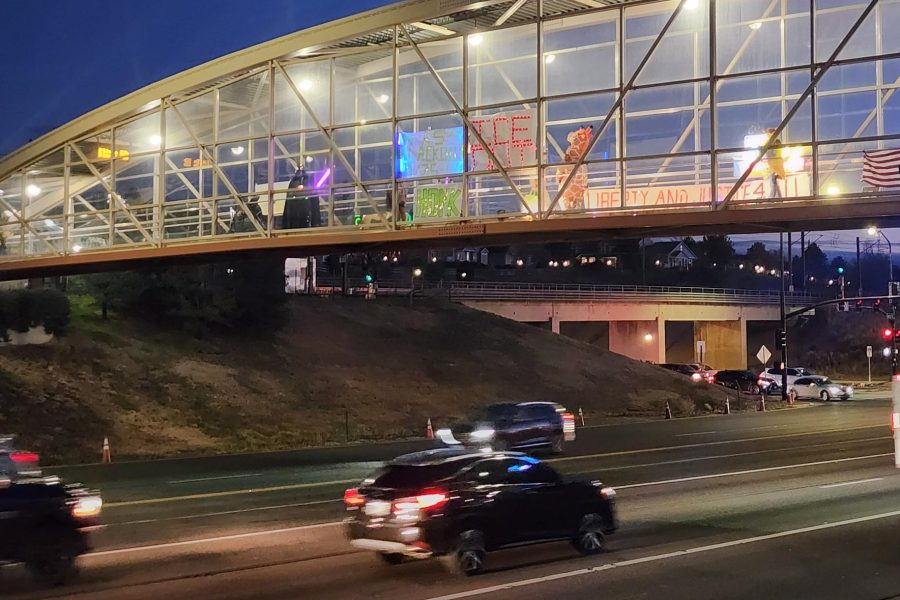
They’re a group of Denver protesters who strap signs that say things like “Fuck ICE” and “Release the Files” to the sides of overpasses above the metro area’s busiest highways, all while pumping up the jam to keep the resistance going.
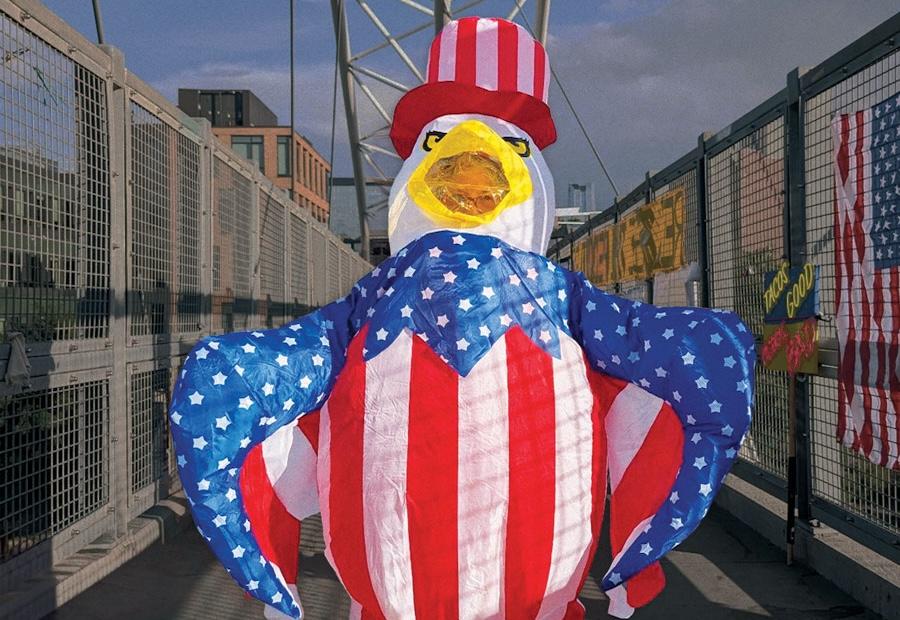
Lori, Rich and Erica are part of a core that includes a walking taco who also goes by Sarah Huston, and Rich’s wife, Rey, who some drivers around town may know as the Statue of Liberty. At times, Chet Nelson, a fellow Troll, paints his face orange and his hands purple to look like President Donald Trump. As in fairytales, most of these Trolls keep their names anonymous, out of fear of being doxxed or harassed.
But you’ll still see them in public, on dozens of bridges from Golden to Denver to Aurora, and from Republican Congressman Gabe Evans‘s district in the north metro to parts of Congresswoman Lauren Boebert‘s district in the south. Some of the Trolls are retired, some are veterans. Some have lived in Denver their whole lives, and others moved here as adults. But when they’re out on a bridge, they’re one entity, holding party-style protests that have been drawing more and more people, especially in the wake of violence by federal immigration agents in Minneapolis earlier this year.
Bennito L. Kelty
A Dichotomy of Craziness
Last March, Lori found a kindred spirit on social media in a fellow protester named Crystal, one of the few people who responded to a post looking for people interested in demonstrating on a pedestrian overpass in Littleton, above South Wadsworth Boulevard near the intersection with West Bowles Avenue.
“It was a little scary when we first started, because it was just two of us,” Lori recalls.
“It was just her and I and whatever random people we could scrape together and convince to be out there with us,” Crystal says. “It felt a little bit dangerous having just Lori and I up there.”
At the first bridge protest, Lori and Crystal were joined by about a dozen friends and teenagers who brought Pride flags and hung signs comparing Trump to Adolf Hitler. The message upset one driver so much that he pulled over and walked up to the small group “to tell us he was disgusted by young people carrying Pride flags and that he had a gun in his truck,” Lori remembers.
Crystal sat on a bench and talked to the man for about 45 minutes, “not trying to change his mind, just trying to mellow him out,” Lori says. The man reiterated his issues with the flag and sign, but left without harming protesters.
“That was our very first feet to the fire. It was scary, but also we had someone come up and drop off sunscreen and bottles of water. It was such a dichotomy of craziness.”
Lori, protester
Part of a Larger Movement
When Lori and Crystal started demonstrating on bridges last March, other groups were building off the success of the Fifty State Protest, a nationwide event that drew upwards of 3,000 people to the Colorado Capitol on February 5, 2025, the same day ICE raided apartments in Denver and Aurora.
A reported 34,000 people showed up to a rally in March hosted by Bernie Sanders and Alexandria Ocasio-Cortez in Civic Center Park, just down the hill from the Capitol.
Nationwide protests continued over the next few months, with local groups pulling permits and posting details on social media regarding rallies in Denver that drew thousands of people to the Capitol. Usually the result of a “call to action” by the national 50501 movement (the number 50501 comes from the idea of a protest in all fifty states, in all fifty capitals, on one day), these events included the March 4th for Democracy; a March 20 protest that brought 4,000 demonstrators to a rally for education and teacher compensation; two Hands Off events in April, the first drawing 8,000 and the second 4,000 people; and A Day Without an Immigrant in May.
Courtesy of the Colorado Bridge Trolls
Meanwhile, Lori and Crystal stuck to the bridges over Interstate 225 and Interstate 25, as well as the pedestrian bridge over Sixth in Golden, “and there were many times Crystal and I were the only people there,” Lori says. “People told us that it was performative or ‘blah, blah, blah.’ They don’t agree with your brand of protesting.”
As they struggled to persuade people to hit the road with them, they wondered if it was worth it. “Most of the time, it was five or less of us,” Lori says. “It took us some time to build enough of a core to know we could count on people to come.”
Their small numbers made them easy to bully, too, Lori says, and they were “periodically” confronted. Most drivers who were angered by their protests or signs would usually flip a middle finger, but some called the police and accused them of throwing items off the bridges.
“We had a guy pull over and come up with an Xacto Knife, yell at us and start shredding our banners, shredding them to pieces,” Lori remembers. “We’ve had another guy come by and rip banners off their moorings. That happened a lot more when it was just women on the bridges.”
Crystal remembers a “pretty scary” incident where she and her daughter were confronted by “a guy who threatened us with a gun and threatened my kid” while on the South Wadsworth Boulevard overpass.
But there’s no platform like a bridge, Lori believes, and she’s stuck with them because she knows thousands of people are seeing her message. Crystal says it’s been “energizing” and “cathartic” to reach so many people. A little support doesn’t hurt, either, and it usually comes every few minutes in the form of a honk.
“In two hours, I’m getting a message in front of 40,000 to 60,000 eyeballs, and we’re moving around, so it’s not the same eyeballs,” Lori says. “It’s not like I’m hitting up the same commuter traffic all five days a week and showing them the same thing. It’s an incredibly effective way to get the message out.”
According to the Colorado Department of Transportation, her estimates are modest. An average of 150,000 vehicles drove underneath the Dayton Station pedestrian bridge per day in 2024, the most recent year available on CDOT’s traffic data dashboard. More than 200,000 vehicles a day on average passed under the Downing Street bridge, CDOT’s 2024 data shows, while more than 250,000 drove under the Highlands Bridge a day.
Lori noticed drivers who “won’t honk because they’re afraid of honking,” but for “whatever reason would smile from ear to ear,” she says. “You see that — and of course you see the people who flip you off — and knowing how many cars are passing under us, you would get a gauge on how people are feeling.”
The honks, smiles and small group of friends Lori has cultivated during troubling times was a way “to replenish our own personal souls and to be able to cope with what we’re living in,” she says.
But eventually it was time for Trolls-in-training to make a little noise of their own.
Organized Noise
When Denver started hitting the streets after Trump’s return to office in January 2025, Rich and Rey decided to ride the surging wave of activism.
Rey says she’s been an activist since she lived in Los Angeles during the Rodney King riots in 1992, so protesting was nothing new to her. Rich, meanwhile, was so inspired by the energy at 50501 rallies at the Colorado Capitol that he became a “kind of a connoisseur of protests,” he says.
He tried some singing and togetherness at vigils held outside the Aurora ICE facility every Monday for Jeanette Vizguerra, the immigrant activist who was detained in mid-March. (She’s since been released and is prominent in Denver’s protest scene.) Rich went to the Capitol for every 50501 protest, too, showing off the big, flashy signs that he made at home. “It was fun for me, just to be around people,” he says.
A Navy veteran, Rich is pretty handy with electronics. Thinking bigger than placards with printed slogans like “ICE Out!” or cardboard scrawled with “Chinga La Migra,” Rich hand-painted signs blue and yellow, like a Ukrainian flag — only he equipped them with cats and tacos made of LED flex lights that glowed white and neon green, too.
By July, enthusiasm for nationally planned protests began to wane in Denver. A Good Trouble Lives On protest, named in honor of late Congressman John Lewis, drew 2,000 protesters, and the turnouts continued dropping from there. Rich began looking for something beyond Capitol rallies, and came across information about a bridge protest on the r/DenverProtests Reddit page, which became a hub for local organizers in early 2025. This particular bridge protest was to be held at the Dayton Station pedestrian bridge over I-225, by a light rail station near Aurora and southeast Denver.
“I had never been to one, so I decided I’d check it out,” he says. “I was really just kind of blown away with the cars all honking, and how it made them feel good. We were waving to people. It felt good for me.”
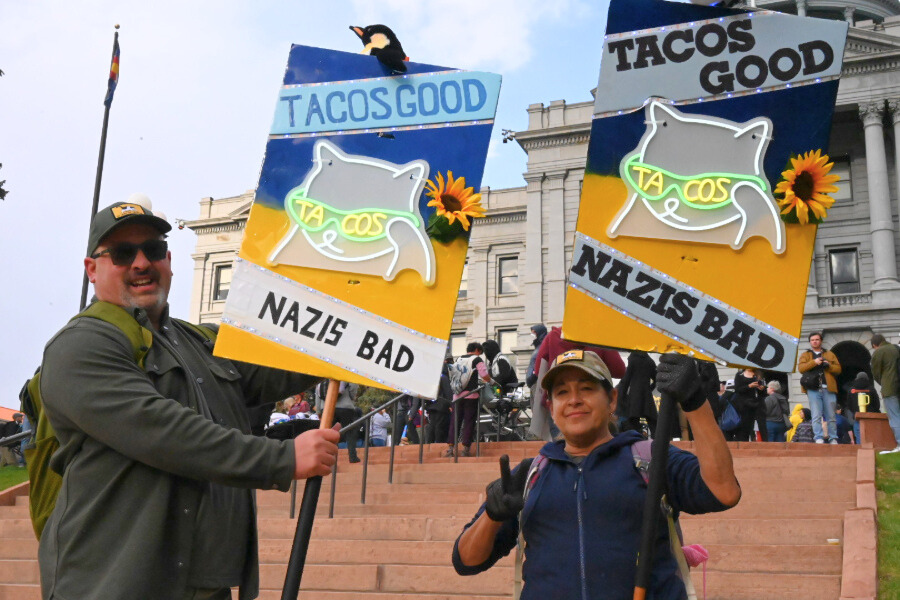
Bennito L. Kelty
Rich was “hooked pretty quickly,” he admits. He came back and helped Lori and Crystal unfurl banners reading “Defend Democracy” and “Release the [Epstein] Files.” Lori and Crystal were now organizing three bridge protests per week, and Rich “didn’t miss a single one,” he says.
All they were missing, he thought, was music.
Pumping Up the Party
Rich had brought a “boombox” to protests before, and usually got a positive response as “people…always gravitated to me” when his tunes played, he says. He made a YouTube playlist to set the protest vibe just right, featuring “Killing in the Name” by Rage Against the Machine, “Fortunate Son” by Creedence Clearwater Revival and “Seven Nation Army” by the White Stripes. He then created a separate playlist just for dancing: “Gasolina” by Daddy Yankee, “Let’s Go Crazy” by Prince, “Livin’ la Vida Loca” by Ricky Martin, “Twist and Shout” by the Beatles and “Pump Up the Jam” by Technotronic. Some songs made it onto both, like “fascionista” by Jessilyn, “Not My President” by CNG, “Fight the Power” by Public Enemy and “Short Dick Man” by Gillette and 20 Fingers.
“I had a pretty good playlist going,” Rich says. “I was, like, ‘You know what? Maybe I should spend some money and get an actual, really powerful speaker.'”
So he bought a JBL Partybox Stage 320, a $600, R2D2-sized, high-powered speaker on wheels. However, with a cacophony of supportive honking, roar of motors and the hum of high-speed tires below, “it’s loud being up on the bridges, so you need something loud you can hear,” Rich explains.
He bought another Partybox and linked it to the first one via Bluetooth, but he still wasn’t convinced it was enough and eventually bought a third. That’s loud enough…for now.
“He quickly became someone I lean on very heavily,” Lori says of Rich. “He’s become very important to me, and he was willing to be completely involved.”
Even though the bridge protests were merrier and stronger by July than they had been a few months earlier, the turnout was still smaller than what Lori wanted. So she started thinking about branding.
“We need a logo, we need to call ourselves something,” she remembers saying to Rich and Rey, who’d quickly joined her husband as a regular. “It’s hard to market and grow the size of these events without that.”
After a bit of “spitballing,” Lori says that Rich proposed calling themselves trolls, playing off the idea of trolling Trump and how trolls in fairytales dwell by bridges (though usually under them).
“I love it,” Lori said — and the Colorado Bridge Trolls were born.
Gumby, Darth Vader and Lady Liberty
Looking for ways to keep the messaging fresh and motorists engaged, Lori dug up an old costume of Gumby, the clay, shape-shifting green humanoid that had a children’s show in the ’50s and then an odd revival in the ’80s, largely thanks to Eddie Murphy’s famous Saturday Night Live bit. She’d used the costume at a Denver’s St. Patrick’s Day parade thirty years before, but it had lain dormant since then.
For protesting in the 2020s, it was perfect.
“If this administration is going to be ridiculous, we’re going to be ridiculous. If I’m dressed as Gumby, that’s pretty ridiculous. That’s where that was born from.”
Lori, protester
Dressing up for the first time this past summer, Lori says she “quickly realized” that the costumes also offered anonymity. She understood how intimidating it could be expressing political views on a street corner, and they had already dealt with angry confrontations. At Capitol rallies, some protesters were showing up in masks and dressed in black, including people who identified as members of Antifa or Black Bloc, far-left, anti-fascist groups often accused of violence, but she was looking for a more light-hearted idea.
“For people who wanted anonymity, you could get that inside a costume without being scary, like Black Bloc,” she recalls. “It was still appealing to the masses that we wanted to attract to the movement, which were people that really needed to get out there and do something for their souls, but they were afraid. They didn’t want to be part of something really big. They didn’t want to get swept up in something. They didn’t want to be part of the police presence, all of those things that scared them.”
Avoiding Violence
Protests like ICE Out and No Kings 2 in June had seen police clash with people trying to march onto the highways. There had also been attacks on protesters reported, including two people who threw bottles and yelled at anti-ICE protesters last February. Three seniors who were walking near the Rage Against the Regime rally in August were allegedly attacked by masked protesters, with two of the seniors, both women, ending up in the hospital.
Lori says that the Trolls’ interactions with law enforcement have always been harmless; they usually entail an officer checking to make sure their signs are tied to the bridges right, telling them why police were called, and then leaving after watching them protest for a bit. Still, she decided to buy a few more inflatable costumes, including two mushrooms colored with wavy tie-dye designs and a big, baby-blue bunny “straight out of Snow White,” to lend to other protesters who didn’t want to show their faces,
Although she still puts on ol’ Gumby now and then, Lori usually lends it to other trolls who’ve joined the group.
“The key to our success has been making it fun for the people who join and the people driving by.”
Lori, protester
“The cool thing about the costumes is it lets people have fun. If I wore a Gumby shirt around town, it doesn’t matter what people’s political beliefs are, people are high-fiving.”
“It’s a marathon, not a sprint, so you’ve got to have fun,” adds Rich, and the costumes offered a way to keep the activism entertaining.
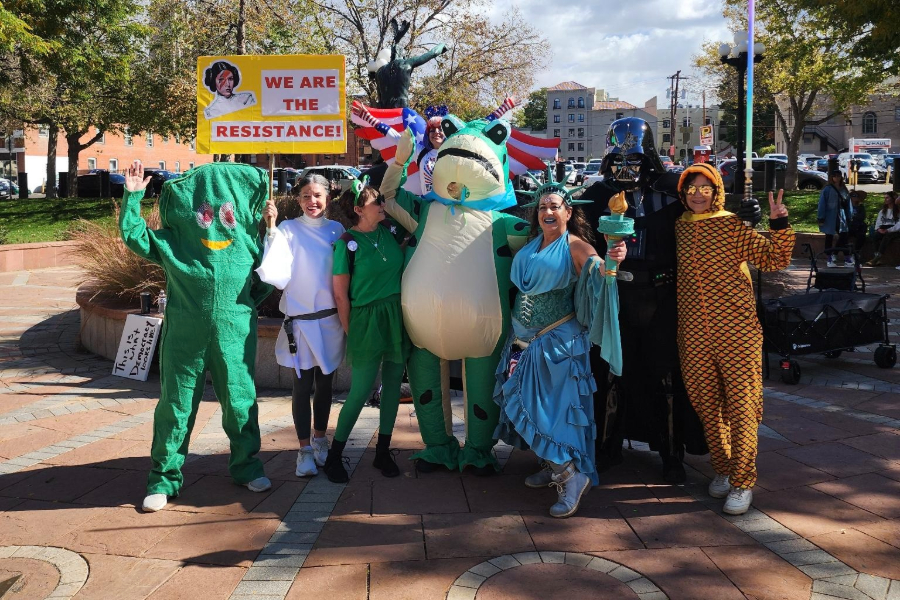
Courtesy of the Colorado Bridge Trolls
He was excited to suit up, too, but didn’t know how he wanted to dress. He thought a giant robot might fit with his neon signs. But after looking at costumes sold online, he ended up buying a Mandalorian helmet from the Star Wars franchise on Amazon.
“It was too small, because I have a big head,” he says. “The Vader helmet was the first one that fit my head, so I went with that.”
At first, Rich had just the helmet, but he soon made his own red lightsaber, bought a custom-made black cape, and obtained the rest of Darth Vader’s exoskeleton-like suit. Although Rich puts Trump and Vader in the same category of “bad guys,” he says his costume is just for fun, and not to make any political statement.
“It’s not too serious. If the Mandalorian fit my head, I’d be in a full Mandalorian suit,” he notes. “At night, the lightsabers are really bright. I’ll usually hand out a couple, and people get really into twirling them.”
Meanwhile, Rey wanted to embrace her Mexican roots and life in America. Día de los Muertos, the Mexican holiday held in November to honor deceased relatives, is “very important” to her, she says, but she also liked the idea of a Latina Lady Liberty welcoming immigrants to the U.S. So she combined the two styles, using masks and face-painting. A former Renaissance Faire regular, she also sewed the costume of Lady Liberty and dyed it copper green.
“I think those costumes really translate across language barriers, especially Lady Liberty,” she says. “It also works to de-escalate, and it helps keep solidarity with all of us. It could be a metaphor, like I felt it was in my case. It’s empowering.”
The costumes also added to the fun of the Trolls events, giving her a feeling of “channeling anger into hope,” Rey explains. “If you come to one of them and we’re all there, you’ll find that it’s really joyful. We have to look at the terror we’re facing with some kind of ability to not shrug it off, but to have some sort of light or hope. It really does help when you have some kind of hope.”
As the Trolls began dressing up, “we had quite a few more regulars join,” Crystal says. Although she’s never donned a costume herself, she took on the planning and announcements for their events.
The Bridge Trolls were meeting as many as three times a week, and Crystal and Lori went from being the only regulars to seeing the core group grow into a few dozen people. Ready to hand over the baton, Crystal appreciated the steadier presence of others.
“I was feeling pretty burnt out,” she says. “Luckily, there were quite a few people willing to fill in and be a regular presence. …I learned from the whole evolution of the group that you can’t wait for someone else to tell you what to do in a situation like this. You have to take the initiative and learn as you go.”
Trolling at a Whole New Level
In August, Trump deployed the National Guard into Washington, D.C., and residents began protesting, including one man who threw a Subway sandwich at the face of a federal immigration agent. Others wore costumes.
Denver resident Sarah Huston followed the coverage, and she couldn’t help but laugh at a photo from D.C. of a protester being arrested while dressed as a banana.
“It’s been such chaos for the last year,” Huston says. “That’s when I decided, I’m not going to break any laws — but if I get arrested for some BS charge, I want whoever’s arresting me to feel like an idiot.”
Huston had been attending rallies and marches “out of the gate” from the time Trump returned to office in January 2025, but by the time she saw the banana, Denver protests had lost their momentum. The Colorado Bridge Trolls were just starting to pick up steam, though. When Huston saw a public invitation to bring her favorite costume and prepare to dance on an overpass, she bought a $30 taco costume from Walmart to embrace “Trump Always Chickens Out” (TACO) — and went right over.
“We had a great time,” she says of her first experience. “Hearing all the mad honking, I really saw the value in what we were doing.”
Erica joined that same month, after she saw an announcement for the Bridge Trolls on the website Mobilize, where anyone can post details for an upcoming protest. She saw that the rally was right by her house and recommended costumes, but the biggest draw was the music. “I remember thinking, ‘Well, that looks kind of cool,'” she says. “And yeah, it was so much fun…they’re just a really fun group.”
Erica and Huston kept coming back. Erica would come wearing a blue-and-white tutu with stars and stripes, which is now her signature outfit, even though she’ll occasionally borrow one of Lori’s mushroom costumes. As summer passed and fall arrived, the costumes were even handier because of how warm they were, but the Trolls also believed in the power of protesting that way.
“I believe we can take the country back if we can stand up to him, so I run around in a taco costume. Plus, I love the way it makes people laugh. I like to put smiles on faces.”
Huston, protester
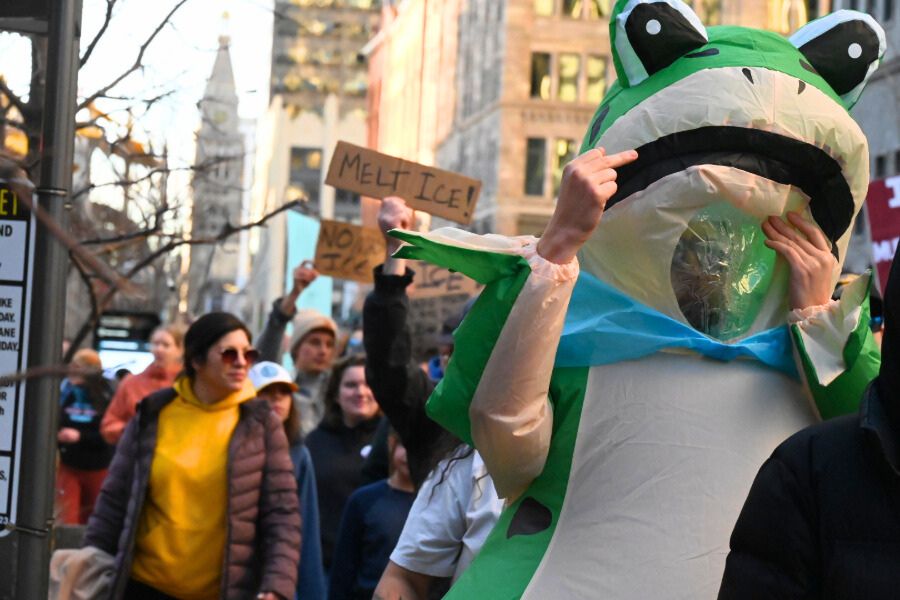
More people believed in the power of costumes after protests against ICE in Portland, Oregon, in early October. While standing in front of a row of immigration agents at an ICE facility, a man dressed in a tall, inflatable frog costume was pepper-sprayed through the costume’s air vent by an officer. The videos and images of a puffy, cartoonish frog being met with aggressive violence appeared on national news and became a symbol of what Rey calls “tactical frivolity.”
The Portland frog incident came just a couple of weeks before a nationwide No Kings 2 protest in October. In Denver, the protest drew an estimated 8,000 people — some estimates put the number far higher — and costumes were noticeable in the crowd. Some members of the Colorado Bridge Trolls showed up with speakers, dance moves, signs and costumes for drivers passing down Lincoln Street. Rich appeared to be the only Darth Vader, but there were plenty of Lady Libertys, with Rey among them. Other protesters, including Trolls and non-Trolls, dressed up like characters from South Park, unicorns, a lobster with a guitar (i.e., a “rock” lobster), and an axolotl, a rare and endangered amphibian from Mexico.
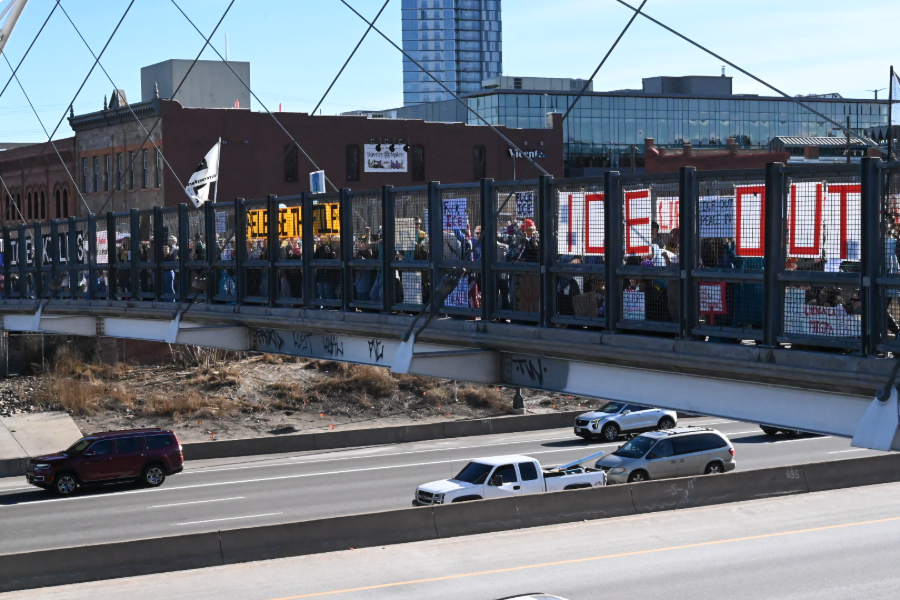
Bennito L. Kelty
But No Kings 2 was the last protest that saw a large turnout in 2025. At the same time, the Trolls were winding down for a couple of months as the weather got colder and the holidays approached. In November and December, they went from organizing three events a week to three or five a month, Lori says.
The group’s targeted issues became more diverse with more members. Protesting ICE was still a constant theme, as agents had detained more than 70,000 people and deported more than 600,000, including more than 3,000 in Colorado, by the end of the year, according to the American Immigration Council and the Trump administration’s own numbers.
Rey says she was most upset by the loss of women’s rights, while Erica protested for human rights and Huston said that protecting democracy worldwide was her biggest priority.
Standing Up to Immigration Enforcement
Immigration enforcement stayed in the headlines, though. In December, Trump initiated Operation Metro Surge, a large-scale immigrant enforcement campaign in Minneapolis. As in Los Angeles in June and D.C. in August, Minneapolis residents responded with protests, and federal agents responded with violence — but this time, it was fatal. When activist Renee Good, a Colorado native was fatally shot on January 7, thousands of Denver protesters rallied at the Capitol on January 9 to show their anger and sorrow.
The Colorado Bridge Trolls held their own protest on the Highland Bridge, and Lori says that more than 400 people turned out. She had to lead a chunk of them onto the nearby 15th Street overpass because they couldn’t all fit on the Highland Bridge. According to Rich, it was the most energized response to a Bridge Trolls protest.
“The honks per minute, you’ve never heard it before in your life. People are laying on their horns,” Rich says. “Old people were dancing. The energy was incredible.”
Then federal immigration officers killed Alex Pretti, a VA nurse and activist whose parents live in Colorado, on January 24. Pretti’s death was followed not just by one night of protests, but an entire weekend of demonstrations including a vigil by the Aurora VA facility, businesses across Denver going on strike, high school students walking off campus and marching through downtown, and speeches and rallies at the Capitol, La Alma Lincoln Park and at the Cherry Creek headquarters of Palantir.
Of course, the Colorado Bridge Trolls had to get in on the action. By that time, they had hosted about 100 events, including protests on bridges, street corners and with the larger crowds at the Capitol.
They returned to the Highland Bridge, their “favorite,” according to Lori. The turnout was again large enough that they spilled over to the 15th Street overpass when the bridge became stuffed with people of all ages grooving and waving. Rich’s playlist, loud enough to drown out the rising tide of repetitive “beep, beeeep” from below, made for quite the show for those driving along Central Street.
Many protesters on the bridge didn’t have a way to tie their signs to the chain link perimeter, so they held them up by pressing the signs with their palms, often striking up conversations with the person next to them stuck doing the same. Some passersby stopped and took pictures, letting their children meet Darth Vader or stare at the giant taco wagging back and forth. Groups of young, smiling walkers changed their course to see what was going on. Some never left, or just came back with their own signs.
After a year of setting out to have fun while standing up for what matters to them, the Colorado Bridge Trolls seemed to have found a way to bridge joy and resistance, while still focusing on the real issues.
“It’s a whole different atmosphere after Renee Good was killed, after Alex Pretti was killed,” Rich says. “As much as people are scared of the administration, I’d be scared of the masses that are changing their minds.”