
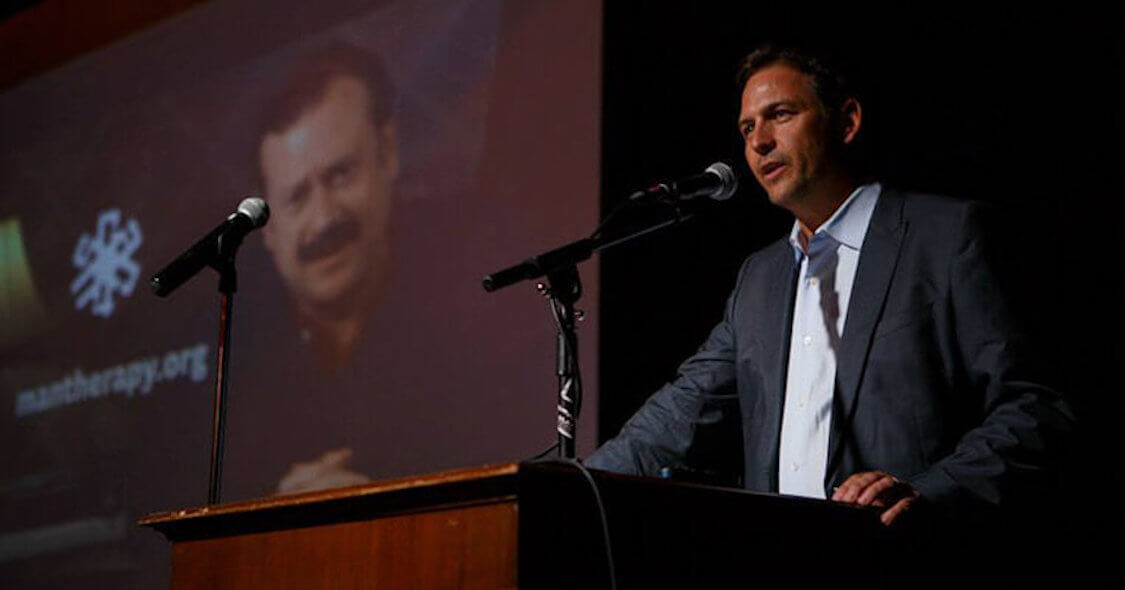
Courtesy of Trip Starkey

Audio By Carbonatix
Independent Journalism in Denver Needs You
We need to raise $25,000 by August 9 to support the reporting our community depends on. Reader support keeps us independent and is playing a larger role in funding local journalism and shaping what comes next. If you believe independent local journalism matters, make a contribution today.
Approximately 15 years ago, Joe Conrad made a startling discovery. Men were in crisis.
The problem wasn’t a lack of mental health resources for men. It’s that they weren’t finding or using them.
Conrad, founder and CEO of Cactus, a Denver creative and advertising agency, isn’t a therapist or psychologist. However, what he does know better than anyone is how to reach an audience – especially a resistant one.
The missing piece in reaching men who are struggling? Humor. Irreverence.
If you wait until a man is in crisis, you are too late. So he founded Man Therapy, “the manliest tool for men’s mental health.”
It’s a campaign that turned into an online repository of resources about anger, suicide, trauma, grief, stress, sleep, firearm safety and anxiety. On the website, men can take a free quiz called the “20-PT Head Inspection” that will provide insights into their mental health and find a directory of crisis support resources and therapists or read testimonials from men who have struggled.
But this isn’t your typical mental health resource. The landing page on anxiety starts like this: “If you’ve still got hair, don’t tear it out.” Or, scrolling down: “Anxiety: When worry grabs you by the balls.” The face of the website is Dr. Rich Mahogany, a fictional therapist delivering the messages. He’s a real man’s man, loosely modeled after Ron Swanson, the “Parks and Recreation” character made famous by Nick Offerman. Stoic, deadpan, at times crass, he’s going to tell it like it is. But he also cares.
The origin story
Conrad founded Man Therapy with the support and guidance of two others: Jarrod Hindman and Dr. Sally Spencer-Thomas.
Hindman first became involved with Man Therapy through his role at the Colorado Department of Public Health and Environment. As the new director of the Colorado Office of Suicide Prevention at the time, he was looking to fill a major gap: Men made up the vast majority of suicide deaths in Colorado, yet there were no initiatives tailored specifically to them. He connected with Conrad after hearing him speak about public health marketing.
Similarly, psychologist and suicide prevention expert Spencer-Thomas knew that a big part of the population was slipping through the cracks. When she lost her own brother to suicide, it ignited an even bigger desire to help.
Money to fund the campaign was tight. Hindman had about $10K through a grant, but it didn’t even come close to what was needed. Conrad wasn’t deterred. He decided his agency would execute much of the campaign pro bono as a passion project, calling in favors to anyone in their network.
Hindman, Conrad, and Spencer-Thomas then began collaborative whiteboarding, strategy discussions and fundraising, ultimately forming a public–private–nonprofit partnership that led to the creation and launch of Man Therapy in 2012.
The problem persists
Earlier this spring, Conrad attended the National Council for Mental Wellbeing conference held in Denver. As he scrolled through the agenda sorting by topic, he saw it all: youth health, senior health, but no category for men.
Colorado consistently has one of the highest suicide rates in the nation, which Hindman attributes to a number of factors, including a shortage of mental health professionals. In rural Colorado, “we still embrace that cowboy mentality,” he says. “If you’re suffering, pull yourself up from your bootstraps and muscle through it.”
“Masculinity and how we’ve defined it contribute to a lot of really good in the world, but it also has contributed to men waiting until any health problem becomes a crisis,” Hindman adds. “Far too many men are dying before there’s ever even a chance to get help.”
Messaging
Spencer-Thomas says part of the problem in the past with mental health campaigns is that the mental health professionals are writing the messaging. “We don’t know how to communicate with the public about mental health,” she says. “But marketers do.”
Spencer-Thomas’ work focuses on men in the construction industry, an audience that is particularly hard to reach, and she learned a lot about how to approach a male audience by asking them directly. “They said, ‘Come softly at us with mental health language. We don’t see our challenges through a mental health framework. We don’t see ourselves as having depression, so seeking help in the traditional form isn’t going to help us,'” she says. “They told us, ‘We will listen if you make it funny.’”
Hindman, who today serves as CEO of Sources of Strength, a suicide prevention and mental health organization, shares the same sentiment, pointing to messaging as the most important element of Man Therapy.
“It’s not uncommon for messages in suicide prevention to be ‘it’s okay to ask for help’ and ‘seek help when you’re struggling.’ But, asking for help doesn’t fit the traditional ethos of maleness,” he says.
The brass and cheeky tone of Man Therapy’s messaging didn’t always land with mental health providers, who told Spencer-Thomas that you can’t make fun of something that is not funny. She pushed back. “But you haven’t been able to reach them yet,” she says. “This is what they tell us will reach them.”
Conrad says if anyone tells him the campaign is making light of mental health, he just smiles, nods, and gently pushes back: “Maybe this ad isn’t directed toward you. You don’t want to shock them, but we do need to engage them. We have evidence our approach works. It’s why we are successful.”
Don’t just talk about your feelings – read about them
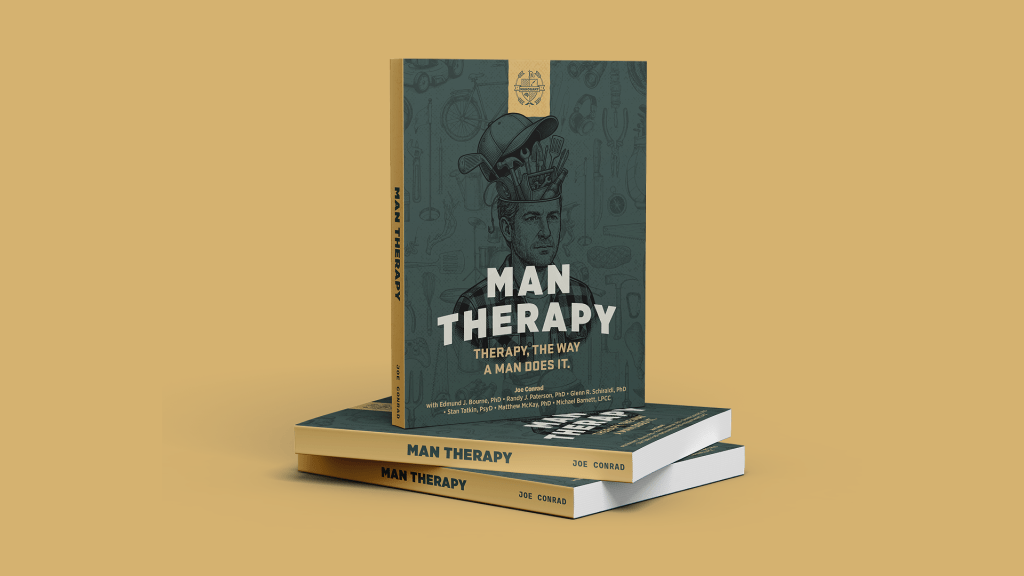
Trip Starkey, Man Therapy
The next chapter in the Man Therapy story is actually a full book, “Man Therapy: Therapy the Way a Man Does It,” which was released earlier this summer by New Harbinger Publishing.
The book has seven chapters, including “Chapter 4: Depression – You Can’t Rub Dirt on Your Feelings” and “Chapter 6: Impulsive Behavior and Addiction – Kick the Habit Before It Kicks Your Ass.” The book is written by Conrad, with contributions from professors, psychologists, therapists and more.
Although Man Therapy is primarily a digital platform, Conrad said it was time for a physical tool. He wanted to bring a clinical lens to it and put together a comprehensive guide for what men typically experience.
The book’s intent is to break mental health stigmas early, provide easy to follow advice, and serve as a pep talk for men about why taking care of mental health is the manliest thing a guy can do.
Man Therapy’s impact
A four-year, $1.2 million CDC-funded study found that Man Therapy not only reduces depression, suicide risk, and bad mental health days, it also improves help-seeking behavior in working-age men.
A frequent keynote speaker, Spencer-Thomas says when she talks about Man Therapy publicly, she receives feedback – often from women – who say they’ve shared the resources with their brothers and husbands. She feels strongly that if her brother had access to Man Therapy, he would have had a fighting chance at surviving because he felt so alone in his shame.
And Conrad knows the campaign works because he hears directly from those who have been impacted by the resources. There was the platoon leader in Louisiana, deployed, who sent a two-page-long email about what Man Therapy has done for him; the woman in California who said nothing had ever worked with her twenty-something son, but the website clicked with him; the voicemail from the man in Kalamazoo, Michigan, who broke down crying, saying “your website saved my life tonight.”
When he founded his ad agency Cactus, Conrad’s goal was to give a more powerful voice to campaigns that matter. “We’ve proven that creativity can solve problems. Young men are struggling. The world has never needed Man Therapy more. The campaign is living proof that when people come together against all odds, it can have an amazing impact.”
“Man Therapy: Therapy the Way a Man Does It” is available on Amazon in paperback, Kindle or audiobook. Watch the book trailer here.