Photo by Emily Ferguson

Audio By Carbonatix
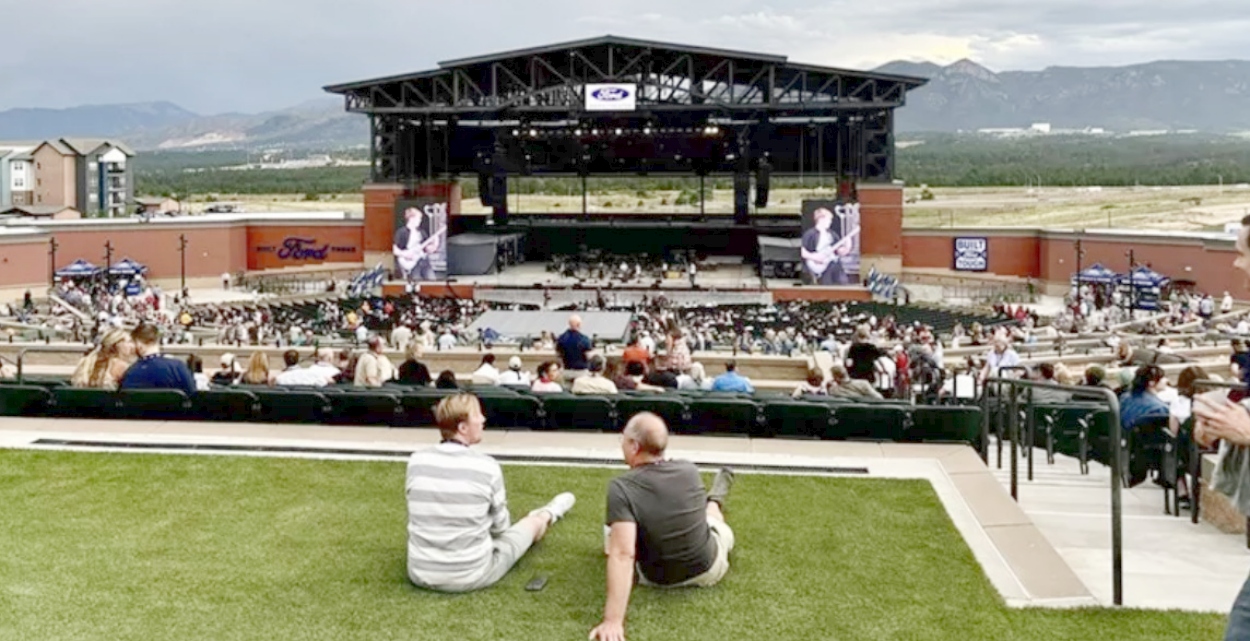
A March 12 Colorado Senate hearing promises to kick up quite a racket — and not only because the subject is a possible change to the state’s noise ordinance. Attendees are expected to include folks who already feel the sounds in their neighborhood are too loud, including members of the grassroots Ford Hurts Families organization currently suing the owners of acclaimed Colorado Springs concert site Ford Amphitheater over their alleged unwillingness to dial down the music.
A February 21 Ford Hurts Families post entitled “Speak Now or Forever Live With Blank Checks for Unlimited Noise” describes the proposal, Senate Bill 26-098, as an attempt by “Big Entertainment” to “forever allow local governments to grant blank checks for unlimited noise. This is not a minor policy tweak — it is a fundamental rollback of uniform statewide noise pollution safeguards that have protected Coloradans for over 50 years.”
Senator Matt Ball, a Democrat representing District 10 in Denver, is a co-sponsor of the proposition, and he characterizes it very differently. In his words, “Senate Bill 98 restores local control over noise regulation. For decades, cities and towns across Colorado had the authority to issue noise permits for specific events. That longstanding practice changed after the Colorado Supreme Court’s ruling in Hobbs v. Salida last year, which limited local governments’ ability to grant those permits to private parties.”
Ball adds that “the proposal came to me from the Colorado Municipal League, which represents cities and towns throughout the state. I’m not sure who opponents mean by ‘Big Entertainment,’ but I haven’t had conversations with any entertainment companies or industry groups about this bill.”
VENU, Ford Amphitheatre’s owner that is also in the process of creating a major venue in Centennial, did not respond to questions from Westword. But the “About” section of its website bears the banner “Disrupting the Music Industry,” and maintains that “we exist to create extraordinary experiences that resonate deeply with the people who matter most: our community.”
Ford has certainly made a splash nationally. Last month, the music trade magazine Billboard named it one of 2026’s top venues, alongside the likes of the Las Vegas Sphere and London’s O2 Arena. But when Ford debuted in August 2024 with OneRepublic as its headliner, the gig reportedly generated 144 noise complaints.
Since then, plenty of major acts have performed at Ford (capacity: 8,000), including Beck, Leon Bridges, Miranda Lambert and legacy outfits such as Foreigner and Chicago — and the criticism of their clangor has continued unabated, too, as noted by Ford Hurts Families. An unnamed spokesperson for the group responding to Westword‘s questions via email notes that “despite this groundswell ongoing response by ordinary residents from all walks of life, the real story here is not about any group of responders — it is about the unjust, unfair harm that families in pre-existing neighborhoods are experiencing at the hands of relentless amphitheater noise pollution, and the failure of their local government leaders to protect the citizens they were elected to serve.”
Similar assertions can be found throughout the lawsuit against Ford, filed on behalf of eight named individuals. One section reads: “Plaintiffs purchased their homes and raised their families in these communities years, sometimes decades, before the amphitheater opened. They did not move to a concert venue; a concert venue moved to them. Now, families who invested in the tranquility of these neighborhoods find themselves unable to escape noise pollution that exceeds state law by multiples — 1,000% to 10,000% in sound level — and that has deprived them of the comfort of their homes.”
The complaint’s examples of harm include “a mother forced to medicate her autistic son and place him in a sensory room with noise-cancelling headphones during concerts to prevent manic episodes; a disabled veteran with a diagnosed anxiety disorder who must flee his own home for hours on concert nights; schoolchildren unable to sleep on school nights because of thumping bass and profanity-laced lyrics audible through closed windows; people unable to use their own personal indoor spaces because of invasive pollution.”
Debate over sound levels in the residential areas around Ford have raged for years. The amphitheater’s builders promised that neighborhood levels would typically top out at 47 decibels, under the 50 decibel limit established for the hours of 7 p.m. to 7 a.m. by the Colorado Noise Abatement Act — and a Colorado Public Radio report revealed that an independent study conducted in 2024 by Wisconsin’s Hankard Environmental Inc. found that Ford complied for the most part, with a handful of exceptions. But readings taken by lawsuit plaintiff Danielle Frye have been consistently higher: 70 decibels for a Dwight Yoakam concert in May 2025, 71 decibels for a Red Clay Strays show that September. And submitted as part of the suit was a June 2025 recording from the backyard of one resident that captured Three 6 Mafia repeatedly shouting “fuck that shit…fuck that shit…fuck that shit.”
According to the Ford Hurts Families rep, the state legislature needs to address the following issues when considering the bill.
- This is about pollution, not “local control.” Noise is legally recognized pollution that impacts public health and the environment. It does not stop at city boundaries.
- The [Colorado Noise Abatement Act] already allows true local flexibility. Municipalities and nonprofits are exempt from statewide limits if they co-sponsor events and accept noise responsibility. That balance has worked for generations.
- SB26-098 expands exemptions from noise limits to for-profit commercial entities. It would allow private corporations to bypass statewide pollution limits through local government permits. There is no limit to the noise levels, duration, and frequency of events that could be allowed through local government permits, if SB26-098 is enacted. If passed, harmed residents will have no legal recourse.
- In the 2025 Hobbs v. Salida case, the Colorado Supreme Court warned against an exemption that “swallows the rule.” This bill risks eliminating meaningful statewide limits in practice, resulting in a patchwork of noise limit jurisdictions across Colorado.
- If enacted, the bill would strip residents, already in court, of their [Colorado Noise Abatement Act] legal protections mid-dispute. Changing the rules now undermines public trust in the rule of law.
Along with Ball, the original sponsors of SB 26-098 were Senator Larry Liston, a Republican representing District 10 in Colorado Springs, and Representative Gretchen Rydin of District 38, which encompasses parts of Littleton and unincorporated Jefferson County. Liston hasn’t responded to Westword‘s questions, but Rydin corresponded via email on March 2, pointing out that “as a former city council member, I value local control, especially when it comes to creating space for culture and fun.” She then added, “I think the opponents’ concerns are valid. Citizen voices matter. I’ve learned more about the backstory to this lawsuit in the last week than I knew before I signed onto the bill. As you know, the bill is starting in the senate, so I am keeping a close eye on what is happening there. If it makes it to the house, I will be very open to compromise.”
Three days later, on March 5, Rydin followed up with an email sharing the names of two “new co-prime sponsor(s) in the House,” Representative Mandy Lindsey, a Democrat for District 42 (Aurora), and Representative Max Brooks, a Republican for District 45 (Douglas County).
As for Ball, he acknowledges that “I wasn’t aware of the Ford Amphitheater situation until after the bill was introduced. I understand the concerns raised by residents in north Colorado Springs, and I’m sympathetic to them. Ultimately, Senate Bill 98 isn’t about the noise levels at any single venue or project — it’s about who has the authority to decide what those noise levels should be. Colorado’s communities have different needs and different expectations. I believe those decisions are best made locally, by elected officials accountable to their own residents, not by the state.”
The Ford Hurts Families spokesperson counters that everyone backing the bill “needs to realize what they are doing, honestly look themselves in the mirror, and face the reality they have created: Is relentlessly harming hundreds or thousands of innocent Colorado families why you come to work each day? Is this the legacy you want to leave?”
The hearing on Senate Bill 26-098 is scheduled for 1:30 p.m. on Thursday, March 12, before the Colorado Senate’s Local Government and Housing Committee.
Click to read the January 2026 lawsuit against the owners of Ford Amphitheater.