


Audio By Carbonatix
Has “Black Mirror” taught us nothing?
A 2013 storyline from the dystopian television show is now reality: Tech companies are selling chatbots to grieving individuals to imitate conversations with dead loved ones. The so-called “generative ghosts” or “griefbots” use artificial intelligence trained on the deceased’s social media posts, voice recordings, photos and even journal entries, through platforms like Project December, Seance AI and Super Brain.
Researchers at the University of Colorado Boulder are conducting the first-ever user experience studies of the chatbots, according to the university. The initial findings were surprising, say the researchers, who authored a study published by the Association for Computing Machinery in June.
“We originally thought it might feel very ‘Black Mirror’ creepy to people and make them uncomfortable,” study author Jack Manning said in a CU release. “I ended up being completely wrong. People thought it was amazing.”
Researchers recruited 16 participants aged 22 to 50. They each lost a close family member or friend, some less than a year ago, some more than 20 years ago.
Participants chatted with two iterations of the AI ghost for 20 minutes each: one speaking in first person as if it were the deceased, and the other using third person, referring to itself as a representative of the deceased. The study found that users preferred the first-person chats, called the “reincarnation” version.
Some participants reported that the illusion was shattered when the AI used the wrong nicknames or phrases. However, others earnestly spoke of the chatbot as if it were their loved one communicating from the grave.
“Thank you for following through on your promise to visit me. It was so, so powerful,” a 50-year-old woman who lost her grandmother reportedly said, referring to a childhood conversation in which her grandmother promised to come back after her death. “I’d like for you to come to me again.”
A 32-year-old woman who also lost her grandmother reported: “It just feels like I’m getting the closure I needed so bad. … I can see her. I can feel her.”
When asked if they would use the technology again, all of the 16 participants said yes, according to CU. Though some expressed concern over how repeated use would impact them, and nearly all feared how it would impact other people struggling through the grieving process.
“I don’t know if I would like the person I would become if I kept using this always,” a 23-year-old man who lost his stepfather told researchers.
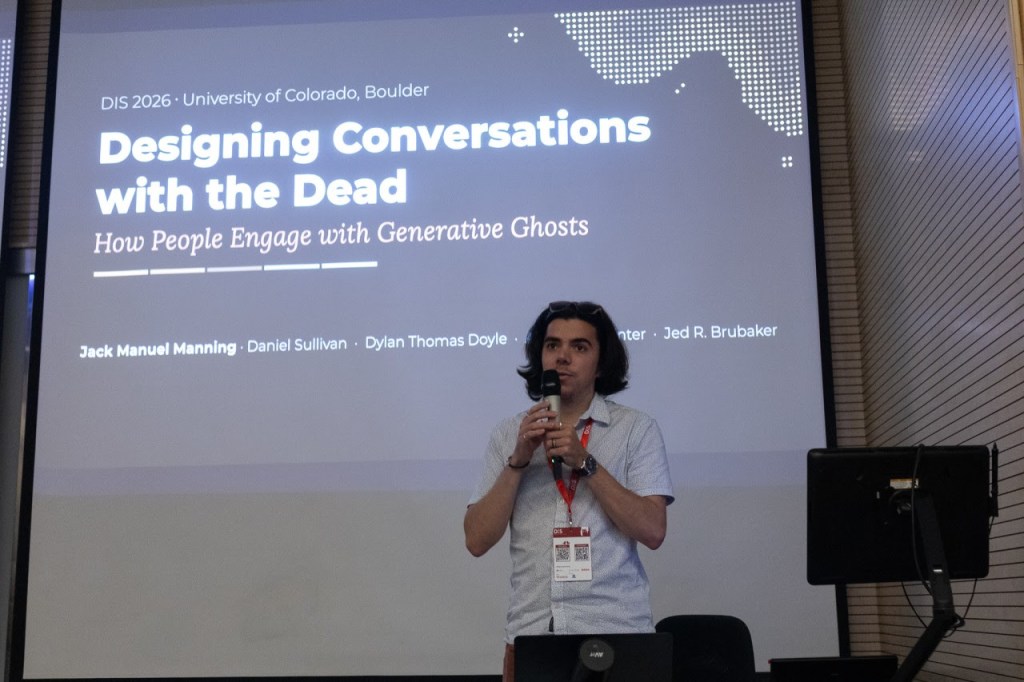
Jack Manning via the University of Colorado Boulder
Critics have raised concerns about tech companies financially exploiting vulnerable people in mourning. Others fear the isolation and social stigma that developing intimate relationships with AI can lead to, as is the case of an Aurora man’s years-long romantic attachment to an AI companion. In addition, mental health experts warn of growing reports that extended chatbot use may trigger or amplify psychotic symptoms in some people.
However, advocates insist AI is a helpful tool to manage grief. Some people facing health challenges have even turned to preemptively creating virtual personas to comfort their children once they die, uploading their favorite memories and pre-recording speeches for weddings and graduations they won’t live to see on platforms like HereAfter AI and StoryFile.
“We anticipate that within our lifetimes it may become common practice for people to create custom AI agents to interact with loved ones and the broader world after their death,” study author Jed Brubaker said in the release.
Researchers have already begun the next studies, including one analyzing the mental health impacts of interacting with AI ghosts.
All of the researchers involved with this initial study have personally experienced the death of close loved ones, it notes. Manning’s sister died from a heart condition when they were children, according to CU.
“I think a lot about 11-year-old me. If I had access to ChatGPT and it started responding as my sister late at night without supervision … that is a very scary thought,” he said. “But as we have learned through this paper, it can also be an incredibly meaningful experience for people that enables them to get some closure and peace.”
The study stresses the need for “cautious, intentional development of generative ghosts,” concluding that “intimacy cannot be offered without risks.”