
RDNE Stock Project

Audio By Carbonatix
More than 11,000 people are currently suing hair relaxer companies, claiming that chemicals in the hair-straightening products gave them cancer.
Now, Colorado legislators are moving to alert residents about the dangers of such products. If made law, House Bill 26-1135 would require manufacturers to add warning labels to hair relaxers and synthetic or natural hairpieces to inform buyers if the products contain an intentionally added carcinogen or reproductive toxicant.
“This is, at its core, a women’s health and consumer protection issue,” state Representative Regina English, a lead sponsor of the bill, said during the House committee presentation. “Women should not have to rely on investigative reports or scientific journals to understand the potential risks of products they are encouraged to use as part of routine grooming and cultural practices.”
The issue was brought to public attention in 2022, when researchers with the National Institutes of Health published a study showing that women who frequently used chemical hair relaxing products were more than twice as likely to develop uterine cancer as those who did not.
State rep Junie Joseph, another bill sponsor, said she had long used synthetic hairpieces, but only found out about the potential health risks last year.
“Everybody wants to look cute, but they don’t want to die looking cute,” Joseph said. “Hair relaxers and synthetic hairpieces are disproportionately marketed to and used by Black women and other communities of color. We have a responsibility to ensure that transparency and consumer protections reach communities that have historically experienced higher cumulative exposure to harmful chemicals.”
The bill unanimously passed the Senate Business, Labor & Technology Committee on Tuesday, March 31, without discussion. Senators added the bill to the consent calendar, meaning it is all but guaranteed to pass the full Senate when it reaches the floor for a vote in the coming weeks.
However, the proposal faced a rougher road in the House of Representatives, where it passed in a 42-20 vote.
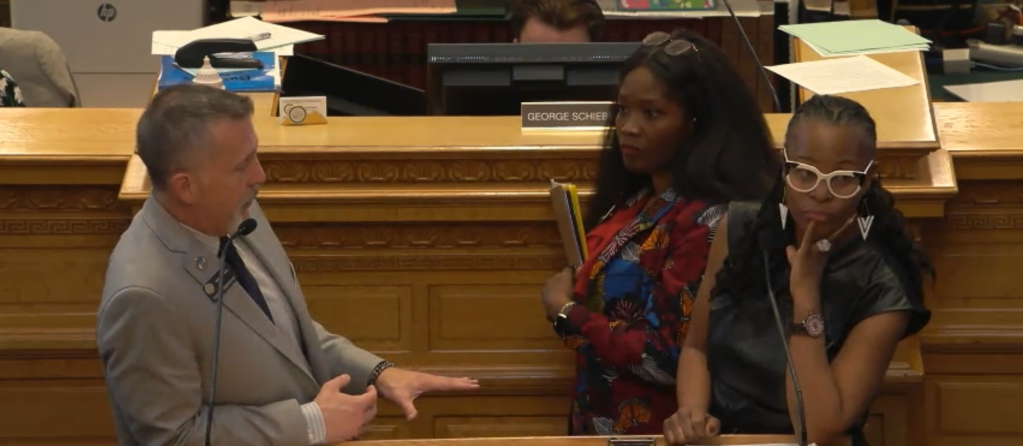
Republican Representative Max Brooks was the sole “no” vote against the bill during the House Business Affairs & Labor Committee on February 26. He argued that it could lead to increased costs for consumers if manufacturers are fined for failing to add warning labels. Under the bill, violations would constitute a deceptive trade practice, so the attorney general could pursue civil penalties against manufacturers.
The Colorado Channel
“Might we be, through this legislation, swapping one item of disproportionality with another?” Brooks said, further arguing that warning labels are ineffective because he doesn’t read labels on his food. “Do we really think that folks are going to pay attention? …I went and got some sort of prepackaged stuff. I didn’t pay any attention whatsoever to what was on the label. I just ate it because I was hungry.”
Nineteen other Republicans joined Brooks in voting against the bill on the House floor. The bill is sponsored by four Democratic women.
Despite the conservative complaints, the bill sponsors maintain that the proposal is essential for protecting the health of all Coloradans, and particularly Black women.
No organizations registered in opposition to the bill, according to the Secretary of State’s Office. The Women’s Foundation of Colorado and Heritage Action for America are both registered in support.
“The benefit far outweighs the cost,” Joseph said. “Real lives are at risk.”