Bennito L. Kelty

Audio By Carbonatix
Denver City Council moved forward a law on Monday, February 23, that bans agents from Immigration and Customs Enforcement (ICE) from wearing masks or covering their face while operating in the city.
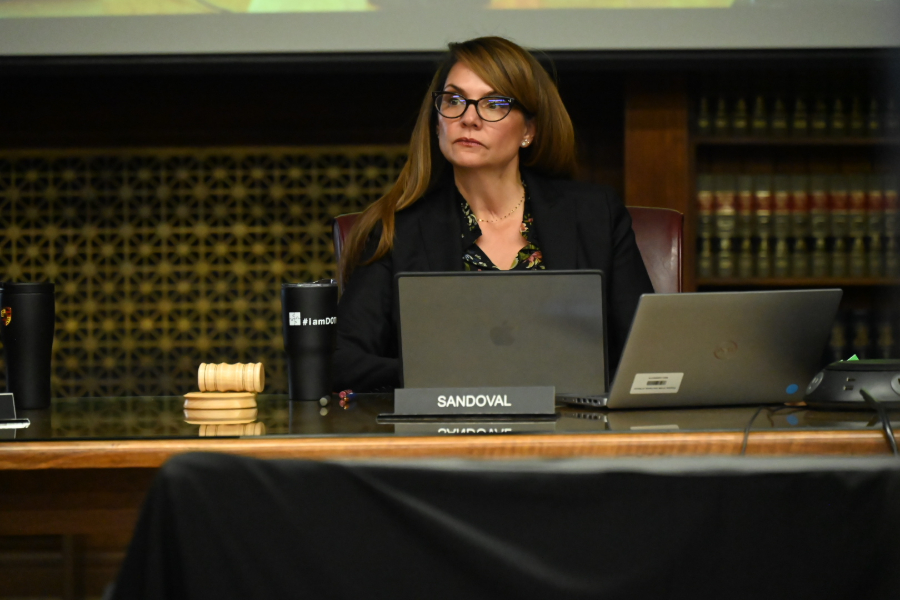
“One thing our community wants is action,” said Council President Amanda Sandoval. “This isn’t controversial. We just want it to be operational.”
The mask ban needs one more vote from council, scheduled for Monday, March 2. It would immediately go into effect with a signature by Mayor Mike Johnston after that vote, Councilwoman Sandoval said.
The new law would apply to ICE as well as any other federal or local law enforcement, including police, sheriffs and state troopers.
Councilmembers first considered the mask ban on January 12, shortly after the fatal shooting of Renee Nicole Good, an activist who was shot and killed by ICE agents in Minneapolis.
At a January 12 Budget and Policy Committee, councilwomen Flor Alvidrez and Shontel Lewis presented the mask ban as a way to respond to fears in the community after violence in Minneapolis, which also to the death of activist Alex Pretti. Alvidrez on Monday said she had been working on the bill since July despite only recently presenting it.
Questions about how the policy will be enforced still remain. Jon Griffin, a deputy legal counselor for city council, said that in theory, Denver Pplice Department officers would arrest ICE agents if they were unmasked, but councilmembers worried that would create more problems.
Denver Police Chief Ron Thomas said in a February 5 article by the Denver Gazette that “fundamentally, I agree that [ICE] shouldn’t be wearing masks,” but in practice, “I don’t necessarily think that it is best to meet force with force.” He has also said that DPD officers would intervene to stop a federal agent using excessive force.
Councilwoman Lewis said the idea for a mask ban came from similar laws in California, the No Secret Police and No Vigilantes acts, which have both been defanged or held up through court challenges.
A federal judge blocked the mask-banning portion of the No Secret Police bill on February 6, and a federal appellate court stopped the No Vigilantes Act on February 19 by ruling in favor of a temporary injunction, which has stopped it from being implemented while its court case plays out.
On February 11, the Denver Council Health and Safety committee approved the bill for a vote before the full council vote. Councilmembers also heard comments from the public during that meeting, with most people speaking in support of it.
“Public safety begins with trust in the rule of law,” said Denver resident Uriel Espinoza. “When agents conceal their identity, it creates fear and invites confusion.”
Councilwoman Lewis said at the February 11 meeting that DPD would enforce the mask ban through citations instead of arrests. An ICE agent could be hit with a $999 fine or jailed for 300 days, or both. The severity of the penalty would be up to the DPD officer issuing the citation.
DPD officers would also be able to issue a citation to an ICE agent retroactively “in instances where an officer’s identity is later uncovered,” Lewis said at the February 11 meeting. She said that federal agents who fail to identify themselves to DPD officers could also be arrested on the assumption that they’re impersonating an officer.
The bill would restrict law enforcement from wearing not just masks but any “opaque mask, garment, helmet, headgear,” including a “balaclava, tactical mask, gator, ski mask” and anything similar.
Those face coverings wouldn’t be allowed during arrests, interrogations or “other activity that restrains the movement of an individual,” nor would they be allowed on city property, the law reads.
A few exceptions are in place: Law enforcement would still be able to cover their face for undercover operations, SWAT and Emergency Response Unit duties, and “tactical operations that require protective gear,” like gas masks.
Officers would be able to wear transparent masks as well as helmets that don’t cover their face, medical masks and protective eye gear, according to the law. The bill also allows an exception for hijabs and religious garbs.
Lewis defended the amendments on Monday, saying it doesn’t take away from council’s opposition to ICE tactics.
“Because we’re putting these measures in place, that doesn’t mean that we are in agreement with circumventing due process and kidnapping people in our streets,” Lewis said. “We’re trying to figure out where we have some influence and opportunity, and we’re against the inhumane treatment happening in our cities.”
Other local efforts have been made to check ICE, too. In January, the Aurora City Council passed a resolution denouncing ICE, its facility in detention facility in Aurora and the killing of Good. Last Thursday, the Denver Public School board advanced a policy that would require ICE agents present a warrant to enter DPS property or school-sponsored events.