Bennito L. Kelty

Audio By Carbonatix
The Iranian holiday of Nowruz landed on Friday, March 20, this year, marking the beginning of spring and the Persian New Year. That same day, the Colorado State Capitol’s most prolific protester, Roushan Kia, stood at the corner of Lincoln Street and East 13th Avenue with a message about the deceased Ayatollah Ali Khamenei.
“He’s not dead!” Kia told Westword. “That’s what the global media want you to believe!”
Nearly three weeks have passed since the United States and Israeli military action led to the death of Iran’s theocratic leader, whom Kia has been denouncing weekly from his spot in front of the Capitol for the past five years. Khamenei was a lynchpin in the “axis of evil,” Kia said, and terrorized the world alongside leaders like Vladimir Putin from Russia and Kim Jong Un from North Korea. Plenty of people might agree, but Kia’s belief that Khamenei is still breathing isn’t exactly mainstream.
“During Saddam Hussein, what did the U.S. do? They bring him from his hole, put him in the court and they hung him in front of everybody,” Kia said. “In Libya, Muammar Gaddafi, the same thing: The people dragged him out, killed him, and the pictures were advertised everywhere. Where is [Khamenei’s] body? I haven’t seen it.”
The U.S., Israeli and Iranian governments have all confirmed that Khamenei was killed by Israeli missile strikes on February 28. A conflict between Iran and the United States has been dragging out since then. Kia finds the ongoing military action in his native country “unnecessary,” arguing that “billionaires” are the only ones who stand to profit.
“Who does it benefit?” Kia asked. “The rich, because war is always a way for them to be more powerful. But real change has to start with the people. That’s the only way to bring about a true social revolution, which is what is needed there.”
Kia said he hasn’t missed a beat since the war in Iran started, still holding weekly protests at the Capitol. “Why would I stop? [Khamenei] is not dead” he added with a grin.
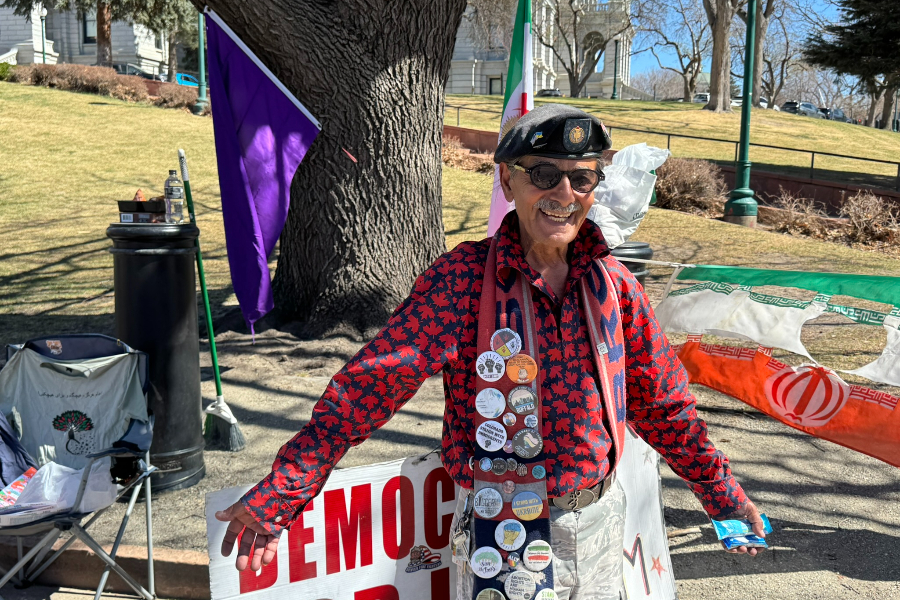
Always donning a beret and fatigues, the 75-year-old Kia has a militant look, but insists he’s out there “to educate the people.” He was born in Iran and immigrated to Denver to study electrical engineering in 1978, a year before the first ayatollah, Ruhollah Khomeini, installed an Islamic regime. According to Kia, his sister, Maryam, died after he had left the country. He’s been posting up at the Capitol in 2021, calling for regime change in Iran.
Kia said his sister was one of the first women to die during the Iranian revolution. Since then, the Islamic regime has “done nothing but beat and execute the women of Iran.”
Behind the lawn chairs where Kia sits and stacks flyers supporting women in Iran, he erects the national flags of Iran, the U.S. and Ukraine, which he supports in its war against Russia. He’ll also unfurl banners, like one that had pictures of the “axis of evil” with their faces crossed out.
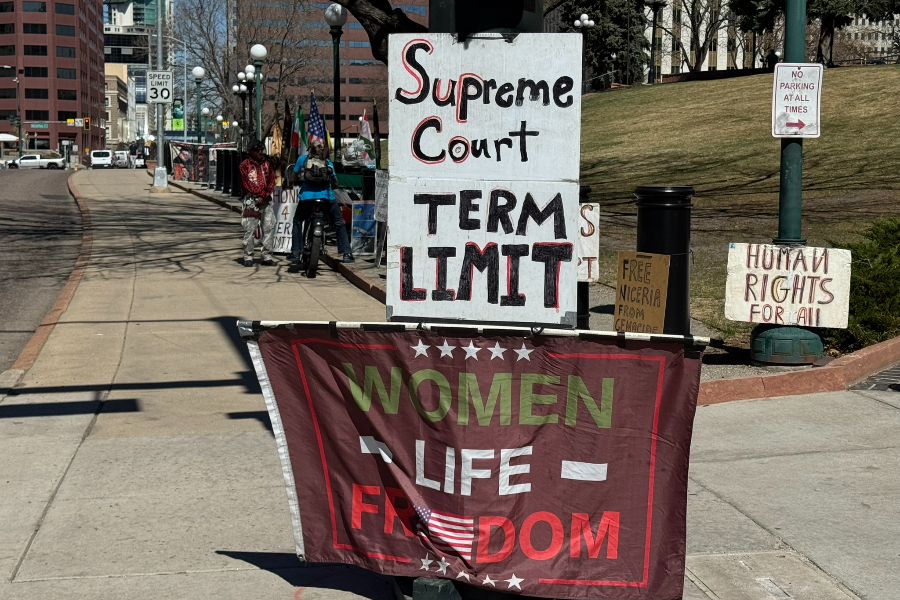
Kia displays handwritten signs with a variety of political statements, like one reading “Supreme Court Term Limit,” “Human Rights for All,” and “Free Nigeria From Genocide,” referring to violence by the jihadist group Boko Haram in the west African country. He also likes to share a 2022 Time Magazine cover honoring the “Women of Iran” as the heroes of the year. (In late 2022, Iran saw mass protests after Mahsa Amini, a 22-year-old woman, died in the custody of Iranian morality police after refusing to wear a hijab, and her death led to the start of the Woman, Life, Freedom Movement, which Kia strongly supports.)
“I wanted to see the U.S. back up the Women, Life, Freedom Movement of Iran,” Kia explained. “Five years ago, how old were those women? They were young — and protesters, millions of them, they came out into the street against the ayatollah, and they almost won.”
Bennito L. Kelty
For the most part, Kia has stuck to his normal schedule at the Capitol on Fridays, Saturdays and Sundays from 9 a.m. to 5 p.m. In the last year, he has “come out more because when there are demonstrations, I want to be here,” referring to a surge in activism since Trump
On Friday, a man walking by the Capitol with a friendly smile stopped to ask Kia, “So, what do you think about Trump going in and taking care of Iran?”
“No! They don’t! That is the fake news!” Kia blasted back. “How come Saddam Hussein was globally pictured, and Gaddafi, same thing, but they didn’t put a picture of the Ayatollah Khamenei? They are fake news!”
“Ah, I don’t know about that,” the pedestrian said. “He’s dead.”
Kia wasn’t having it, but the man kept his smile said Iran was “days away from developing a nuclear weapon, and Trump wiped it off the map,” the same justification the White House has offered for military action in Iran. Kia responded by repeating his point about Hussein and Gaddafi.
“Well, all right, I just wanted to see what you thought,” the man said before walking off. Kia continued to yell, “The Ayatollah is not dead!” at others who were strolling by, only stopping to chat with familiar faces.
For Kia, the ayatollah’s survival isn’t just a crack-pot theory, like Tupac living in Cuba. The idea that Ayatollah Khamenei is still alive scares Kia, he said, because he continues to worry for the women of Iran.
“What will happen to the women in Iran under the ayatollah? He is still around and he will continue to execute the women who lead a movement against him. The people here, you need to educate them that the women in Iran still live under the ayatollah,” Kia warned. “The U.S., if they had killed him, they would have shown us a picture, we would have seen a body, but we haven’t seen anything. What the fuck are they doing?”
Even if he sees Khamenei’s corpse with his own eyes, Kia said he will continue protesting at the Capitol.
“I would continue because my goal is not agitation,” he says. “It is education, and killing does not do that.”