
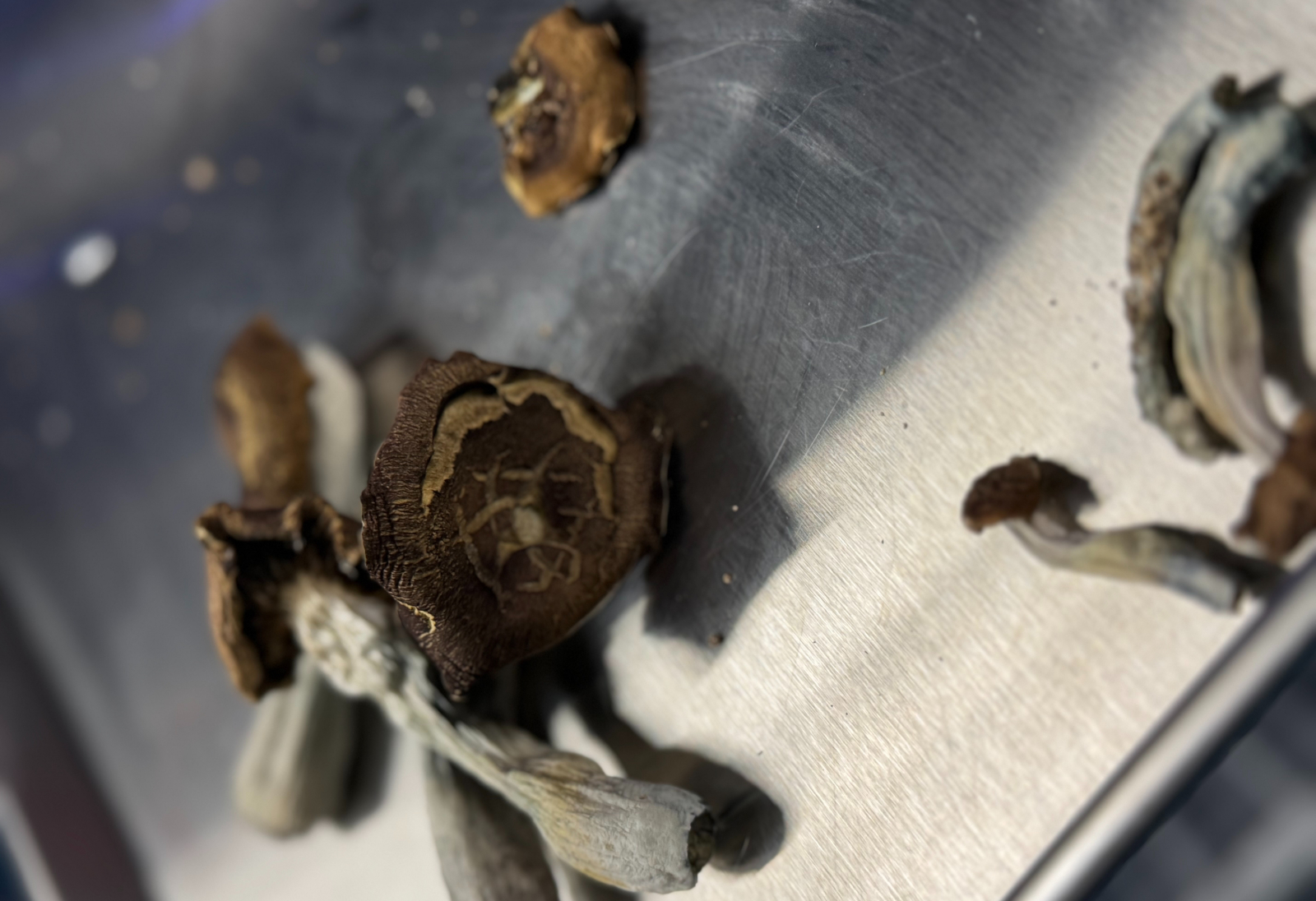
Courtesy of Psylutions

Audio By Carbonatix
Three years after voters approved the Natural Medicine Health Act, Colorado’s legal psilocybin program is moving forward carefully.
The state has decriminalized personal possession and use of psilocybin mushrooms, with a personal use space that has embraced mushroom-infused chocolate bars and gummies, similar to retail cannabis.
However, the regulated psilocybin industry treats psilocybin as a medicine, produced under strict conditions for use in licensed healing centers only. And despite public fascination with mushroom-infused gummies and chocolate bars, those products are not exactly top-of-mind.
Capsules, Not Candy
Under current rules, psilocybin product manufacturers can only make capsules and tea bags with ground mushrooms, unless they hold an extraction endorsement.
“To manufacture chocolates, gummies, pressed tablets, and tinctures, licensees must obtain an extraction endorsement,” says Heather Draper, communications manager for the Colorado Natural Medicine Division. “That endorsement involves additional requirements beyond the product manufacturing license but is otherwise available.”
Even with that endorsement, production remains very limited to a small number of operators. Psylutions, a Denver-based company founded by Rhonda DeSantis, was the first to earn extraction approval from the Colorado Natural Medicine Division, which regulates licensed psilocybin businesses.
“We’re the only one licensed in the state so far with an extraction endorsement, and we are already producing edibles using homogenized powder, not just extractions,” DeSantis says.
Although DeSantis is currently the only licensed manufacturer in Colorado producing psilocybin edibles at the moment, she says she’s not seeing much demand from facilitators for them yet, with most facilitators requesting capsules so far. For now, her team is trying to educate healing centers and psilocybin users about the benefits of edibles and extracts. According to DeSantis, extracts can be more shelf-stable, and they have the ability to retain the pharmacological signatures of a mushroom strain while removing the parts of the mushroom that are offensive to most taste buds.
Another point to consider is the cost of goods: The maximum dosage permitted per therapy session is fifty milligrams, and the raw cost of psilocybin lands between $5 to $7 a milligram. That means a max dose could be as much as $350 before any fees related to therapy and the rest of the session.
According to Ryan Phillips of psychedelic-assisted therapy clinic Transcendent Integrative Health, average doses usually land around 25 milligrams, or roughly $125 to $175 in raw mushrooms.
“Trying to roll this out in the real world has been messy, driven the cost up and reduced accessibility. We haven’t stayed true to the way the law was originally written, and bureaucracy has made this more difficult than it needs to be,” Phillips says.
In Colorado’s personal-use and gifting space, Travis Fluck of the Denver Mushroom Cooperative says he regularly gifts a 25-milligram dose’s worth of mushrooms at local events and exchanges for free. There are also underground and gray-market brands out of Denver selling the same doses in edible form for around $20 to $35, approximately $100 cheaper than the licensed therapeutic model.
The Facilitator’s Perspective
According to Skippy Mesirow, founder of Sanctum psychedelic therapy in Aspen, the precision, set and setting of a session matter most, no matter the product.
“We’d love to use whole fruiting bodies,” Mesirow says. “But the variability is so high that it can change the entire outcome of a session. Right now, capsules are the only way to be exact.”
For now, gummies and chocolates don’t fit Sanctum’s philosophy, and the demand isn’t there, either.
“The medicine and the method both matter. It’s like a three-Michelin-star restaurant, the lighting, the scent, the presentation, every detail shapes the experience,” he says. “I haven’t had a single guest ask for a [gummy or chocolate] product. People come for transformation, not candy.”
Jillian Gordon, co-founder and primary facilitator at Go Within Collective, says most people coming to licensed psychedelic clinics still aren’t sure what they’re getting themselves into as first-time users. Most of their curiosity is around the full process, not just the dosing and method, she says. Still, Gordon believes most treatment facilities would like access to all dosing methods.
“Demand may be coming from facilitators more than the public. Most people don’t even know what we do yet, so we’re still educating the public on this offering. We want the flexibility of having more options to decide how to administer,” Gordon explains. “Edibles are great for people with GI issues for example.”
Phillips says that he is seeing demand for gummies, but not in healing centers. He notes that most demand moves through the internet, with grey area brands either offering “magic mushrooms” that don’t really contain psilocybin, or true psilocybin-infused edibles flying under the legal radar.
Starting Material, Specific Effects
While it is currently prohibited to label or market psilocybin products with any health claims or effects-based language, Psylutions cultivates seventeen strains of psilocybin mushrooms, with another eight or nine in research and development. The company works closely with healing centers to identify strains with distinct properties and therapeutic potential, DeSantis says.
DeSantis and Santum are collaborating on this effort.
“We’re working toward a Sanctum-specific strain,” Mesirow says. “Something that mirrors our place, mind, body, spirit, and connects people to the land while staying precise. We want to develop mushrooms that are stable and consistent enough for therapeutic use, but that still carry the essence of the mountain and the work being done here. That’s the holy grail.”
For DeSantis, extraction isn’t about making confections; it’s about precision and safety.
“It’s not a random retail buyer walking into a dispensary,” she says. “Healing centers purchase the products; they’re professionals who should know the difference between quality and shortcuts, as long as we educate them.”
Two Markets, Two Mindsets
Colorado’s psilocybin rollout reflects a dual reality. Inside the regulated system, facilitators and extractors focus on consistency, testing and therapeutic precision. Outside of the licensed space, consumers continue to favor familiar, shareable formats from the personal-use space, like gummies and chocolates, which are legal to make and share, but not to sell.
Tasia Poinsatte is the Colorado director for the Healing Advocacy Fund, a nonprofit advocacy organization that supports states in implementing regulated psilocybin therapy programs. She says that distinction defines how Colorado differs from Oregon, the first state to legalize therapeutic psilocybin. In Oregon, there is no decriminalized personal use for psychedelics, she points out.
“In Oregon, it’s been difficult to make the regulated system accessible. It’s expensive and not very integrated into existing care models,” she says. “In Colorado, we worked to allow a therapist to license their office as a micro-healing center. That integrated model, where talk therapy, psychiatry and psilocybin can all coexist, is something Oregon didn’t have.”
For Poinsatte and other psilocybin activists, grounding mushrooms in clinical frameworks is key for moving psychedelic-assisted therapy, although retail-friendly edibles can have their place, too.
“People need to know what they’re taking – that it’s safe, consistent, and part of a real care structure. That’s what creates trust,” she says. “Decriminalization gives people freedom to grow and share, but the regulated model gives people safety. Those two things can coexist, but they are not the same thing.”