
Courtesy of DOTI

Audio By Carbonatix
Most of the bridges that Denver drivers cross every day are in need of repair, some more than others. But the city’s Department of Transportation & Infrastructure is ready to move past the drawing board and get started on the city’s most important vehicular bridge-repair projects in the year ahead.
Bridges near Quebec Street and Interstate 70, as well as two viaducts over Burnham Yard and a couple of small overpasses south of Capitol Hill, are DOTI’s highest priority. According to ratings by the National Bridge Inspection Standards, these bridges are highly trafficked and in “poor” or “fair” condition, which requires extra inspection and restrictions to prevent deterioration to the point that they’re unusable; these federal standards are designed to prevent the chance of a collapse or other safety risks very early on.
Denver has nearly 650 bridges, about 400 of them for vehicular use. According to the NBIS, none of the vehicular bridges are closed, but 51 of them, about 13 percent, are in poor condition, while 210, or 52 percent, are in fair condition. Less than half of Denver’s vehicular bridges, only 34 percent, are in good condition, meaning they have no structural deterioration and don’t need major repairs or replacements.
Last June, DOTI identified five major bridge replacement projects to prioritize, but the city’s Capital Improvement Plan budget, created to fund the most important physical infrastructure improvements, couldn’t cover them all during a budget crisis. According to the city, DOTI secured about $170 million for three of those projects in 2025 through the voter-approved Vibrant Denver bond, while one is funded through 2017’s Elevate Denver bond and the other through the CIP budget. Construction on any of those projects isn’t expected until 2027 at the earliest, but all five projects are expected to be completed before 2031.
From east Denver to the Broncos’ future stadium, here are five bridge projects Denver is about to tackle.
“Critical” on Quebec Street
During a town hall in September, Denver Mayor Mike Johnston told residents of Central Park that they had “three of the five top-priority bridges in the city.” Those “critical” bridges included two spanning Quebec Street and one connecting Quebec Street over a smaller street near Interstate 70.
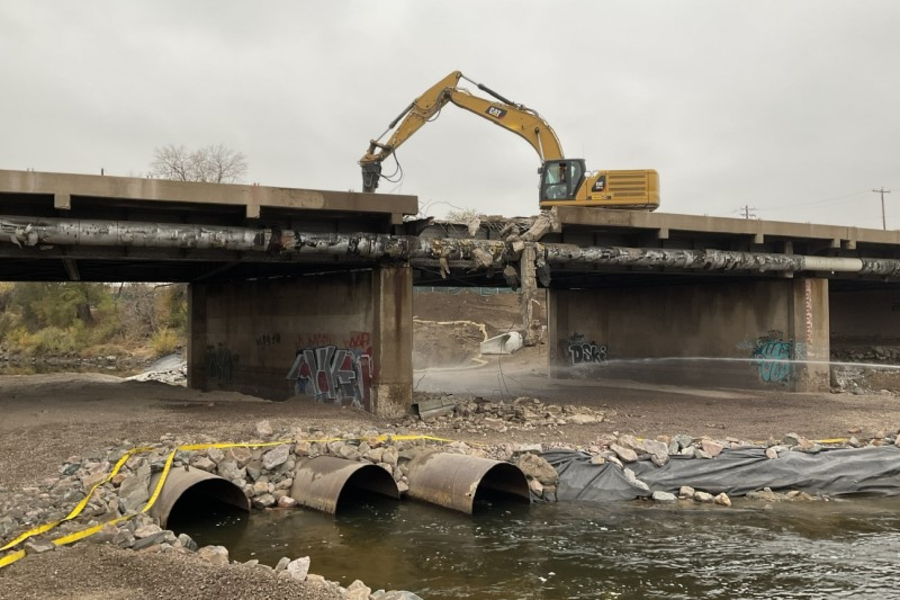
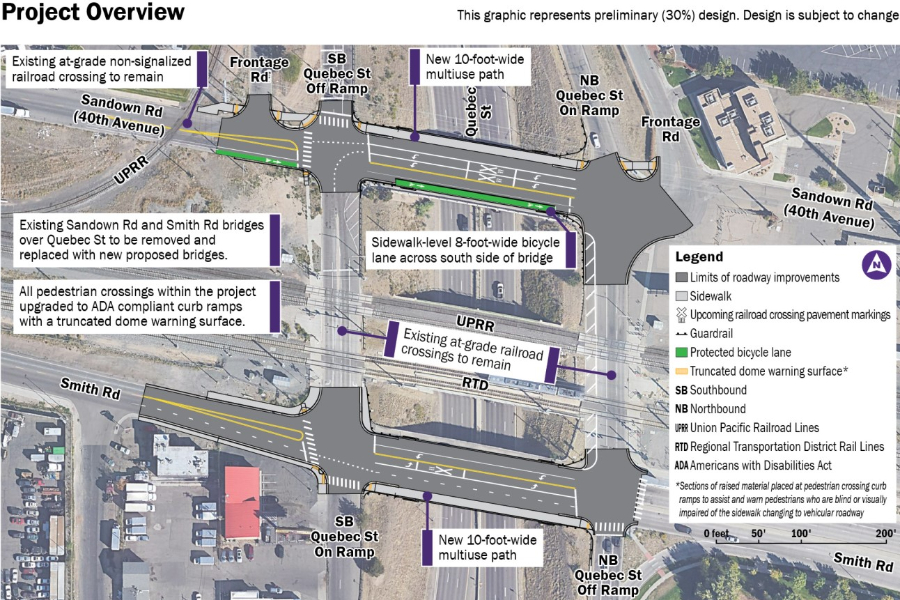
DOTI broke those three replacements down into two projects worth $51 million. The larger project is a $41 million replacement of the two east-west bridges along Smith and Sandown roads over Quebec. Located near Union Pacific and RTD rail lines as well as the city’s largest hotel-homeless shelter, “the bridges are more than fifty years old, are in worsening condition, and do not meet today’s standards,” according to DOTI.
The two bridges were weight-restricted by the Denver Fire Department in November, so fire trucks cannot use them to prevent further deterioration.
According to DOTI spokeswoman Nancy Kuhn, the $41 million project will be covered through the city’s CIP budget, making it the only one of the five big bridge projects to not rely on any bond funding.
Courtesy of DOTI
The project would start in late 2027 and finish by 2030, according to DOTI. Kuhn says the design phase for the new Smith and Sandown bridges will wrap up soon, although it was originally supposed to be done by the end of 2025; the city has been gathering community input and planning the project since 2022. According to DOTI’s preliminary plans, the bridges will be “removed” one at a time. The replacement bridges will add ten-foot-wide bike and pedestrian paths and curbed ramps for people with disabilities.
Immediately north of the Smith and Sandown bridges, Quebec goes over East Airlawn Road, a small two-lane street. The city is investing nearly $10 million to replace that bridge, too. According to DOTI, the bridge over East Airlawn Road was built in 1961 and rehabilitated in 2012, but is now suffering from “advanced deterioration” and could be “a major reliability risk.”
The East Airlawn Bridge will be paid for by Elevate Denver bonds. The bridge over East Airlawn is supposed to see construction start by the third quarter of 2026 and is expected to finish by 2027, according to the Elevate Denver project list.
Building Over a Broncos Stadium?
In June, DOTI identified viaducts (bridges with arches under them) connecting west Sixth and Eight avenues over Burnham Yard as high-priority projects, but the department didn’t have an estimate or source of funding. A month later, Mayor Johnston and an executive committee included the two viaduct projects in a proposed Vibrant Denver bond package with a $139 million price tag.
Denver City Council ultimately approved the proposed budget for the two viaduct replacements in August, and voters approved all five Vibrant Denver bond packages in November. Both viaduct reconstruction projects will have to align with a small area plan that will set the foundation for a major redevelopment around Burnham Yard, a 155-year-old former rail depot where the Denver Broncos want to build their new home. Broncos ownership has already announced it will cover the cost of constructing the domed stadium itself.
According to the city, the Sixth Avenue viaduct connects a freeway from Mariposa Street to roughly Seminole Street, and sees about 64,000 cars every day, making it one of Denver’s busiest roads. The Vibrant Denver bond is supposed to put $50 million towards rebuilding the viaduct; DOTI considers it one of the most important bridges in the entire metro area.
“Failure of the bridge (or even load rating it) would have major consequences for the region,” according to a project description. “Future reconstruction of the 6th Avenue Viaduct requires careful proactive preparation.”
The Eighth Avenue viaduct, which connects Mariposa and Osage streets, handles a smaller load — about 14,500 cars a day — but will require more money to fix, according to DOTI, with an $89 million Vibrant Denver project responsible for the eastern half of the bridge. The viaduct was fully closed for a weekend last June for resurfacing; that $1.5 million project made “minor repairs” to “keep it operational in the very near term,” but officials say the viaduct still needs a major reconstruction.
“Greater investment is required to reduce the city’s risk and enhance transportation connectivity,” according to a project description. “The investment will preserve the ability for 8th Avenue to be an important east-west connection.”
Although some Vibrant Denver projects saw a groundbreaking just days after voter approval in November, most of these projects don’t have a detailed timeline. Johnston promised a six-year completion for all Vibrant Denver projects, however, with 2031 as the latest finish date. The small area plan for Burnham Yard is expected by the end of 2026, and the Broncos plan to open their new stadium in time for the 2031 NFL season.
Connections Over Cherry Creek
Just south of Cap Hill, the city needs to replace two seventy-year-old bridges that cross Cherry Creek and the Cherry Creek Trail along Lincoln Street and East Sixth Avenue.
“Both bridges are in poor condition and at the end of their service lives,” according to a city project description. “These structures are critical links for the major arterial roads, serve the Denver Health complex and support emergency response routes.”
Along with the Quebec Street bridges, the two Cherry Creek bridges were weight-restricted by Denver Fire in November.
The City of Denver
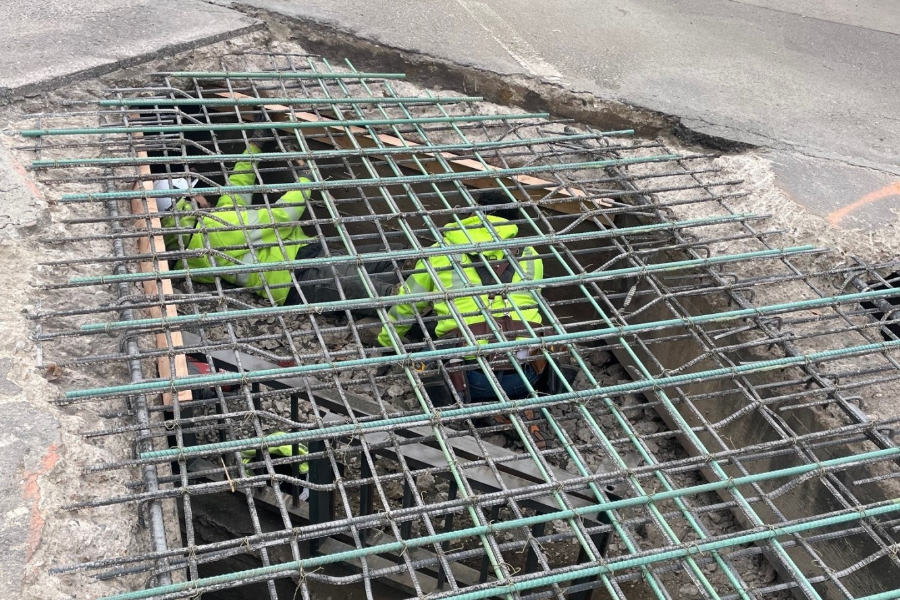
The city will use the replacements as a chance to widen sidewalks on the two bridges, improve drainage, make the area safer for pedestrians, and improve access for cyclists, scooters and people with disabilities. The existing Lincoln Street bridge provides a narrow on-ramp for cyclists and others coming off the Cherry Creek Trail to street level; the new bridge would give Cherry Creek Trail users passing underneath a wider overhead clearance.
In June, DOTI was still searching for the $31 million needed to carry through the project. A month later, Johnston suggested raising $20 million with the Vibrant Bond package to replace the two aging bridges. The city revised that number to $29 million, which is what voters approved in November; the city’s CIP budget covers the rest.
According to the city, final designs for Cherry Creek replacements are expected by mid-2026, but there’s no specific date yet.
We’ll cross that bridge when we get there.