Nicole Daniels

Audio By Carbonatix
Over 21 years after Colorado voters approved the multi-billion-dollar FasTracks transit expansion program, promised rail lines are still not complete and likely never will be. Now, local officials are cautiously gauging public opinion on a proposed ballot measure to fund a different passenger rail system.
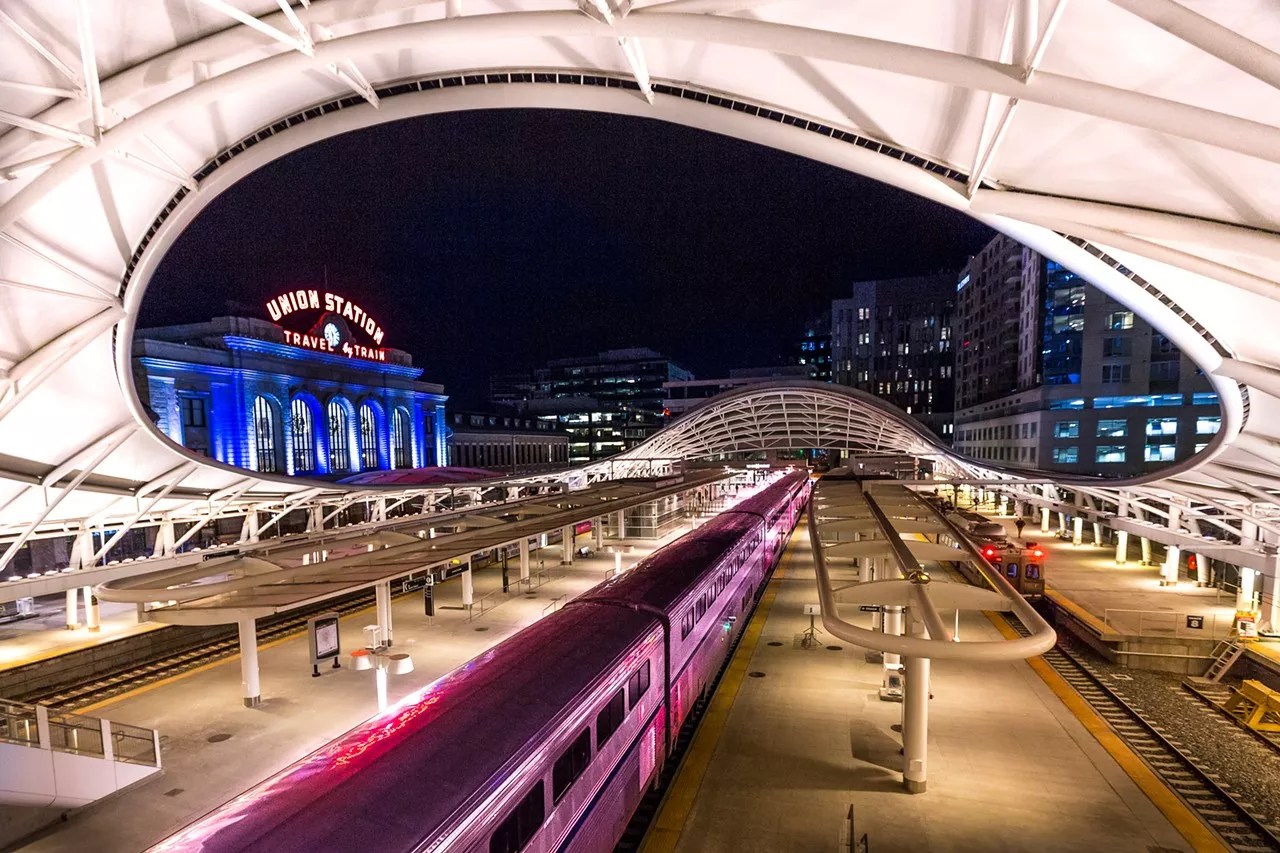
Dozens of community members gathered in downtown Denver on Wednesday, March 25, as part of a series of town halls for the Front Range Passenger Rail. The commuter rail is expected to launch by 2029 with three daily round trips between Denver and Fort Collins, using funding from RTD and state transportation fees. It should finally deliver the line connecting Denver and Boulder, which was supposed to come from RTD’s FasTracks project.
But advocates want more money to take the trains even further. They’re considering running a ballot measure this November to raise sales taxes, which would fund the extension of rail service to Colorado Springs and Pueblo, and increase the number of daily trips to ten by 2045.
“One of the key pieces is restoring trust in the voters that we can follow through on commitments and get good things done,” said John Putnam, chair of the Front Range Passenger Rail District Board. “Getting a successful passenger rail program up and fulfilling some of the promises of FasTracks is instrumental.”
Public trust is currently lacking. Incompletion and underutilization have resulted in FasTracks being widely considered a failure, causing many residents to be wary of footing the bill for transportation projects that may never come to fruition. Governor Jared Polis has publicly pressured RTD to complete FasTracks for years. He is now a leading voice in support of the Front Range Passenger Rail.
Polis pushed for the project to run a funding ballot measure during the 2024 election, though the Front Range rail board delayed the initiative, saying they needed more time to plan and build public support.
“Is 2026 the year when we might make that happen?” Putnam asked on Wednesday. “A lot of that [decision] is coordinating with you.”
The crowd at Wednesday’s town hall was calm and quiet, appearing largely neutral to the presentation. During the Q&A portion, questions revolved around yet-to-be-determined specifics regarding rail service, funding and the ballot measure. More details on the implementation and financial plan are expected to be finalized in the coming months, Putnam said.
The current plan for the ballot measure is to increase sales taxes in areas around the rail line, but not necessarily across the entire Front Range Passenger Rail district, as the district extends beyond communities that would directly benefit from the project, Putnam explained.
Some attendees questioned RTD’s long-time financial issues, as the entity is helping to fund the Front Range rail’s starter service. RTD is actively considering reducing regional bus and train services amid a $215 million budget deficit.
“It would be a failure if people got off the Front Range Passenger Rail [in Denver] and had to take an Uber to get to their final destination because we don’t have good local transit,” said Jill Locantore, executive director of the Denver Streets Partnership. “We can only go to the voters so many times to ask them to fund transit. …If we go to voters in 2026, it may be many, many more years before we can ask again. Can we ask voters to fund not just the Front Range Passenger Rail, but also better local transit service?”
The public has reportedly been more enthusiastic at other meetings. Putnam noted that more than 300 people showed up to a project town hall in Pueblo earlier this month. Many residents of Pueblo’s surrounding communities currently rely on buses to get to the capital city, said Ean Tafoya, state director of GreenLatinos.
“Why do they need to come to Denver? Because we have the hubs of everything, health facilities in particular,” Tafoya said. “We have elders, veterans who have to come to Denver to get the services they need. What we want to do is make that equitable. We want to make it cleaner. We want to make it safer.”
In the long term, organizers hope the Front Range Passenger Rail will one day provide service all through Colorado, from the New Mexico border to the Wyoming border.
Another community town hall was held in Colorado Springs on March 26, with one more scheduled in Fort Collins on March 30.