
Bennito L. Kelty

Audio By Carbonatix
More than a hundred residents and business owners from Denver’s Golden Triangle area poured out their frustrations regarding crime and homelessness during a January 7 community meeting with city officials tasked with trying to solve those problems.
The crowd was an impassioned mix of young and old, renters and owners, residents and proprietors. Representatives of Mantra Cafe, Circle K and Margot Flats, a voucher-accepting apartment building, described a daily struggle with crime, homelessness and aggressive behavior. Surendra Pokharel, the owner of Mantra Cafe, a Nepali-Indian restaurant that opened last year at 1147 Broadway, said he’s been harassed by homeless residents who make racist remarks, telling him things like, “Go back to where you came from.”
Right in City Hall’s backyard, the Golden Triangle is the area between Speer Boulevard, Broadway and West Colfax Avenue. Although it’s known for hipster delis and cafes, old brick warehouses turned into stylish apartments and some of the state’s best museums, the neighborhood also hosts multiple parts of Johnston’s All In Mile High (AIMH) program, the multimillion-dollar street-to-housing pipeline he’s been building for the past two years to solve Denver homelessness.
The Golden Triangle is home to Elati Village, a 44-unit micro-community that’s a collection of shed-like housing units for homeless residents. Wednesday’s meeting took place at the Schoolyard, the renovated school at 1115 Acoma Street, where residents had gathered two years ago to push back on early AIMH plans to install two micro-communities in their neighborhood. But at the January 7 meeting, discussion centered on the area at 10th Avenue and Broadway.
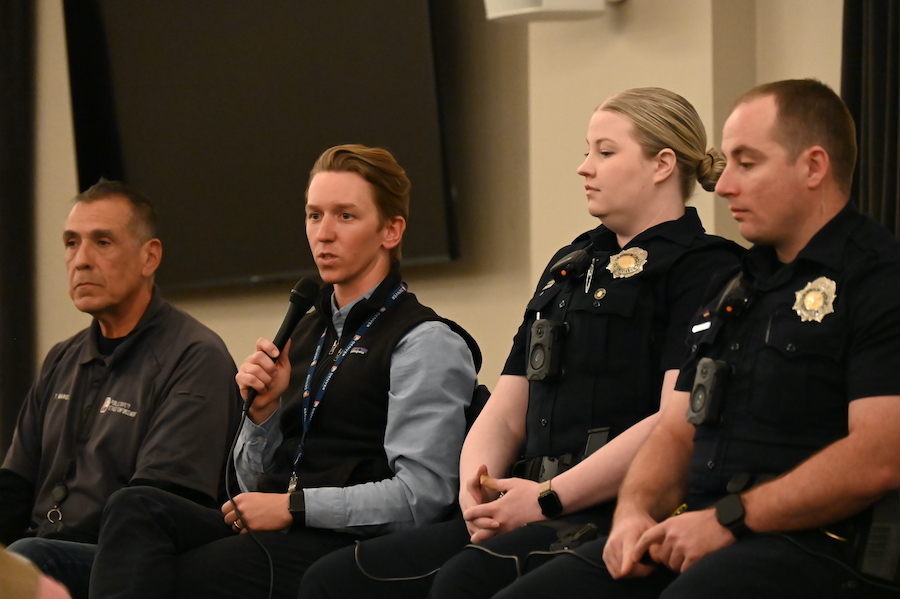
Cole Chandler, the mayor’s senior advisor on homelessness resolution and a champion of the micro-community concept during his days with the Colorado Village Collaborative, had volunteered to sit on a panel; he was joined by Kayla Knabe and Glenn Main, two Denver Police Department community resource officers who regularly attend meetings with the neighborhood, and Tim Marquez, a member of the Street Engagement Team, a Denver Safety Department program that writes low-level offense tickets.
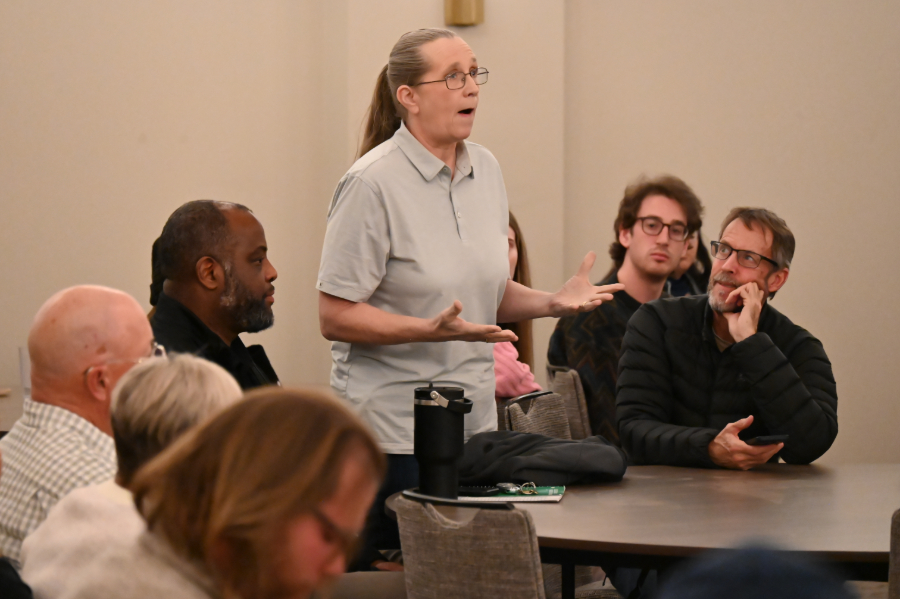
“I appreciate what you’re doing,” Golden Triangle resident Natalie Jansen told the panel. “But it’s not working.”
Bennito L. Kelty
“Open Your Eyes”
According to numbers provided by Chandler at the meeting, the Johnston administration has moved 8,000 people “indoors” and 7,000 people into permanent housing. The most recent Point-In-Time count, a federally funded tally of homelessness by county, recorded 785 people sleeping on the streets of Denver in January 2025.
The Johnston administration has already celebrated reaching the halfway mark to solving homelessness, but plenty of doubt surrounds that milestone. According to Chandler, the city has cut homelessness by 45 percent during Johnston’s term, and now it’s focused on delivering “intensive case management” to the populations most resistant to housing, including people with “chronic mental health issues, substance abuse and frequent arrests.”
“We’re very committed to solving what is now that hardest part of this problem,” Chandler told residents. “We’ve reduced their time in jail, and we’ve increased their access to services. And that’s also increased their stability.”
Chandler was seeing a much rosier picture than most of the people in the room, however. A Golden Triangle resident told Chandler that homeless populations “are being pushed” out of downtown by street enforcement, including encampment sweeps, and into the surrounding neighborhoods. When Chandler responded, “I don’t agree that they were pushed here,” shouts rang out from the crowd: “Are you serious?” and “Did you just say that?”
“That’s so false, you’ve got to see, open your eyes,” Golden Triangle resident Brad Schuster said, throwing up his arms.
According to members of Denver City Council representing areas outside of downtown, homelessness is migrating into their districts. In 2024, Jamie Torres and Kevin Flynn, who represent west and southwest Denver, respectively, said that AIMH had pushed homelessness up the light rail lines and park trails. Councilman Chris Hinds, whose district includes the Golden Triangle, describes the area as “ground zero” for the homelessness crisis.
Apartment Nuisances
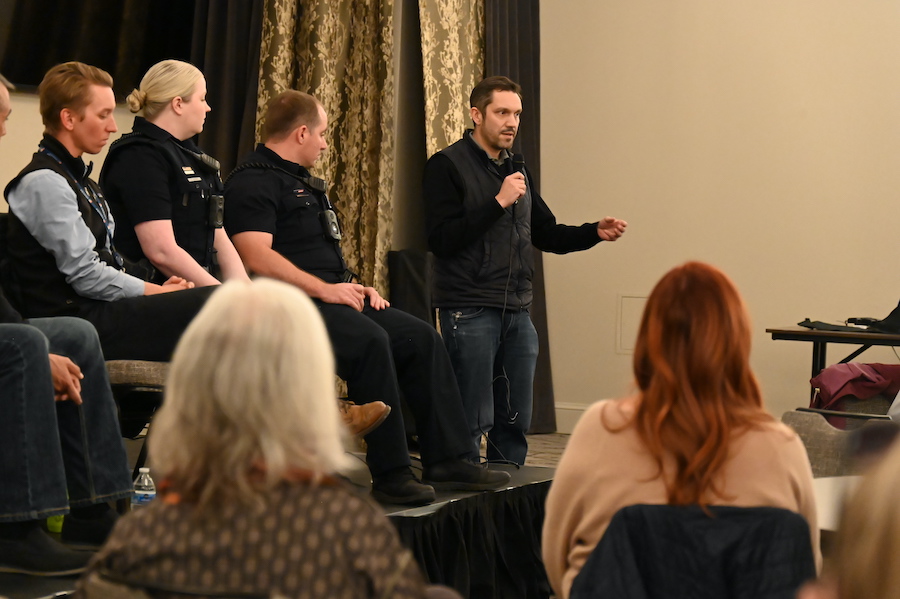
At the meeting, residents got some of their most anticipated updates from fellow attendees, notably the business owners. Ben Gearhart shared information on the eviction of two drug dealers from Margot Flats, the three-story apartment complex he owns at 1023 Broadway. Margot Flats, which accepts housing vouchers to subsidize rents, had two drug dealers on its second floor, according to Gearhart; he evicted three individuals between December 3 and 18. The social media account DoBetterDNVR posted videos of supposed Margot Flats drug dealers around that time.
“We wanted it to happen quicker, but the process of evicting someone in this state, particularly in this city, is challenging,” Gearhart said. “But we don’t have any drug dealers that are active. Now, I’m not saying we don’t have folks who start at Circle K and make their way to their way out. Circle K is their lifeline.”
Gearhart described “a big rolloff in the alleyway” when they were evicted, and explained that their belongings had to stay outside for 48 hours because of local laws, which led to “messages about some of the trash that is spilling over.” According to Gearhart, the experience pushed Margot Flats to hire “fully armed” nighttime security to “clear the hallways,” equip a back fence with “spikes,” and add new locks on the doors “four or five times.” Margot Flats is even “working with covert operations” at DPD and sharing camera footage with a narcotics team, Gearhart added.
According to the City of Denver’s Eviction Information Sheet, property owners have “no duty” to leave belongings out for 48 hours, but it’s recommended by the city as a reasonable amount of time.
Bennito L. Kelty
A resident asked Gearhart if the dealers had gotten housing at Margot Flats via an AIMH program run by Housing Connector, a Seattle-based nonprofit. Through a current two-year, $10 million contract with the city, Housing Connector matches formerly homeless residents with housing that accepts vouchers. Gearhart said he believes that was the case, adding they used “rental subsidies from a nonprofit.”
“I’m sorry about that,” Chandler offered. “Some of those things are within the city’s control, some of them are not. Any time these cases come up, we do our best to work within the imperfect system.”
According to Chandler, federal and local governments vet permanent housing vouchers based on “high acuity,” or how severe their need is, by looking in part at “physical health, behavioral health challenges.”
“And so the federal government has said these are folks that qualify,” Chandler added.
Problems at the Broadway Circle K
The intersection of 10th and Broadway, home to a Circle K, was the focus of the hottest discussion.
At one point, a resident volunteering to organize a Golden Triangle neighborhood watch group told the audience that she needed more people to help “put pressure on Circle K to be a better neighbor.”
The owner of that Circle K, a woman who asked to go only by Petra B., then stood up and defended her business, saying, “We’re trying.” Petra said she owns hundreds of Circle K gas stations throughout the Denver area and in New Mexico, but Denver has a “new breed” of homeless people who “get very aggressive instantaneously.” According to Petra, they “don’t care” how many times they get arrested.
Bennito L. Kelty
“We have beefed up our security, we have security seven days a week, twelve hours a day. I just invested an additional amount of money to go ahead and put new cameras in that are anti-loitering cameras. …We’re picking up the trash, we’re picking up feces, we’re picking up drug paraphernalia,” Petra said. “We are trying to be a good neighbor. …We’re as much a victim of these new breed of homeless because they’re really a new breed to us.”
According to Knabe, the DPD hasn’t formed a neighborhood watch in four years. She encouraged everyone to report suspicious activity to the police, but with specific advice.
“If you are seeing people just using drugs, it’s not helpful for us,” Knabe said. “But if you are seeing folks who are dealing drugs, that’s the information that we need. Our inboxes get incredibly full with the same pictures of people doing drugs.”
Hungry for More Answers
Residents left the meeting wanting more, frustrated after panelists had often admitted they were powerless to make most of the changes being demanded or they weren’t qualified to answer questions.
“That’s something to take up with your state legislature,” Chandler had to say in response to complaints about Colorado’s no-cash bail law. “We’re in an imperfect system, and we’re trying to make it up and get people connected to services. People need stability, they need a roof over their head, they need treatment, they need access to behavioral health services, and they need access to a system that moves people in that direction.”
Some residents who spoke up wanted the city to go in another direction, however.
“When do you give up?” someone asked panelists describing how the city tries to prioritize access to services, like housing and case management, over jail time. “Eighteen strikes, and you’re out?”
The meeting’s organizer, Penny Winkle, told the audience she would work on bringing in state legislators for the next Golden Triangle community meeting, which is scheduled in three months. For the Golden Triangle, that would be Colorado House Representative Alex Valdez and State Senator Matt Ball, but residents said they’d like to have the ear of Mayor Johnston first.
“Obviously, we have two different perspectives on the problem,” a resident said. “Do you think the policies that have been in place warrant Mayor Johnston being re-elected?”
While all the panelists declined to weigh in on a political question, they agreed that homelessness is less of a problem than it was a few years ago.