Bennito L. Kelty

Audio By Carbonatix
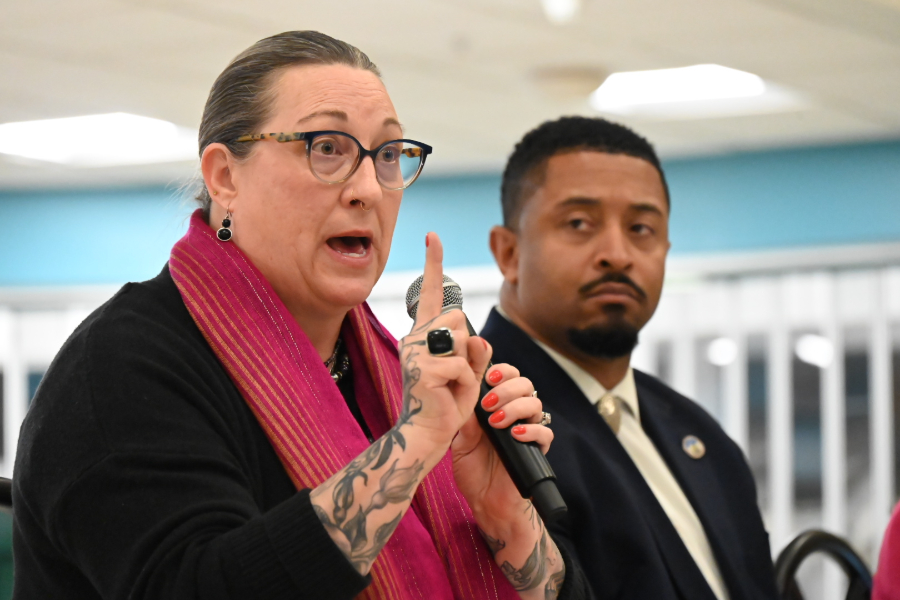
Elected leaders from northeast Denver, including Denver City Councilmember Stacie Gilmore and State Representative Jennifer Bacon, promised legislative proposals and pressure to protect local residents from the threat of Immigration and Customs Enforcement and data centers powering Artificial Intelligence during a community meeting in Green Valley Ranch on Wednesday, February 18.
The meeting, which roughly ninety residents attended, was hosted by Colorado Senate President James Coleman and featured a panel with Gilmore, Bacon and Denver Public School boardmember Monica Hunter. All of them represent districts in northeast Denver, which Coleman noted is one of the fastest-growing and most racially and ethnically diverse parts of the metro region.
Green Valley Ranch, one of a handful of neighborhoods in northeast Denver, is 41 percent Hispanic and 28 percent Black; it has 37,000 residents, according to the City of Denver.
“I know you guys are seeing a lot of new development here,” Coleman told the audience. “Most people who are moving to the metro area are moving here.”
During a short talk, Coleman said he’s working on bills that will bring affordable housing, better health care and a lower cost of living to his constituents.
Hunter, too, spoke briefly — about a DPS policy that is scheduled to come up for a board vote on February 19 to protect immigrant staff and students from ICE. “It says that visiting is a privilege and limited to parents, guardians and those with specific educational business,” Hunter said. “So the rule of thumb for all at the door is if a government official arrives without an appointment to an entry, they will be denied access.”

Bennito L. Kelty
Fears of ICE
Green Valley Ranch resident Sean Wright attended the meeting because he says he’s “mainly concerned with immigration” and fears that aggressive enforcement is a threat to his family even though they’re citizens.
“It’s kind of scary, because my kids have friends that are immigrants,” Wright told Westword. “I don’t want them to get caught in the cross and have to witness things or something happens to them to where they’re taken. That’s very important to address that right now.”
Gilmore spoke to those exact concerns, telling audience members that they need to rely on each other because she doesn’t trust that local elected officials and the Denver Police Department are prepared to protect residents from ICE. Her fears were based on the violence in Minneapolis in January, she added, when President Donald Trump’s large-scale immigration enforcement operation there led to two activists being shot and killed by federal agents.
“Know the people that are in your network that you know could go missing right now,” Gilmore said. “Everybody knows somebody. It is everybody’s responsibility to keep our neighbors safe…I do not hear enough elected officials telling their constituents exactly what is going on and how we need to lean on each other.”
Gilmore also talked about the ICE detention center planned for the town of Hudson, and warned that U.S. citizens could be sent there if federal law enforcement isn’t kept in check. And despite DPD Chief Ron Thomas’s statement earlier this month that his officers would intervene to stop excessive force, she said she worries that people will not be protected from ICE.
“These are thousands of beds that the Department of Homeland Security is trying to secure. They could put us in there. They could put me in there. They could put you in there and ruin your life,” Gilmore warned the audience. “The more of us that speak up, there’s strength in numbers. We’re talking as a city, but you’re going to have to depend on your neighbors, because I cannot tell you that the police are going to be where we need them to be when and if those times come.”
And Gilmore wasn’t done. “I want Flock cameras out of the City and County of Denver,” she said. The cameras operated by Flock Safety and installed on traffic lights at roughly seventy spots in Denver have been a source of controversy, as people worry that ICE and other federal agencies can access personal information without proper protection by the city. Flock uses AI to sort data collected through traffic surveillance, including license plates, car colors and dents.
“I don’t want mass surveillance,” Gilmore said. “It does not make us safer. It does not. It gives the government a way to surveil us.”

Bennito L. Kelty
Data Centers
Bacon, who showed up towards the end of the meeting (and virtually attended a judiciary committee meeting while sitting on the panel), still spoke at length about data centers, which store data and power the AI tools that sort that data. Nationwide, they also suck up tens of billions of gallons of water a year for cooling systems, and require “grid-capacity” electricity, Bacon said, meaning they have to tap into a city’s power source to run.
One Green Valley Ranch resident said that “many of us pass these data centers” while driving in northeast Denver, and wondered if they’ve led to higher utility bills.
Bacon responded that a single data center uses as much water as a golf course, and said installing more of them will raise utility bills because more transmission lines would have to be added. House Bill 1030 and Senate Bill 102 are both aimed at regulating data centers and making their way through the legislative process, she added.
“Right now, what we’re looking at is, if we are going to have data centers, what kind of responsible guardrails should we have around it?” Bacon said. “But the bigger question is, can our state actually sustain these?”
According to Gilmore, data centers should be banned from Denver because “they gobble up energy,” use water and “we know nothing about” the scale of their environmental impacts.
“In the City and County of Denver, we should ban data centers. We need to ban them,” she said. “They’re horrible for the environment. When people live near wells, their well water turns brown.”
Gilmore Criticizes the Mayor
Gilmore warned the audience that the city is facing a “dire” budget situation in 2026, even after dealing with a $200 million deficit in the current budget. She criticized Mayor Mike Johnston’s lack of transparency, in particular with the Denver Auditor’s Office request for data from All In Mile High, which uses former hotels to transition people out of homelessness.
“The auditor can’t get the numbers for All In Mile High, so we know exactly how much was spent and how much truly in the hole we are in the City and County of Denver,” Gilmore said.
Asked about that accusation, Michael Brennan, a spokesperson for the Auditor’s Office, offered this response to Westword : “Our audit of All in Mile High is scheduled for the March Audit Committee, and information related to Councilmember Gilmore’s comments will be shared.”
Gilmore also blamed Johnston’s decision to lay off 171 city employees last year in order to balance the budget for a lag in city services right now. That’s the reason “your trash isn’t getting picked up,” she said, and asked residents to support overworked staff at recreation centers and libraries.
Johnston will be up for re-election in April 2027. A few candidates have already launched their election bids, including progressive Lisa Calderón, who was in the audience.