
Evan Semón Photography

Audio By Carbonatix
Whether you ride them or trip over them on the sidewalk, electric scooters have become an everyday part of Denver life. But big changes are on the horizon.
Veo is expected to take over the city’s e-scooter operations this spring, pending approval from Denver City Council. The company will replace the current operators, Bird and Lime. And with a new company comes new micromobility devices.
Veo plans to roll out a fleet of five different vehicles in the Mile High City: a traditional standing e-scooter, a sitting e-scooter, a two-seated e-bike, a cargo e-bike and a first-of-its-kind tricycle. “It will be the country’s — and probably the world’s — most diverse fleet of dockless micromobility when it launches,” says Alexander Keating, Veo’s vice president of policy and partnerships.
The vehicles won’t hit Denver’s streets until May 1, but Westword got to take a spin early. Here’s what you should know:
The Vehicles
From the beginning to the end of your ride, each step will be slightly different with the new Veo vehicles.

Evan Semón Photography
When a vehicle is unlocked, a voice happily introduces users to Veo and can be customized to explain local riding laws, such as “Don’t ride on sidewalks.” That same voice will emit periodically throughout your ride if you do something wrong; for example, “Double-riding detected,” or “Hard breaking detected, please ride safely.” It will also explain what’s happening if riders enter a geofenced zone that automatically slows the vehicle, like on 16th Street.
If a user ends their ride in a mandatory parking zone, like Union Station, they’ll have to park in a designated corral. To prove they’re in the right spot, riders scan their vehicle’s QR code and then tap their phone to the parking corral. This tap-to-park system is more geographically precise than GPS, Keating explains, intending to ensure proper parking that does not block streets and sidewalks.
The details vary depending on which vehicle you’re riding, but they’re all fitted with a cup holder and phone stand. They also have a QR code that reads “How’s my parking?”, which passersby can use to report improperly parked vehicles. The standing e-scooter has turn signals, and the seated vehicles each have a small mirror to check your rear-view. The seated vehicles also feature front baskets.
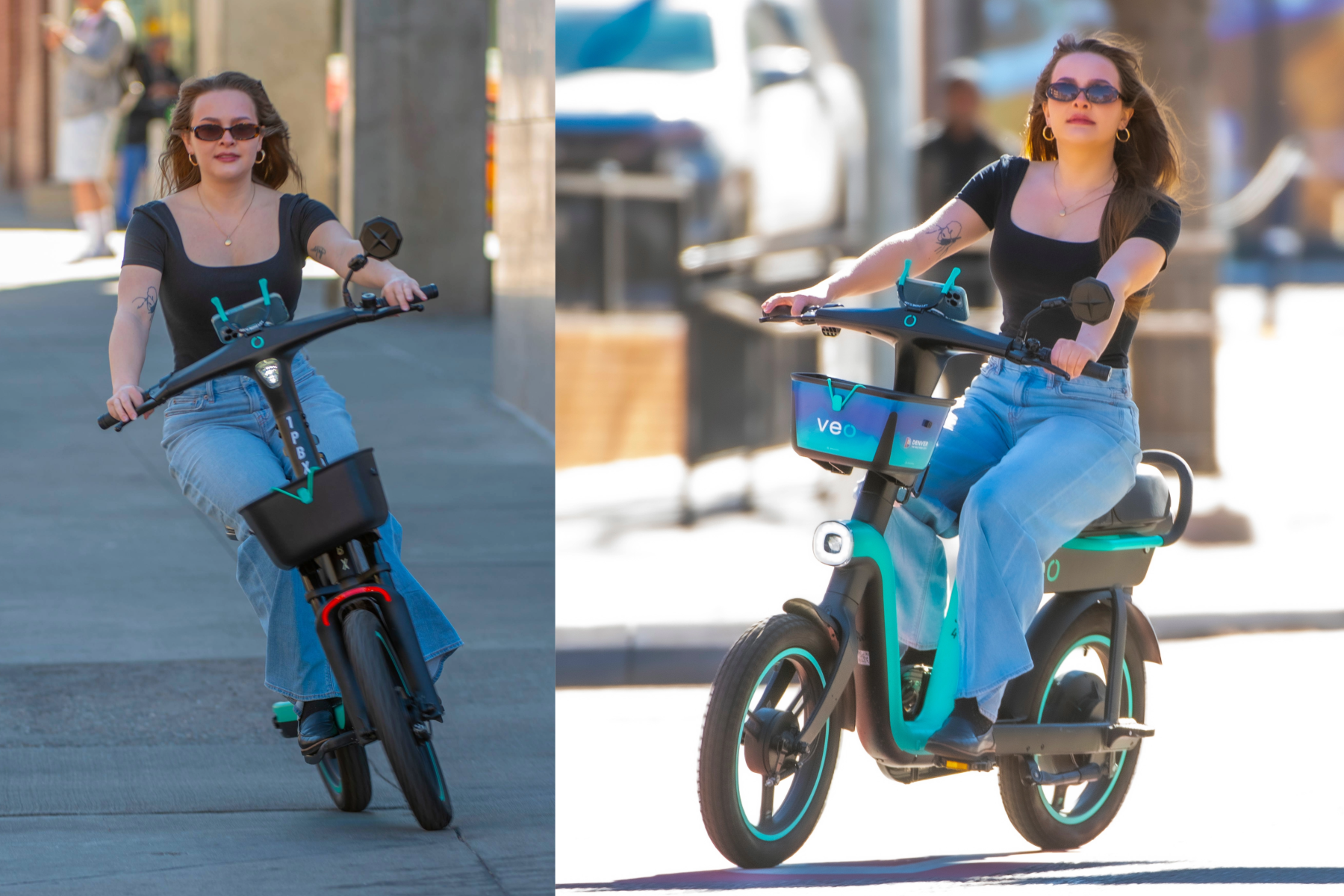
I test-drove all five vehicles around a downtown city block on a Friday morning. During each lap, I rode two lengths of the street in protected bike lanes, one on the sidewalk and one on the roadway, to get the full user experience.
Veo
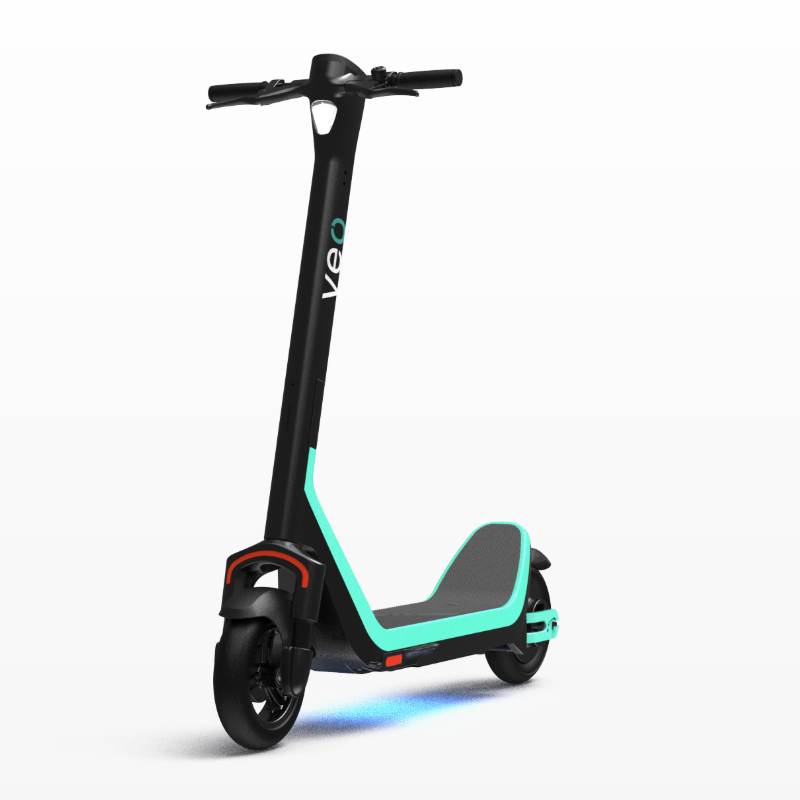
The Standing Scooter comes with front and rear suspension, brake lights and under-deck lighting, of which riders can customize the color.
Riding the scooter feels largely the same as riding Denver’s current Lime and Bird scooters. If users didn’t need to download a new app, I expect many wouldn’t notice that the scooters had changed at all. The largest difference was perhaps the phone holder; it is more robust and sturdy than Lime’s rubber-band-like holders, but doesn’t provide the convenient wireless charging that Bird’s holders do. My only qualm is that the Veo scooter’s turn signals do not flash or make any noise from the front, so it is impossible for a rider to tell whether the turn signal is on or off (Keating says the signal automatically turns off after a time).
Veo
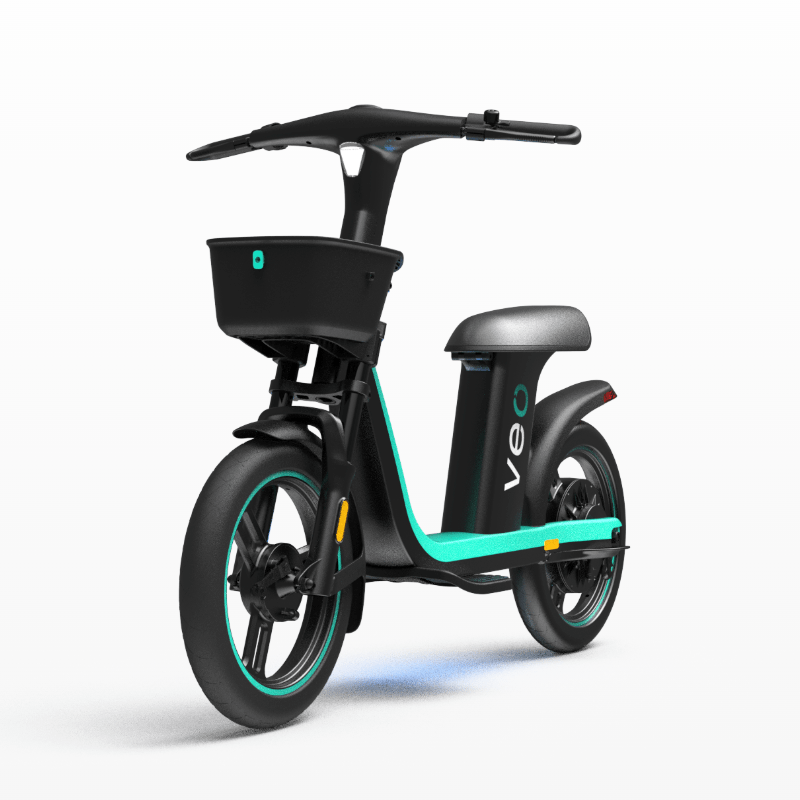
The Seated Scooter has a lower center of gravity and larger wheels than its standing counterpart, while allowing riders to sit.
This was my favorite vehicle to ride. With a suspension system inspired by mountain bikes, the seated scooter feels much safer and more stable than any standing scooter I’ve ridden before. I felt secure riding over potholes and grates, which have launched me off of standing scooters in the past. Plus, the added bounce was entertaining. While actively riding, I was able to stand on the footholds and jump up and down without losing my balance. Thrill-seeking teens will love it, as will users who aren’t comfortable standing during their rides.
Veo
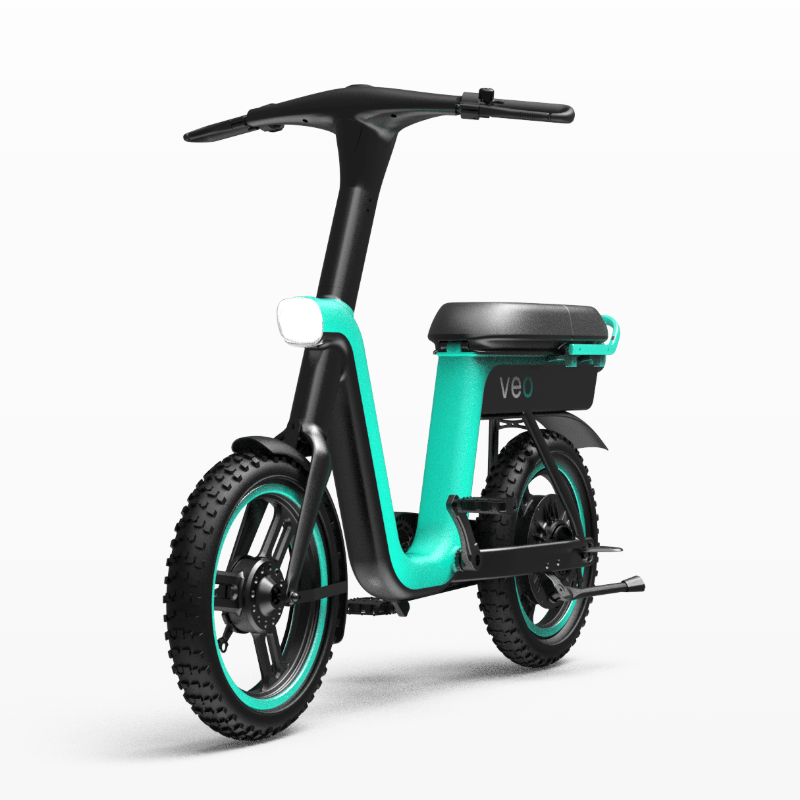
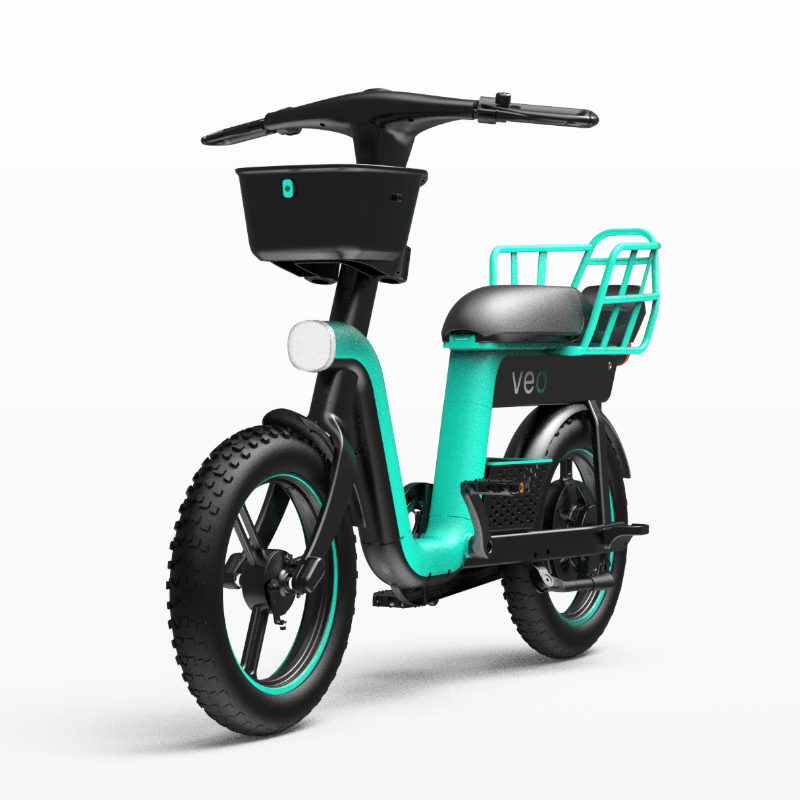
The Two-Seated E-Bike has an extra-long seat for tandem riding, with a footrest and a grab bar available for the rear passenger.
This vehicle fills a major need in Denver. Although it is common to see couples or parents with children squeeze onto one e-scooter together, double-riding is prohibited under city law. Now, residents will have a safe and legal way to do so. The vehicle felt less bouncy but similarly secure compared to the seated scooter. It can be ridden entirely with the throttle, like the seated scooter, or with electric pedal assistance, like a bicycle.
Veo
The Cargo E-Bike is identical to the two-seater, but with a rear cargo basket instead of the second seat.
Again, I found the e-bike to be very comfortable and easy to ride. The pedal assist is strong, making it effortless to get around even without touching the throttle. The rear cargo basket makes it ideal for grocery trips. It can supposedly hold up to one hundred pounds of cargo, using a bungee system or standard pannier bags, although riders must provide those objects themselves.
Veo
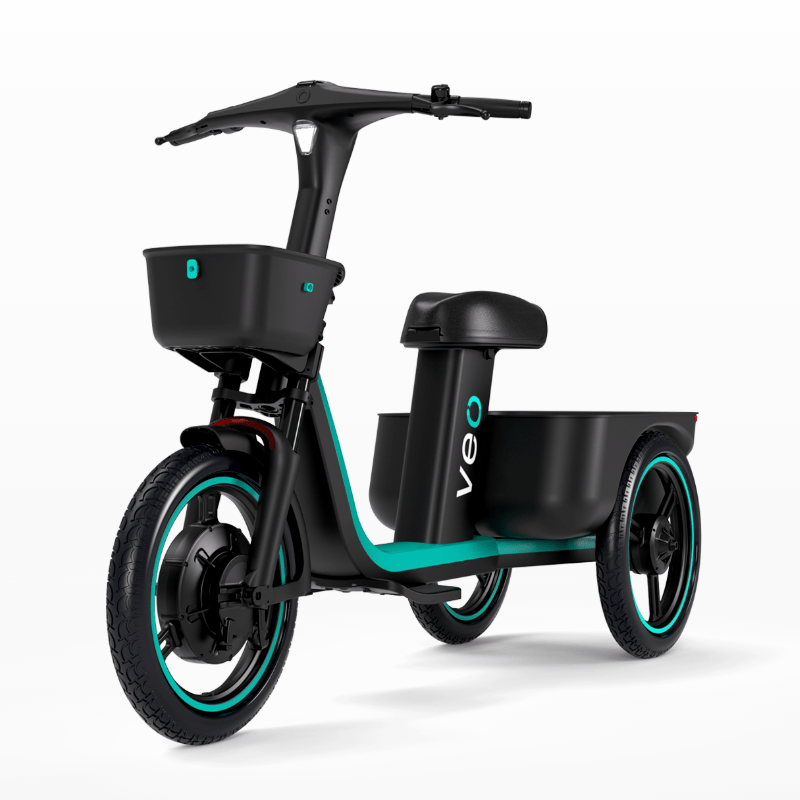
The Trike is a three-wheeled, self-balancing scooter. Denver is the first market to receive a wide release of this new vehicle.
This vehicle both increases accessibility for riders who cannot balance on their own and provides a necessary carrying option for large cargo. The days of propping your suitcase on an e-scooter deck while holding it in place with your foot are finally over. But if there is a downside to the trike, it is the speed. This vehicle is intentionally slower than the other four for balance reasons. It only travels up to around ten miles per hour, while the others can reach fifteen. This makes it uncomfortable and slightly embarrassing to ride on the street, which city law requires if no bike lane is available. If you want to skirt the law and ride on the sidewalk, the trike’s width makes that awkward, too. Even at such a slow speed, I nearly tipped the trike when I turned too suddenly, so users will still need to exercise some caution.
The Rollout
If everything goes to plan, Denver residents will be able to rent a Veo scooter, bike or trike beginning on May 1.
The company will deploy 9,000 vehicles total, which it expects to complete within a month of launch. There should be around 6,000 vehicles deployed during the first week, Keating says.
Roughly 30 percent of the city’s fleet will consist of the traditional standing scooters, and the other 70 percent will be a mix of the four different seated vehicles. As the trike is brand new, there will only be around fifty to a hundred on the streets to begin with, according to Keating.
Low-income residents will continue to have access to free scooter rides, as they currently do under Lime. Keating says the eligibility requirements for Veo’s access program will be the same as Lime’s, providing free rides to anyone who receives city, state or federal subsidies, like SNAP and Medicaid. To avoid complications during the transition, Veo plans to offer an honor-system grace period in which users can access free rides without proving eligibility for the first few weeks.
The plan for Veo’s access program is to offer sixty minutes of free riding per day, with no cap on the number of rides. After riders reach sixty minutes, they will be charged $0.15 per minute with no unlocking fee. Denver’s current Lime access program provides three free rides per day, lasting up to thirty minutes each.
Outside of the access program, Veo intends to charge Denver residents $0.25 per minute to rent their vehicles, compared to the current $0.44 per minute charged by Lime and Bird. Users will still pay the same $1 unlocking fee.
All of these specifics will be finalized when city council votes on Veo’s contract. The council will also determine whether the scooters should automatically stop or slow when a user rides on the sidewalk, how riders or the company are penalized for unlawful behavior, and which parts of the city are mandatory parking or no-riding zones.
The contract is scheduled to go to the Transportation & Infrastructure Committee on March 18 and to the full council on March 30, according to Veo.