
LoDoNA

Audio By Carbonatix
A recent opinion piece criticizes Denver’s decision to move forward with a single shared-mobility operator. From the perspective of neighborhoods and pedestrians who experience the impacts of micromobility every day — particularly in dense, historic areas like Lower Downtown — that piece overlooks several critical realities.
The Lower Downtown Neighborhood Association (LoDoNA) and its Pedestrian Safety Committee support Denver’s single-source selection because it directly addresses long-standing and ongoing failures in rider safety, pedestrian safety, enforcement and accountability that the current multi-vendor system has been unable — or unwilling — to resolve.
Scale matters.
While Lower Downtown represents roughly 1 percent of Denver’s total land area, an estimated 25 percent of all micromobility trips in the city either begin or end in LoDo. This disproportionate concentration means the shortcomings of the existing system — unsafe riding, sidewalk obstruction and improper parking— are felt here first and most acutely. Any policy discussion that ignores this imbalance fails to account for how micromobility functions in practice, not just in theory.
Experience and firsthand knowledge matter.
For more than four years, the LoDoNA Pedestrian Safety Committee has worked to hold the current operators accountable under Denver’s existing contracts. More recently, we participated in interviews with each vendor responding to the City’s RFP. This direct engagement has given us firsthand insight into the daily challenges on our sidewalks, as well as a clear understanding of each company’s policies, technologies and ability to meet Denver’s stated goals moving forward.
The current model is not working.
Based on years of experience, we believe the existing approach requires a fundamental reset to achieve better outcomes for residents and visitors. Across Denver — and in many cities nationally — shared micromobility programs have struggled with persistent safety and parking violations when accountability mechanisms are weak. Denver has the opportunity to set a higher standard, and doing so requires a partner capable of delivering measurable improvements from day one.
Equity must include accountability.
Denver’s shared-mobility equity program is among the most robust in the country and will continue under the single-source agreement. Importantly, this program is mandated by the city — it is not a voluntary initiative by operators. Under the current system, however, there has been virtually no effective mechanism to ensure that riders follow basic rules or laws. Devices are routinely ridden where prohibited and left blocking sidewalks, curb ramps, building entrances, and private driveways, with little consequence for either riders or vendors. Equity without accountability undermines public trust and disproportionately harms pedestrians, seniors, and people with disabilities.
Accountability in a modern micromobility program does not rely on police enforcement. It requires operator-managed consequences that are clear, consistent and enforceable. These can include escalating responses such as warnings, temporary suspension of riding privileges, loss of access to discounted equity programs, or permanent account deactivation for repeat violations. Technology-enabled compliance allows these consequences to be applied fairly and predictably — something that has not been possible under the current multi-vendor system.
By contrast, Veo integrates equity access with enforceable rules, compliance technology and operational accountability — helping ensure the program functions as intended, not just on paper.
Scooter clutter is a safety issue, not a nuisance.
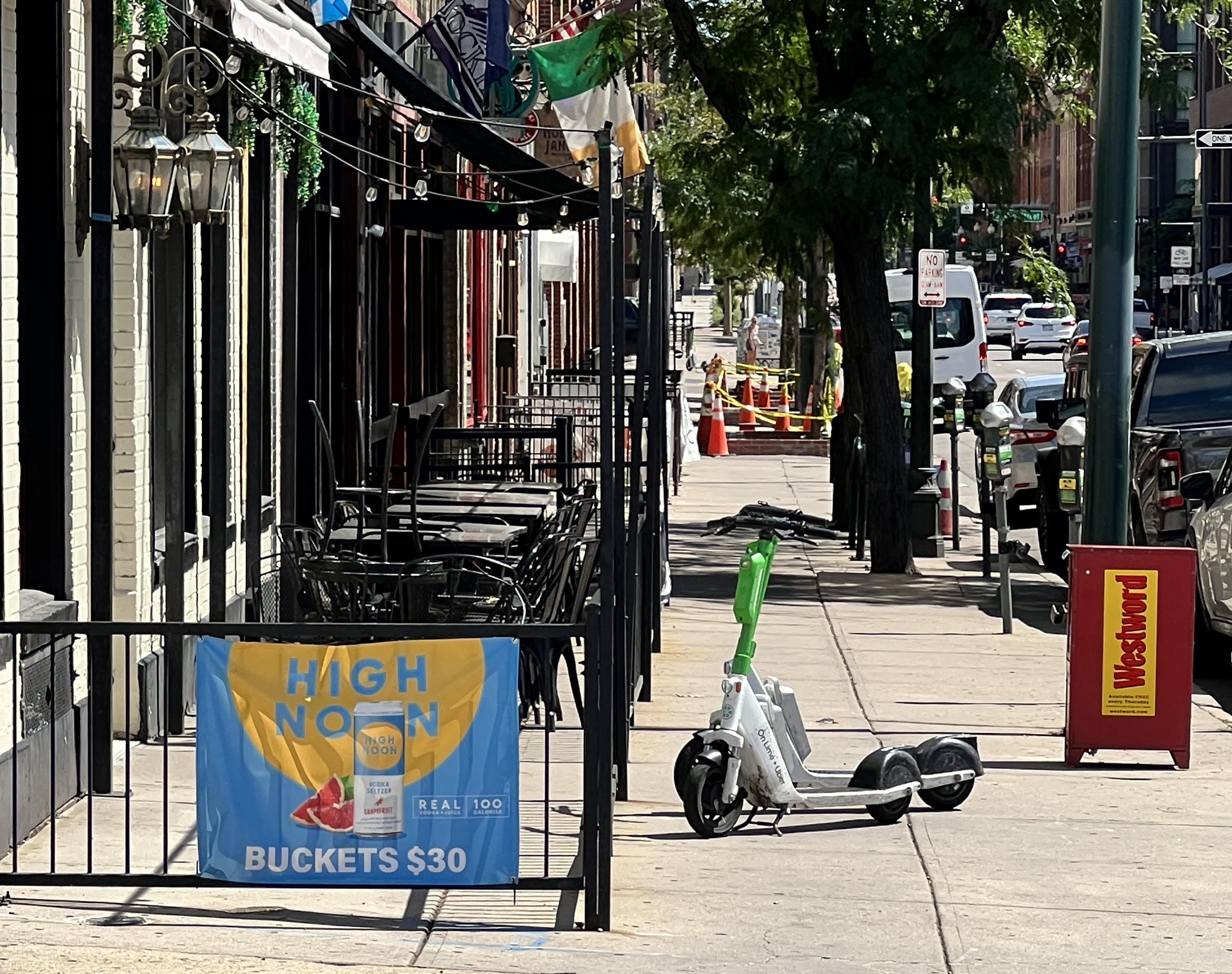
Improperly parked scooters do more than create visual clutter; they create unsafe and inaccessible public rights-of-way. In LoDo, where sidewalks are narrow and heavily trafficked, this often forces pedestrians into the street. Abandoned devices have also posed challenges along trails and waterways, requiring direct outreach for retrieval. Veo’s use of designated racking systems and advanced GPS technology removes ambiguity about where devices belong, significantly reduces sidewalk obstruction, and restores predictability to shared spaces.
Accountability requires a single point of responsibility.
A multi-vendor environment diffuses responsibility and makes enforcement ineffective — particularly when violations are not prioritized by law enforcement. A single-vendor model gives the city one clearly accountable partner, making it far easier to enforce ordinances, parking requirements, equity standards and safety rules. This approach is not about limiting access: It is about ensuring Denver’s existing rules are actually enforceable.
Technology matters.
Veo’s platform includes sidewalk-riding mitigation, post-ride parking verification, and compliance monitoring — tools that have not been successfully implemented at scale in Denver to date. As technology continues to evolve, a single-source model also allows the city to ensure that all deployed devices consistently meet the most current safety and compliance standards.
Finally, the cities cited in the opinion as examples of multi-vendor systems do not operate equity programs comparable to Denver’s. Denver’s leadership in shared mobility is rooted in equity, and any system that fails to preserve that commitment — while also ensuring safety and accountability — is not progress.
LoDoNA and the Pedestrian Safety Committee support shared mobility when it is safe for riders and pedestrians, accessible, equitable and enforceable. Denver’s single-source selection prioritizes pedestrians, protects equity access, reduces sidewalk hazards and gives the city meaningful leverage to enforce its own laws. That is not a mistake — it is a necessary and responsible evolution.
On weekends, westword.com publishes opinion pieces and commentary on matters of interest to the community. Have one you’d like to submit? Send it to editorial@westword.com, where you can also comment on this piece.
