

Bradley Hansen

Audio By Carbonatix
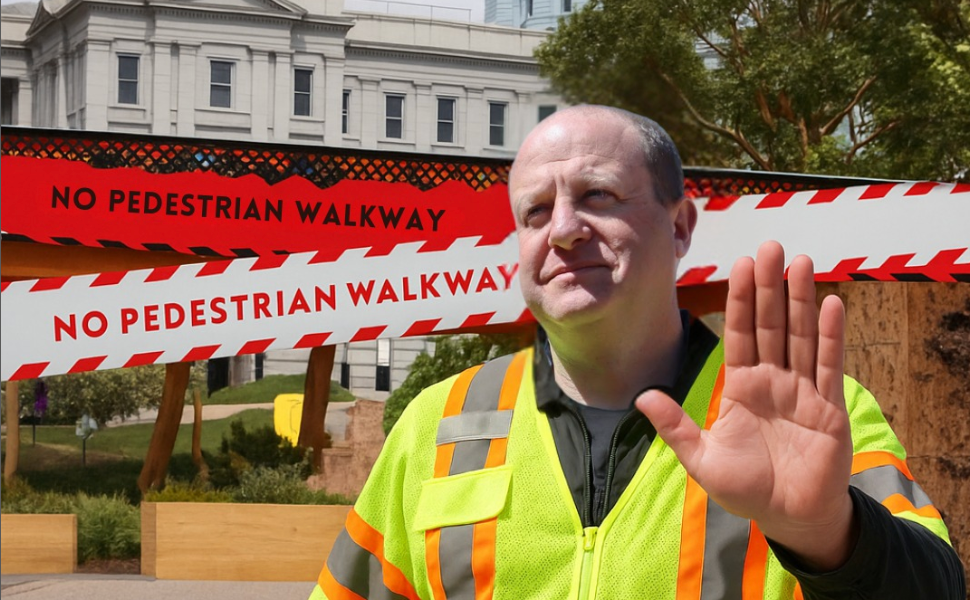
In a way, the Colorado 150 Pedestrian Walkway succeeded in its mission: It united Coloradans across the state…in their near-universal hatred of the proposal.
This wasn’t the connection that Governor Jared Polis originally intended, of course. When he unveiled the official design for the $18.5 million project, he championed it as offering a way for the disabled to reach the Capitol, a place for schoolkids to eat lunch, a gallery for artists, a safety measure for traffic on Lincoln Street…and a present to the public as Colorado celebrates its 150th anniversary in 2026, the same year the United States marks its 250th.
But criticism of the plan came fast and furious (with the price tag rising just as quickly, until it hovered around $30 million). Finally, Polis launched a survey to see what residents of the Centennial State really thought about the giant slip-and-slide from the Capitol down to Lincoln Park, and about Colorado’s birthday in general. “I’m glad to see the interest,” the governor said. “I take it as, wow, Coloradans are really interested. Where do we want to go with it?”
Where 95 percent of those who took the survey wanted the walkway to go was straight to hell…and it did, even as Polis took a weird victory lap. “I was inspired that over 80,000 people participated in just five days,” he exulted as he announced that he would make sure the bridge was never built. “This amazing level of engagement shows that Coloradans care deeply about our upcoming birthday and the Capitol plaza.”
Jared Polis Facebook
Polis began planning for the state’s big birthday years ago; he’d started his January 2023 State of the State speech before the Colorado Legislature with a reminder of the upcoming event. “In Colorado, we lead by example, enshrining these values in all that we say and do. By the time America is 250, we hope for a country that also respects freedom and the personal health decisions of women, transgender Americans, and all Americans,” he pronounced.
Given the current state of Washington, D.C. — which no one could have imagined three years ago — that might be a bridge too far. But we can still look for answers to Polis’s follow-up question: “So, when Colorado is 150 years old, what do we want to be?”
But before we look ahead, join me for a look back at other Colorado falls from grace in 2025.
A Capital Idea
Polis’s walkway wasn’t the only proposal involving Denver’s Civic Center Park, that vestige of the City Beautiful movement that was added to the National Register of Historic Places in 1974, two years before the country’s Bicentennial.
Despite that historic status — and the fact that Denver Parks & Recreation officials had been prescient enough to refuse to let the proposed 150 Pedestrian Walkway land in the city-owned park — Denver launched a $50 million renovation (and that’s just phase one) of Civic Center this fall, right after the Day of the Dead celebration. Which means that the park will largely be dead to any other big celebrations (a Broncos Super Bowl victory rally? or just a salute to changes in the Colorado Rockies’ front office?) for the next year, sending other events to the Auraria Campus and points unknown, while the Greek Amphitheatre is reversed, the gardens ripped up, and the city generally acts as a major 150th anniversary party pooper.

Civic Center Park faces 365 days of the dead.
Monika Swiderski
Civic Center Park is just one of the construction quagmires that bogged down Denver residents this year. Every street seemed to be ripped up, whether to accommodate more bike bollards or to take out bike bollards or to add those hellacious roundabouts in neighborhoods that felt they were getting the runaround. And then there’s the Bus Rapid Transit construction along East Colfax Boulevard, which turned what was once (maybe) billed by Playboy as “the longest, wickedest street in America” into what could be the city’s longest-running obstacle course.
But to qualify for that title, it will have to beat the almost-endless renovation of 16th Street, which finally concluded this fall when it reopened on its 43rd anniversary in October at the cost of $175 million and the elimination of one part of its name: mall. Before the year ended, the city (through the Downtown Development Authority) had invested another $45 million in the Denver Pavilions, which it purchased in hopes of filling that two-block black hole in the heart of downtown with something more than a candy store that closes up before 8 p.m. The DDA also signed off on funding most of the Civic Center project, as well as deals with an immersive theater, as well as ice cream and tea outfits; it will be considering projects worth hundreds of millions more in the new year.
Meanwhile, back at the Capitol, Colorado lawmakers are getting ready to deal with a record-breaking budget crunch as they head into a mid-term election. And the wolves — at least, the opponents of the state’s voter-endorsed reintroduction of the animals — are howling at the door.
Trumper Tantrums
While Colorado was dealing with self-inflicted wounds, the federal government was showing no mercy to this state.
Donald Trump has never been a fan of Colorado; decades ago, he lost the chance to redevelop both Union Station (imagine how lovely it would look gilded, with some nice patio furniture out front) and 1770 Sherman Street. In 2016, he lost the Colorado Republican convention vote to Ted Cruz, which inspired his first accusation that the state’s election system was “rigged.” It was far from the last.

Evan Semon
After he lost the presidential election in 2020, Trump put much of the blame on Denver-based Dominion Voting Systems, inspiring countless conservative yakkers to repeat the claim (and subsequently get sued) despite absolutely no evidence that anyone had tampered with the election.
But Tina Peters believed. The Mesa County clerk was so inspired that she let a protege of My Pillow poobah Mike Lindell into her county’s voting system, then kicked a police officer who dared to ask about some courtroom shenanigans. As thanks for Peters’ heroic efforts, a jury of her peers — and how, since she was tried in bright-red Mesa County, where the prosecutor is a Republican — convicted her of three felony counts of attempting to influence a public servant, one felony count of conspiracy to commit criminal impersonation, one misdemanor count of official misconduct, one misdemeanor count of violation of duty in elections, and one misdemeanor count of failure to comply with the secretary of state (and office for which Peters had run, even after her fall from grace).
In October 2024, Judge Matthew Barrett sentenced the “charlatan” to nine years in prison. “I’m convinced you’d do it all over again if you could,” he said. “You are a privileged person. You are as privileged as they come. You used that for power and fame.”
And in the process, Peters made friends in powerful places. Lindell, who this summer lost a defamation case filed by a former Dominion exec, is now running for Governor of Minnesota. And our pardon-happy president recently released an official “pardon” of Peters, even though she was convicted on state charges and he has no control over the Colorado courts…unless he sends in troops to break Peters out of prison.
Instead, Trump has contented himself with invading Colorado in other ways. For starters, the Department of Justice is now investigating the Colorado Department of Corrections. Perhaps Trump will send in Lindsey Halligan, a Regis University grad and former Miss Colorado USA contestant whom he elevated from her role as his personal attorney to interim prosecutor for the Eastern District of Virginia, where she secured an indictment of both former FBI director James Comey and New York Attorney General Letitia James — until a judge ruled that her appointment was illegal and the indictments were thrown out. Halligan currently has some free time, and might enjoy a trip home.
While in Colorado, she can visit Congressman Jason Crow, who joined five other lawmakers, including Senator Mark Kelly, in a video reminding fellow members of the military that they can and must refuse illegal orders. In response, Trump trumped that their action was “SEDITIOUS BEHAVIOR, punishable by DEATH.” But so far, Crow has survived long enough to see a judge rule in favor of his suit against Trump, after the U.S. representative and former Army Ranger charged that it was illegal for the Immigration and Customs Enforcement officials to prevent him from visiting the Aurora detention center (turn the page for more on that).
That’s just one of many legal actions that Colorado has aimed at Trump. Attorney General (and gubernatorial candidate) Phil Weiser has filed close to fifty lawsuits against the Trump administration, either on his own or joining with other state attorneys general. Several are related to the feds’ crackdown on immigrants; back in March, Denver Mayor Mike Johnston went before a Congressional committee to explain why Denver is not a sanctuary city. Even with a $2 million contract for legal advice, Johnston’s testimony was not persuasive enough to persuade the feds to send Colorado the money it’s been withholding from this and other blue states.
And Trump keeps taking away. In September, he pulled Space Command from Colorado Springs, sending it to Alabama. Finally, at the end of this very long year, he delivered the unkindest cut of all (so far): He announced that the National Center for Atmospheric Research, which has been located in an I.M. Pei-designed building in Boulder for six decades should be dismantled, because it promotes “climate alarmism.”
You know, the kind of hot air that had NCAR sounding the alarm in mid-December that high winds could be hitting the Front Range of Colorado.
Time to say so long to 2025. Out with the bad air, in with the good.