Brandon Marshall

Audio By Carbonatix
After a record year for traffic deaths, the City of Denver plans to expand road-safety measures already tested on Alameda Avenue and Federal Boulevard during 2025, according to the Department of Transportation and Infrastructure.
“We know we need continued attention to how we reduce fatalities on these corridors,” DOTI Director Amy Ford said in the December 23 announcement. “We are continuing to add new measures to help eliminate the primary cause of these tragic occurrences.”
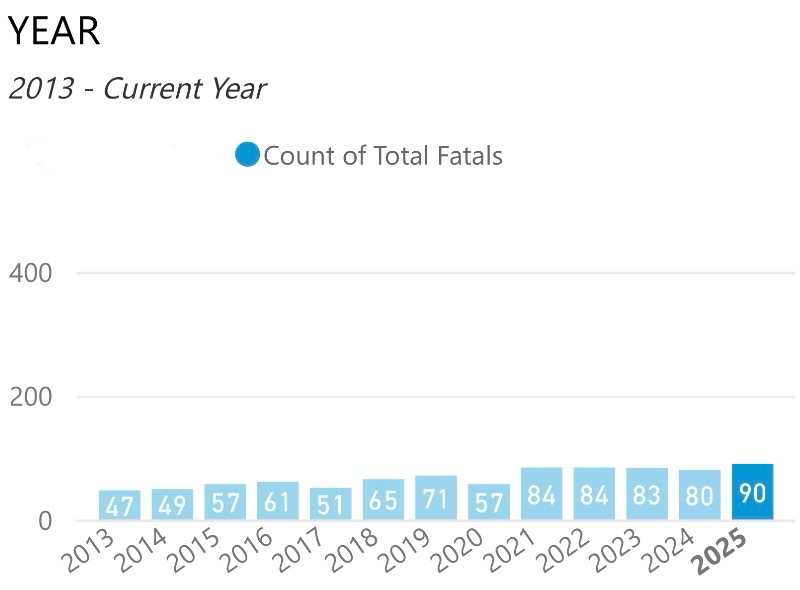
As of today, December 26, the City of Denver had tallied ninety deaths related to car accidents in 2025, including bicyclists, pedestrians and motorists. According to data from DOTI, this has been the deadliest year on record dating back to 2013.
In June 2024, Denver Mayor Mike Johnston launched a $2 million pilot program “focused on the single-biggest driver of death and serious injury in the city, which is people driving too fast,” he said. The System Providing Evidence-Based Enhancements in Denver pilot program rolled out at the start of 2025.
SPEED tried slowing drivers by retuning traffic lights to reset at red, increasing the density of speed limit signs, installing cameras to capture license plates and then mailing speeding tickets, among other measures. The city tested the pilot program on Federal Boulevard from West 52nd Avenue to Floyd Avenue and on Alameda Avenue from Sheridan Boulevard to Havana Street.
Although DOTI never specified how many signs and cameras were installed, the pilot program cost $2 million, with a million dollars put towards each corridor. DOTI has not yet responded to questions about how much the expansion of SPEED will cost.
Despite the introduction of the SPEED pilot program, 2025 was Denver’s deadliest year in traffic. The city is now bring SPEED to Colorado Boulevard, a major north-south thoroughfare, where it will implement the same measures, including more speed limit signs and cameras. According to DOTI, it will add more speed-enforcement cameras on Alameda and Federal as well.
Johnston has been open about Denver moving in the wrong direction for Vision Zero, a pledge made by major cities nationwide to record zero traffic deaths by 2050. Denver joined the Vision Zero network in 2018.
In early December, Johnston told the Mayor’s Bike Advisory Committee that Denver is “going to see one of the highest numbers of traffic fatalities this year,” and that he, DOTI and the Denver Police Department were working on plans to reduce traffic deaths in 2026, calling it a “top priority” and asking for help from the cyclists.
DOTI
But some activists don’t believe the Johnston administration sees cyclist and pedestrian safety as a top concern . A section of Alameda near Washington Park was supposed to lose two car lanes as part of a “road diet” to give cyclists more room ; DOTI ditched those plans after opponents, including Jill Anschutz, the daughter-in-law of Colorado’s richest man, convinced planners to keep one olane. The reversal outraged some Wash Park area residents and activists, with a few calling for Ford’s resignation.
Similar concerns about traffic deaths were voiced in a commentary published December 20 by Jill Locantore, executive director of the Denver Street Partnership, an urban policy advocacy group. She challenged the mayor’s assertion that he can make Denver’s street safer without taking any convenience away from drivers, which she says was disproven by this year’s traffic fatality data.
“If Denver is serious about making our streets safer for everyone — people driving as well as people walking, biking, rolling or taking transit — then we have to be honest about what that requires,” Locantore wrote. “Real safety improvements will sometimes mean slowing cars down, reallocating space or asking drivers to take a slightly longer route. In other words, we must be willing to trade a bit of convenience for a lot of safety.”
Over the past few years, Denver has had some success reducing traffic deaths and car accidents overall. In 2023, the city recorded 38 traffic deaths for people in cars; that was reduced to 29 in 2024 and then 28 in 2025. Between 2023 and 2024, the city’s total traffic deaths decreased from 83 to 80.
But this year’s rise in traffic deaths shows that the city is struggling with protecting pedestrians, cyclists and people on electronic scooters. According to DOTI press, “areas of increase have been in scooter fatalities and in pedestrians on the interstate.”
In 2023, the city recorded 32 pedestrians, three cyclists and two people on scooters dying in traffic. In 2024, those numbers dropped to 26 pedestrians, two cyclists and one person on a scooter.
In 2025, though, the numbers in each category surged past their 2023 levels. This year, the city recorded the traffic deaths of 34 pedestrians, five cyclists and nine people on scooters, as well as one person in an “other” category.
Motorcycle fatalities account for another chunk of traffic deaths. Denver saw eight such deaths in 2023, then 22 in 2024 and 13 in 2025.
Johnston tested the SPEED program on Federal and Alameda because they’re “high-injury networks,” or streets with a lot of serious accidents, he said in June 2024. But in terms of fatalities, Alameda is relatively tame, having recorded two traffic deaths in 2023 and 2024 each and none in 2025.
DOTI Vision Zero dashboard
Federal Boulevard is deadlier: Six people died in traffic there in 2023, five in 2024 and seven in 2025, despite the rollout of SPEED. In the December 23 announcement, DOTI’s Ford noted that by December 22, Federal had clocked seven fatalities for the year.
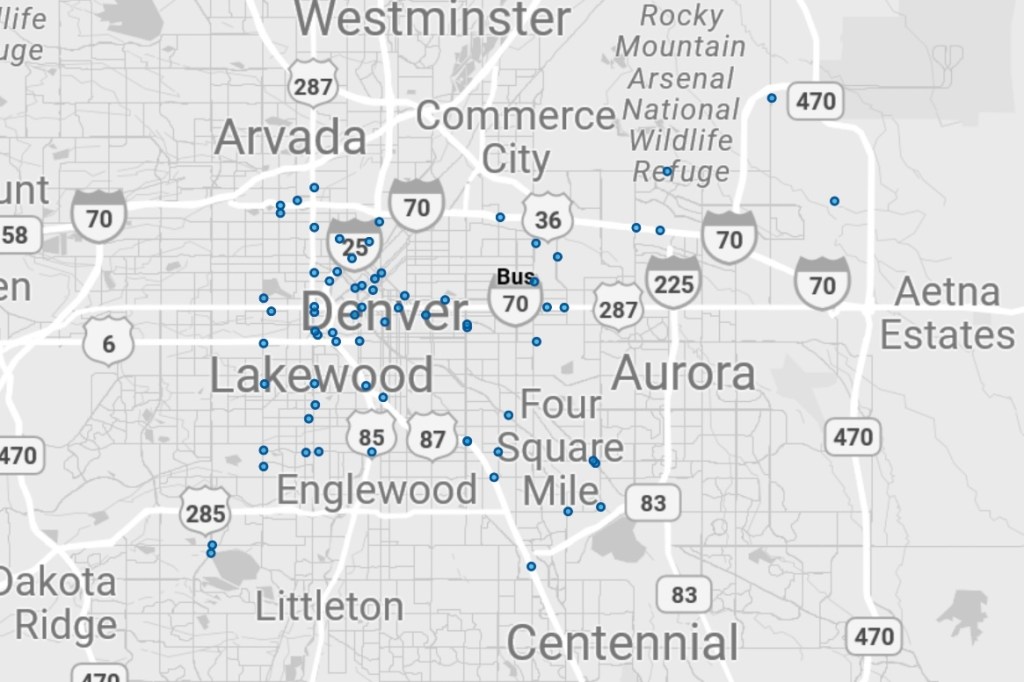
The current Vision Zero map of 2025 traffic fatalities shows that eight people died on or near Federal Boulevard, however. The map also shows that Interstate 25 had eleven deaths in 2025, making it Denver’s deadliest roadway this year. Colfax and Sixth avenues tallied five and three deaths, respectively, in 2025. Federal and Colorado boulevards, as well as Colfax and Sixth avenues, are the streets where most of Denver’s traffic deaths since 2013 have been clustered.
Rather than focus on the overall increase in traffic deaths this year, DOTI is boasting the 10 percent reduction in overall crashes on Federal and 20 percent reduction on Alameda as evidence of SPEED’s success.
According to DOTI, the number of total crashes on Federal went from 643 to 578 between 2023 and November 2025 (DOTI doesn’t offer a more recent figure). On Alameda, total crashes dropped from 478 in 2023 to 383 as of November.
DOTI also notes that fewer accidents on those streets resulted in “serious bodily injury.” On Federal, twenty accidents led to a serious bodily injury in 2023, but that dropped by 20 percent in 2025 to sixteen. Alameda had twelve such accidents in 2023 and eleven in 2024, an 8 percent drop.
DOTI also highlights reductions in late-night crashes between 10 p.m. and 6 a.m. Federal clocked 215 late-night crashes in 2023, but that decreased by 28 percent to 155 this year. Alameda had 103 such crashes in 2023 but just 91 in 2025, a 12 percent reduction.
Ford acknowledges the increase in fatalities, however, saying that DOTI plans to cut the number of traffic fatalities in half by the end of 2026, and that she’s hoping SPEED will get it there.
“While we are proud of the progress we have made, there is still more work to be done,” Ford said. “I look forward to taking additional action in 2026 to better protect pedestrians and drivers.”