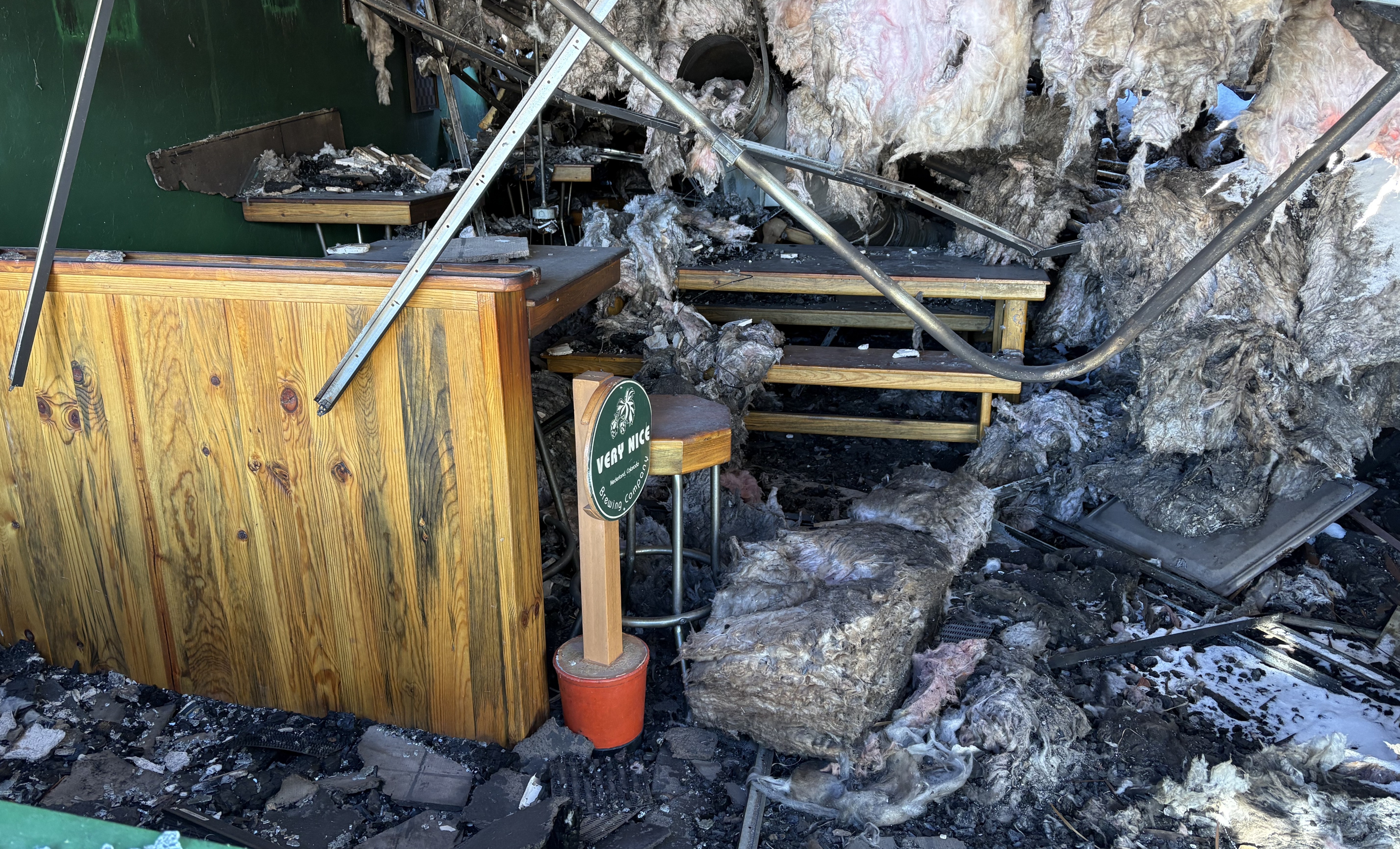
Jeffrey Green/The Very Nice Brewing Company

Audio By Carbonatix
Independent Journalism in Denver Needs You
We need to raise $25,000 by August 9 to support the reporting our community depends on. Reader support keeps us independent and is playing a larger role in funding local journalism and shaping what comes next. If you believe independent local journalism matters, make a contribution today.
During the early morning hours of October 9, 2025, the Caribou Village Shopping Center in Nederland caught fire — and by the time the blaze was extinguished, the structure that once housed eighteen businesses had been transformed into a charred ruin.
More than four months later, the smoke has cleared but little else has changed. What’s left of the center, located at 20 East Lakeview Drive, is now a gaping wound at the heart of the mountain town.
The clean-up has been delayed over a fundamental disagreement over safety and cost between Caribou Village’s owner, Boulder-based Tebo Properties, and the Colorado Department of Public Health and Environment. And while there are finally some positive signs regarding the way forward — including an agreement on February 13 that allowed some of the rubble to be removed — a substantial amount of time is likely to pass before the mess is finally gone.
Concerns over the holdup go beyond aesthetics. Michael Ogletree, senior director of air quality programs for the CDPHE, thinks it’s at least theoretically possible that the Caribou Village wreckage contains asbestos, a known carcinogen. And as Tebo Properties spokesperson Bill Rigler points out, “Since the fire, there have been numerous days with high-wind speeds of over 50 miles per hour that have gone through Nederland, spreading ash and debris. It’s terrible.”
Caught in the middle of this standoff are folks such as Jeffrey Green, co-owner of the Very Nice Brewing Company, a brewery and taphouse that once operated out of the center. Since last fall, Green and his partner and spouse, Susan, have dealt with a series of frustrations in getting the operation up and running again. They’re now readying a new location with the hope of reopening in March — but the space is within view of the Caribou Village detritus, and looking at it makes Green worry about its potential impact on a Very Nice comeback.
“There’s a toxic pile of burnt rubble just sitting there,” he points out. “And who wants to come up to a majestic little mountain town with a toxic pile of burnt rubble in the middle of it?”
On the night of the disaster, word reached Green early. “My wife basically woke me up about four in the morning that day, saying there’s been a fire in Nederland,” Green recalls. “We didn’t know it was the shopping center at first, but I got on Facebook and found out the entire building was engulfed in flame. It was built in 1985 and primarily made out of wood, and it was gone before any firefighter had a chance to save it.”
Plenty of questions remain about what happened. Green notes that “nobody has a cause yet, and it’s kind of mysterious they haven’t figured that out yet. The ATF and the FBI came in and said there’s no credible evidence of arson. But we don’t know what caused it.”
There was nothing to salvage, he adds: “It was a total loss for everybody in the shopping center, not just us.”
Fifty to sixty employees were suddenly without jobs. Nederland, with a population of approximately 1,500, was dealt a cruel financial blow, as Caribou Village contributed around 30 percent of the town’s sales-tax revenue.
Fortunately, the Very Nice Brewing Company was insured, but things soon grew complicated.
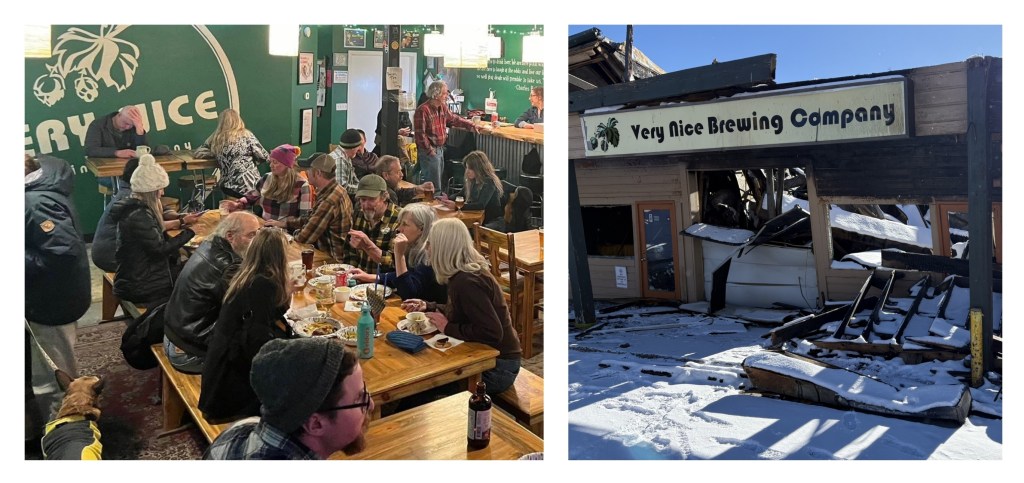
Jeffrey Green/The Very Nice Brewing Company
The insurance company that held the policy “was on it pretty quick,” Green acknowledges. “So we had a lot of confidence in the beginning that this was going to be a straightforward process. They said, ‘We’re going to take care of you. We’re going to make you whole.'”
Problem was, the policy was for replacement cost value of the business’s contents, not actual cost value, and this distinction proved key. The Nederland space at Caribou Village had a full-service brewing operation, but the Greens didn’t want to put money into rebuilding it because they’d built a manufacturing facility in Gilpin County outside Black Hawk a couple of years ago that could handle this function. But the insurance provider balked at offering any compensation for the destroyed brewing equipment in Nederland, they say, and tried to lowball the couple in numerous other areas, too. After weeks of negotiations that were even more painful owing to the trauma they’d experienced, a deal was finally struck, but the final agreement hardly fills Green with joy.
“The insurance we’ve been paying for the last five years was well over $400,000,” he estimates, “and we got about half of that.”
Despite this setback, the Greens didn’t want to give up on Nederland. They eventually found a space in an old bank located at 26 Peak to Peak Highway; Brightwood Music, another business displaced by the fire, is now there as well. Renovations of the building’s top level are going well, and Green praises the Town of Nederland for its assistance. However, his excitement about new possibilities is tempered by the sight of the lingering Caribou Village remains,
“It’s a shadow on the town,” he says. “It just doesn’t feel happy anymore, because there’s this constant reminder of what we lost. It’s a depressing thing.”
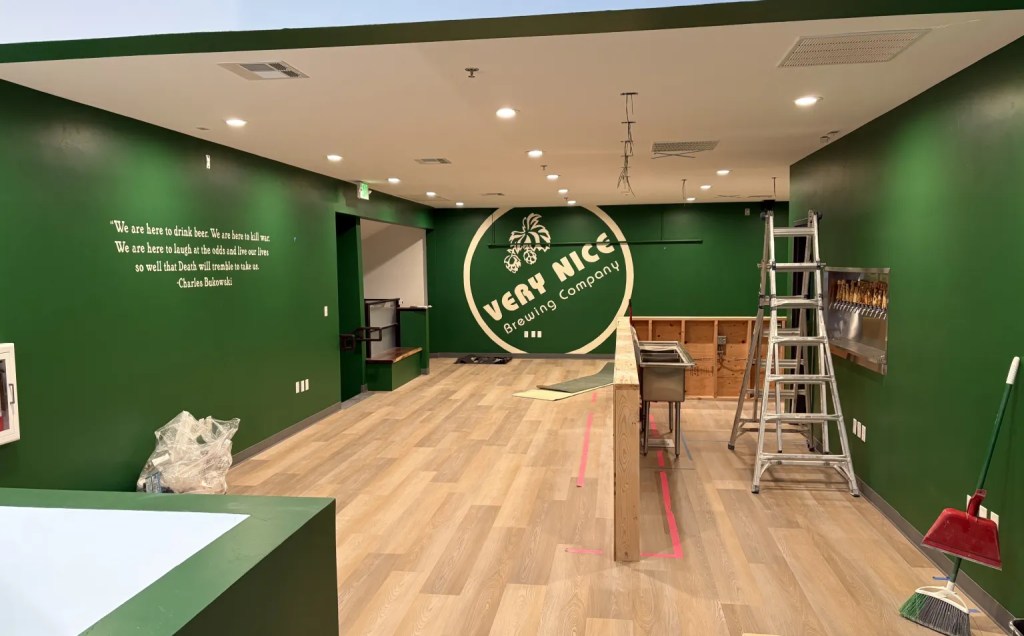
Jeffrey Green/The Very Nice Brewing Company
Tebo Properties spokesperson Rigler sympathizes. “The stories we’re hearing are heartbreaking,” he says. “We got an email from one owner asking, ‘What is happening? When can the rebuilding start? Why are we being punished this way?’ Our hearts go out to them, and we want to rebuild as soon as possible. The fact that we’re now four months after the fire and the ash is still sitting there is a tragedy.”
As Rigler tells it, contractors took 78 samples from the Caribou Village site, and when none of them showed the presence of asbestos, plans were made to begin clearing the ground on December 18. However, he maintains that they have “been prevented by the health department from doing anything.”
Some of the reasons why can be found in a letter from the CDPHE’s regulatory and support unit, which was obtained by another Caribou Village business owner via a Colorado Open Records Act request. One passage reads: “The delay in clean up has been a result of waiting for the property owner to decide how they’d like to move forward. The property owner has the option to choose one of two required paths under state and federal asbestos requirements: (1) hire a Colorado-certified asbestos inspector to further test the debris, or (2) assume asbestos is present and remove it under asbestos-safe procedures.”
The first of these options baffles Rigler. He believes the 78 negative samples to be more than enough proof that asbestos isn’t present, particularly since its use “was discontinued years before the shopping center was built.”
However, that’s not quite right, according to the CDPHE’s Ogletree. “There isn’t a complete ban of asbestos-containing material for use in buildings. Asbestos-containing materials can still be used to this day,” he notes.
The regulatory history of asbestos cited on the federal Environmental Protection Agency website backs up Ogletree’s assertion. The EPA banned asbestos-containing material used in spray-applied surfacing back in 1973, with other specific prohibitions following in 1975, 1977 and 1978. But a 1989 effort by the department to broaden these edicts was overturned a couple of years later. Another thirty years would pass before the EPA’s “final rule” on the topic, issued in 2019; it states that “discontinued asbestos products cannot be reintroduced into commerce without the Agency evaluating them and putting in place any necessary restrictions.”
Due to the shifting regulatory landscape, Ogletree says that it’s standard operating procedure at the CDPHE to require land owners to take asbestos-related precautions whenever they’re dealing with a demolished structure. “In 2025, we had over 7,000 building permits that were required to be treated as asbestos-containing,” he says, and that makes the Tebo Properties position “a unique situation.”
“When something like this has happened historically, the property owners treat it as asbestos-containing for commercial buildings. This is one of the first times we’ve seen where a building owner is looking at doing something different,” Ogletree adds.
Rigler defends the Tebo Properties approach. Following the CDPHE’s recommended asbestos protocol would “add at least a million more dollars to the cost even before construction begins and add another three-to-six months before everything is finished,” he maintains. Moreover, “if the default setting for the CDPHE is to treat everything like it contains asbestos, that seems a lot like scraping your knee and being told by the insurance company that you have to get an MRI to be on the safe side. It’s a level of cost and time that’s really extraordinary, and it’s really unfortunate that the CDPHE is trying to push Tebo Properties down this road despite all the evidence that asbestos has not been found.”
Initially, Tebo Properties proposed to take as many as 500 more independent samples from the site in an effort to get the CDPHE to back down. But before that happened, an alternative compromise was reached. The CDPHE asked Tebo Properties to submit a so-called “site stabilization plan” to ensure that testing could take place without the risk of asbestos contamination. Tebo Properties agreed, and the department blessed the procedure on February 13. The approval means additional testing will start within days…and a limited cleanup was allowed to get underway while that testing was done.
If all the samples come back clean, full demolition is expected to get underway shortly thereafter. If not, the more complex strategy for handling asbestos-containing material will be required, likely pushing completion of the mop-up to late spring or early summer.
Ogletree insists that the remains of the Caribou Village fire haven’t unduly jeopardized Nederland residents. “If asbestos is at the site, it’s less of a risk when it’s all contained in one place than if they were to start moving it around, picking things up and putting it in trucks and moving it around the community,” he says. “And we want to make sure we’re not further endangering the community in high-wind events by making things more loose than they would have been otherwise.”
Both Rigler and Ogletree emphasize that they want to resolve the issue as soon as they can and express sympathy to Nederlanders, who’ve had to stare at the shopping center’s corpse for going on half a year. But Green feels lots of damage has already been done.
“People used to stop a lot in Nederland coming back from Eldora,” he says of the ski area Eldora plans to purcahse. “And even though we’ve had a horrible snow season, there are still lines of cars coming through town, and I can’t imagine they’re stopping like they used to. I know business owners in Nederland are having a hard time. How much that has to do with the lack of snow and how much it has to do with the giant pile of debris, I don’t know. But I know it’s not good.”