
Bennito L. Kelty

Audio By Carbonatix
If you spend enough time at neighborhood meetings across Denver, you increasingly hear the same concerns. Golden Triangle. Ballpark. Montbello. Hampden. Central Park. Different parts of the city, different demographics, different sub-cultures, but the same concerns repeatedly surface.
Our neighborhoods across Denver speak about open drug use, aggressive behavior, unsafe sidewalks, erratic driving, street racing, vehicles without license plates, and noise that disrupts entire neighborhoods late into the night. Folks are describing a city where enforcement feels inconsistent, where response times vary, and where the gap between policy intent and lived experiences continues to widen.
To be fair, the City of Denver is not doing nothing. Police have deployed targeted operations, the city has expanded homelessness services, and community-based groups are stepping in to de-escalate conflicts. But the feedback from residents suggests that the system is not operating in a coordinated way…and the results are not there.
Public safety is about whether people feel order in their lived environments. Right now, too many residents do not.
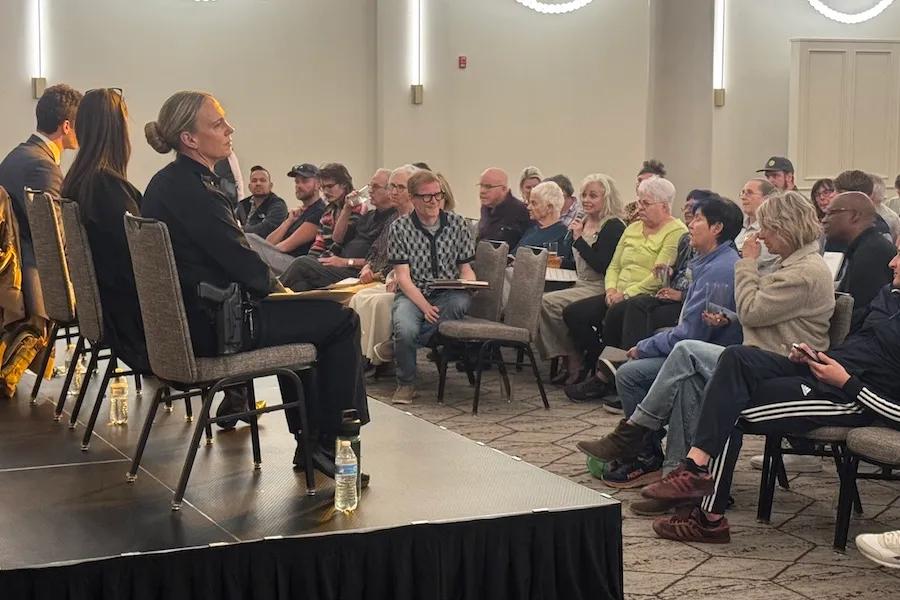
As I’ve attended Denver Police Citizen’s Advisory Board (CAB) meetings and met with residents across neighborhoods, I’ve noticed a few patterns.
First, enforcement is often reactive, delayed or non-existent. Residents are repeatedly told to report issues and that data matters, but when chronic problem areas are obvious, our expectation is proactive intervention. This is painfully obvious when specific problem parcels become evident in the data or repeated situations, like street racing, go unenforced. A system that relies on the steady build-up of call logs is a system that delays action.
Second, there is a breakdown between enforcement and consequences. When individuals are arrested and quickly returned to the same location, it undermines deterrence and public confidence. When the same individuals are allowed to repeat crimes and nuisances, it builds an environment where crime flourishes. This is not a simple issue. There are legal standards, resource constraints and equity concerns, but ignoring the problem or barely reacting does not make the problem go away.
Third, the city is managing pieces of the problem rather than addressing the entire system. Police, prosecutors, homelessness services, nonprofits and neighborhood organizations don’t always work in alignment. In some cases, well-intentioned efforts can even work against each other, concentrating activity in already strained areas. In a time of limited resources, careful planning is the only option to get results.
Other cities have started to address this by treating public safety as an integrated operation system rather than a set of separate efforts and programs. In Houston, homelessness declined over the past decade because the city aligned disparate programs: sharing data, coordinating placements and focusing on moving people off the streets. In Portland and Albuquerque, civilian response teams now handle thousands of behavioral health and homelessness-related calls, freeing police to focus on crime. In Camden, New Jersey, sustained community-based policing and targeted deployment reduced violent crime while rebuilding trust with residents. In Colorado Springs, “clean and safe” teams provide a constant presence to address the visible disorder that police alone cannot manage.
Outcomes improve when cities align resources, clarify roles and focus on execution. Denver should apply the same discipline in our approach to addressing these core concerns.
The solution starts with being honest about enforcement gaps. Traffic violations, like missing license plates, reckless driving and street racing, are not minor issues. When left unaddressed, these issues communicate that basic rules are optional and violators repeat their dangerous actions. The same is true of chronic noise violations. The same is true of open drug use. The same is true of disturbing the peace. These are quality-of-life issues that reduce the livability of a very expensive city for many of us. If Denver wants to be a great city, we need to address these issues. Consistent enforcement makes a difference.
It also means that the police department needs the capacity to meet expectations. Staffing shortages directly affect response times, proactive policing and the ability to sustain a presence in high-need areas. Denver should prioritize reaching full staffing levels and have a serious conversation about whether current authorized strength is sufficient for a growing city with big-city challenges. It also means that, with limited public resources, taxpayer dollars should be focused on what works and that expensive programs, like those focused on homelessness, should be reviewed for outcomes, not just output metrics.
The goal must also be smarter deployment and thoughtful use of resources. Focus enforcement in known hotspots and use data-driven prioritization and clear alignment with prosecutors to ensure that enforcement actions lead to meaningful outcomes. At the same time, Denver should prioritize complementary models through civilian response teams and neighborhood-level tools, like Business Improvement Districts (BIDs) and General Improvement Districts (GIDs).
The City of Denver is already aware of these challenges and is taking actionable steps to address public-safety issues, but achieving outcomes requires the courage to make the hard decisions about enforcement, even those that may be politically unpopular in the short term. Results also require a willingness to recognize what is not working and to make necessary changes to manage an end-to-end system.
In these community meetings, Denver residents are asking for a city that feels orderly, responsive and accountable. They are asking for visible progress in the places they call home. The message is consistent. It’s about time the level of response meets the seriousness of this moment.
On weekends, Westword publishes commentaries on matters of interest to the Denver community. Have one you’d like considered? Send it to editorial@westword.com, where you can also comment on this piece.