
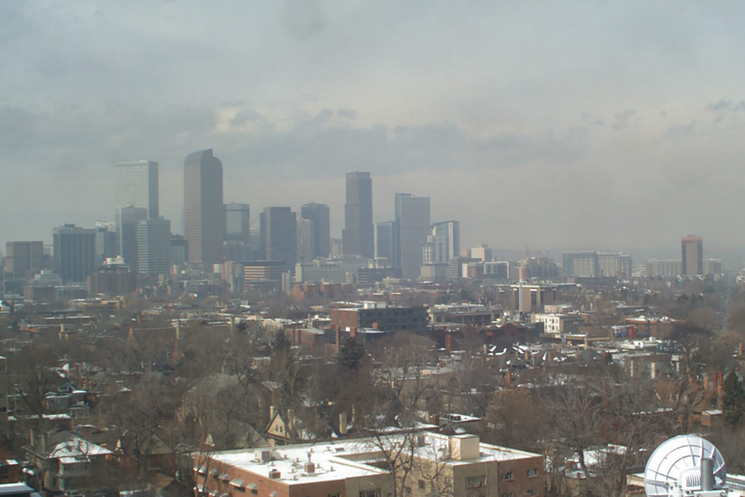
CDPHE

Audio By Carbonatix
Independent Journalism in Denver Needs You
We need to raise $25,000 by August 9 to support the reporting our community depends on. Reader support keeps us independent and is playing a larger role in funding local journalism and shaping what comes next. If you believe independent local journalism matters, make a contribution today.
While transplants often move to Denver in search of fresh mountain air, the Mile High City has always struggled with pollution. News reports of Denver’s smoggy atmosphere date back to the 1800s, shortly after the city’s founding.
By the 1980s, the brown cloud hanging over Denver had a national reputation. After the Denver Broncos were blown out in Super Bowl XXII in 1988, CBS Evening News reporter Bob McNamara got in one more dig, saying the 42-10 loss to the Washington Redskins (now the Commanders) must be hard to swallow “for a town that’s never been number one in anything but carbon monoxide levels.”
Conditions have improved in recent decades, but the city’s persistent haze continues to confound Coloradans to this day. Rob in Arvada asked: “Looking east from the foothills, why is downtown Denver often surrounded by a dirty-looking grey cloud? Is it pollution or something else? How come it’s worse some days than others?”
So, for the latest edition of our Weekly WTF series, we revisited the infamous cloud.
What’s with the cloud?
Essentially, it’s pollution — but that can stem from several different sources.
The phenomenon is largely due to topography. Denver’s proximity to the Rocky Mountains results in increased wind speeds and unique airflow patterns that, as NASA puts it, “frequently trap air pollution, curdling it into a dense, visible layer.”
That means when vehicles driving through Denver emit noxious chemicals, they sometimes hang in the air. In addition to the abundance of vehicles in the city, Denver is close to several industrial plants that emit air pollutants, notably the Suncor oil refinery in Commerce City. Those pollutants result in the formation of ozone when they interact with sunlight and heat.
Denver is the eighth-most ozone-polluted city in the nation, with an average of thirty high-ozone days a year, according to a recent report from the American Lung Association. Though ozone itself is invisible, it is the primary ingredient in photochemical smog, which is a brownish-gray haze.
Wildfires have also become larger and more frequent in Colorado, too, which causes particle pollution, another source of haze. Though Denver is spared from the flames, it suffers from the smoke of increasingly disastrous wildfires, particularly along the Front Range, and even from wildfires outside of the state, as was the case with the Nebraska wildfires in March.
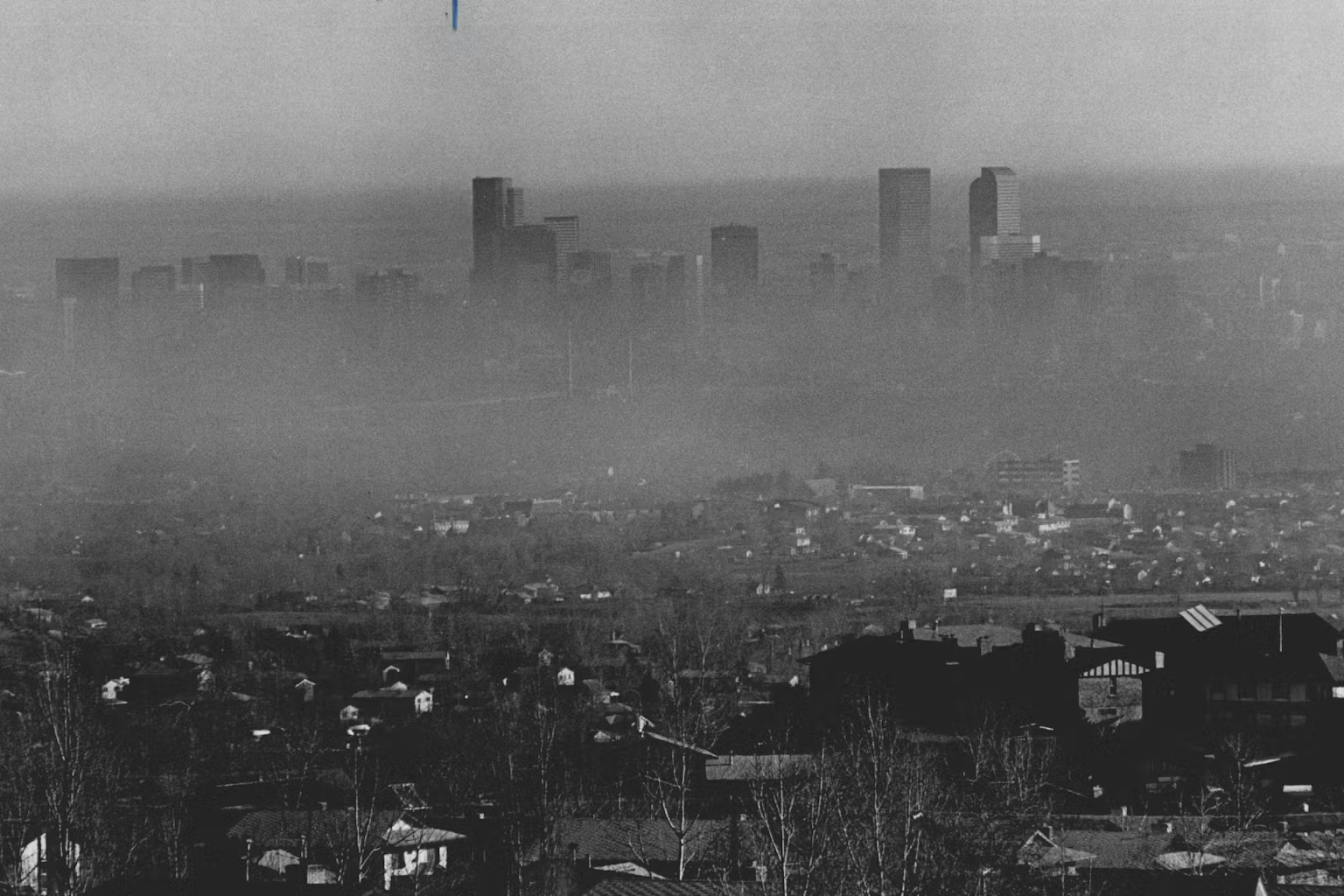
Denver Post via Getty Images
Why does it change day to day?
Dramatic daily changes in smogginess can often be attributed to temperature inversions. That’s when the air temperature is warmer higher up, trapping a layer of cooler air below closer to the ground. Because air under the inversion is trapped, so is pollution. Again, Denver’s topography is highly conducive to the formation of inversions due to its proximity to the Rocky Mountains.
Inversions can happen at any time, though they are more common in the winter, when the sun supplies less warmth to the surface and more warmth to the atmosphere.
In the summer, hazy days are frequently caused by fires in and around Colorado. The dry, warm weather increases the risk of wildfires and, with them, smoke and particle pollution. In addition, increased heat interacting with pollutants causes more high ozone days. June marks the start of high-ozone days in Denver, and health departments keep a close watch.
Still, no matter what time of year, the cloud can still make an appearance.
Do you have a question you want Westword to answer? Submit it here, and we may respond in our next Weekly WTF column.