


Audio By Carbonatix
Independent Journalism in Denver Needs You
We need to raise $25,000 by August 9 to support the reporting our community depends on. Reader support keeps us independent and is playing a larger role in funding local journalism and shaping what comes next. If you believe independent local journalism matters, make a contribution today.
It’s been a weird week for Colorado weather — but not weird enough.
The entire state, including the Denver metro, has seen a significant amount of rain over the past two weeks, drowning out some fear of drought in the area. But concerns about dry conditions are still ongoing.
May 18 was a wacky day for Colorado. In just 24 hours between Sunday and Monday, Gov. Jared Polis declared a disaster emergency for the wildfire blazing in southeast Baca County, snow fell in the foothills and hail rocked areas east of Denver. But the combination of flame and frost was actually a return to normal, according to Colorado State Climatologist Russ Schumacher.
“This is, maybe, a little bit more typical of May. Maybe our brains got all thrown off by how truly unusual it was in March and April,” he says.
The state just experienced the warmest winter in recorded state history, resulting in one of the worst snowpacks on record. Denver Water depends on mountain snowpack for around 90% of its water supply, which is distributed to the city and surrounding municipalities, causing a plethora of areas to undergo drought restrictions in April.
But, hey, we finally saw some rain over the last two weeks — a lot of rain, actually. According to local measurements, Denver saw more precipitation over the last two weeks than it has in the last five months.
Chris Bianchi, 9News meteorologist, said downtown Denver received 1.48 inches of precipitation between May 5 and May 20, surpassing the 1.43 inches recorded across the previous 151 days, from December 4 through May 5.
“That’s mostly a commentary on just how dry this winter/early spring were,” he wrote on social media. “But still, great to see some meaningful water.”
So, were the two weeks of rain enough to curb the drought restrictions through the summer?
“Certainly very welcome to see these rainy conditions,” Schumacher tells Westword. “But still a long way to go to make up the big deficits.”
CBS Colorado Meteorologist Joe Ruch said that Denver International Airport has seen 3.13 inches of precipitation so far this water year, which starts on Oct. 1. Normally, the area would have seen 6.55 inches between Oct. 1 and now.
Therefore, Denver is about 3.42 inches behind schedule, meaning the city needs more than double the precipitation it has seen between October and May just to catch up to the normal rates.
Furthermore, water distributors rely on snowpack in the mountains, not just rain falling in the area. So while rain has helped lower water demand a bit, it hasn’t done much to alleviate water providers’ restrictions, according to Schumacher.
“At the lower elevations, we get a lot of our moisture in the spring and summer, so a wet summer could go a long way,” he says. “It’s a lot harder to make up the deficits in the river flows and in areas reliant on that snow pack.”
The mountains did receive some snow this week, though, with areas like Walden and Estes Park getting around 6 inches between May 18 and 19. Jamestown saw the most during the storm, with almost 9 inches. Although the storm helped the crippling snowpack numbers to some degree, statewide numbers are still sitting around 20% of normal.
The U.S. Drought Monitor map, run by NOAA, the National Drought Mitigation Center and NASA, still had Denver County sitting in a “severe drought” as of May 19. Parts of Jefferson County just west of Denver, like Lakewood and Golden, are in “extreme drought,” one level higher than Denver.
“Extreme drought,” according to the map, means landscapes are dead, fire danger is greater, reservoirs are low, and grasshoppers and “insect infestation” are noted. (By that measure, Jefferson County may look like it is experiencing a Biblical plague here shortly.)
Drought restrictions are still on with Denver Water, but it’s a slight improvement from the map released a week before.
“This isn’t a drought that will be reversed overnight or in a week or even a few months,” FOX31 Meteorologist Jacob Woods said Thursday. “We have to stay patient, and focus on the fact we’ve now been moving in the right direction for two weeks.”
On top of that, NOAA’s 14-day outlook shows a continuing trend of above-normal precipitation chances until around June 3.
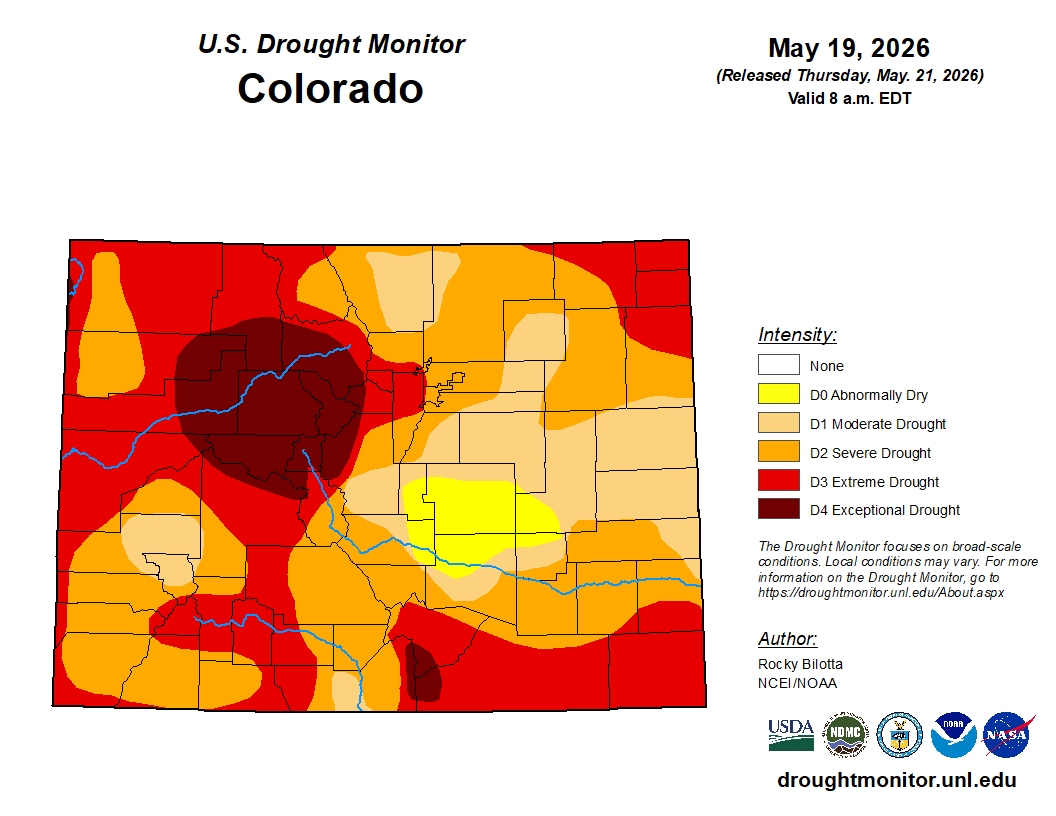
U.S. Drought Monitor