Photo by Evan Semón

Audio By Carbonatix
Denver is changing fast. It feels like every time you turn a corner, there’s a new glass tower (note to local developers: this isn’t Vancouver) or a boring, perfectly symmetrical new gray apartment complex that has popped up overnight, paving over Denver’s weird mix of Victorian, Post-Modern, Art Deco and Beaux Arts architecture. That strange, slightly random character gave our neighborhoods their personalities. For many longtime residents, this erasure feels disorienting.
“I think it’s simply because we are all seeing Denver’s growth and the constant changes to the skyline and surrounding areas,” says photographer Jamie Rogers of Captain Colorado Photography. “A lot has changed in a short period, so it always has us thinking ‘Remember when…’ Change can be scary, and with rapid technological growth, I think we all are reminiscing about simpler times.”
Nostalgia is emotional time travel. You catch a whiff of a familiar perfume or hear an old song you haven’t thought about in a while, and, for a split second, you’re right back in a moment you’d completely forgotten existed. Then you snap back to the present, and it hits you just how much time has actually passed. It’s a strange feeling. You’re happy the moment happened, but there’s a little weight to it, too, because you know you’ll never get to live it again.
That “remember when” feeling has sparked something of a nostalgia boom across the Centennial State. Preserved hotels, historic taverns, hand-drawn typographic art, glossy portraits with venues as subjects, tees of local icons, and museum exhibits about our past are having a moment.
Coloradans are finding all kinds of ways to hang on to the past. There is a real, active push to save the state’s disappearing cultural infrastructure and the sense of community that came with it. As beloved landmarks come down one by one, people are turning to artists, photographers, and local designers to keep the soul of old Colorado breathing.
Courtesy of Rob Steck
From memories to art
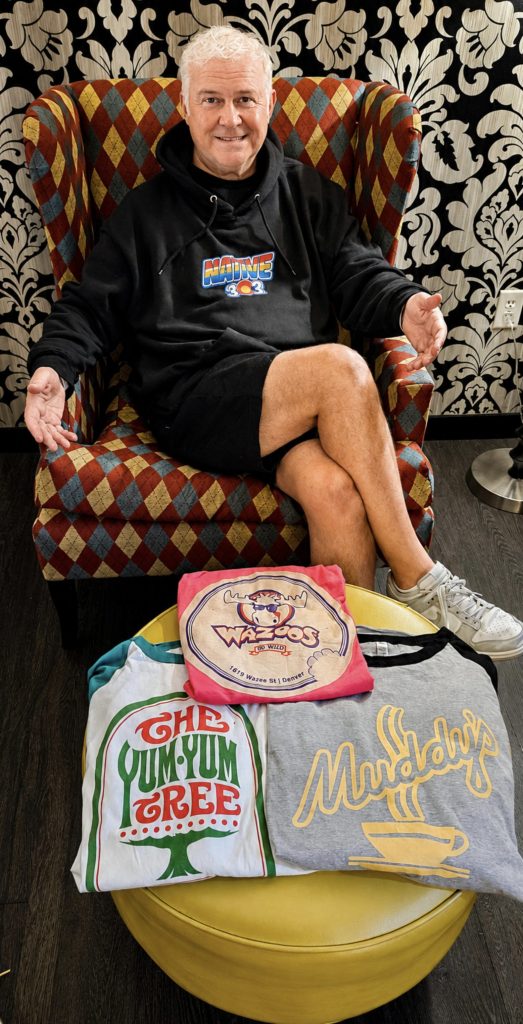
For Rob Steck, founder of the apparel brand Native303, watching his hometown transform is personal. Steck helps locals wear Colorado’s past like a badge of honor.
He can still picture the exact moment it hit him. It was 1997, and he was walking from his childhood home on South Williams Street to Reivers Bar & Grill on Old South Gaylord Street when he passed a favorite historic house. Except it wasn’t there anymore. It had been scraped clean off the lot and replaced with a massive modern home.
“It was like noticing that one house snapped my eyes open to the gutting of the Washington Park I knew and loved,” Steck reflects. “Genuinely, I felt violated. Invaded. Furious.”
That anger got him thinking about just how much of the city’s cultural fabric had been lost to gentrification. Steck has lived in New York, Chicago and London, and that perspective made Denver’s charm click into focus. The magic was in how intimate it all was. “It makes you realize how much more of a ‘neighborhood’ Denver was, than a city,” he explains. Local businesses and family-owned diners were the anchors that held everything together.
“People mourn and praise their memories as if they were a neighbor or member of the family now that they are gone,” he continues. Today, Native303 releases designs featuring the logos of legendary institutions such as Elitch Gardens, the Denver Bears, and the beloved Celebrity Sports Center. For Steck, these designs are pure sensory memory. Ask him what he misses most about old Denver, and he’ll describe the exact smell of walking through the doors at Celebrity.
“A combination of toxic chlorine, hot dogs, stale beer, cigarettes and hot pretzels,” he says. “And somehow you could also smell the sweetness of cotton candy, Icees and fountain soda.”
Wearing one of his shirts has become its own kind of statement. “It’s a special way to stand out and show people you were there, and to invite and encourage solidarity,” Steck says. He talks about the “rusty, jagged edge” of the old city, a Denver where Capitol Hill, Five Points and Colfax were full of unpredictable characters, and how different that feels from today’s more polished version. His shirts offer a bittersweet way back, and customers can’t help sharing stories with him about favorite dishes, first dates and chance encounters at the places on their chests.
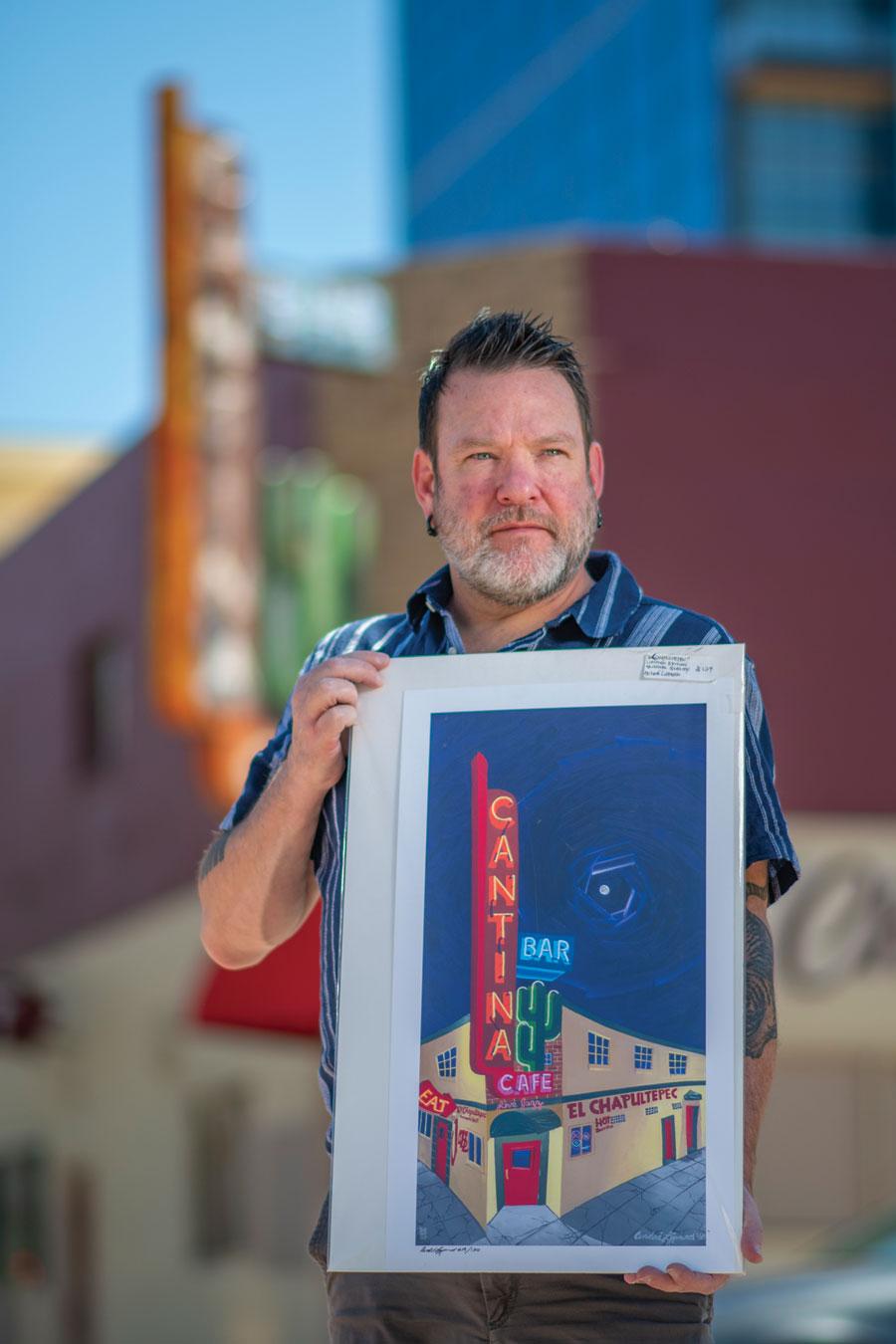
Where Steck captures local nostalgia through apparel, fine artist Andre Lippard captures the soul of the buildings themselves on canvas.
Lippard’s journey into local preservation began almost by accident. Early on, his cityscapes were entirely fictional. But driven by an affinity for Colfax’s music scene and nightlife, he decided to apply his distinct style to a real-world landmark, the iconic Bluebird Theatre. That single shift redirected his career, making Denver city scenes the foundation of his work.
Lippard’s style leans into surrealism, tapping into the subconscious layer of how we experience urban spaces. His canvases act as emotional time capsules. Viewers routinely gather around his paintings to reminisce about personal history, forgotten nights or dreams sparked by the places he paints.
“Nostalgia has always accompanied change, and with recent growth, we see many older venues going away to make room for the new,” Lippard reflects. Beloved spots that have since closed, like one of Denver’s most special historic jazz venues, El Chapultepec, now primarily live on in memory — and on his canvas.
Driven by a desire to archive sites with deep historical recognition, Lippard continues to document Denver’s shifting landscape. His new body of city scenes, featuring local staples like Bastien’s, My Brother’s Bar, the Edgewater Inn and the Berkeley Inn, will be unveiled at his annual solo show at Next Gallery in the 40 West Art Hub, opening Nov. 13.
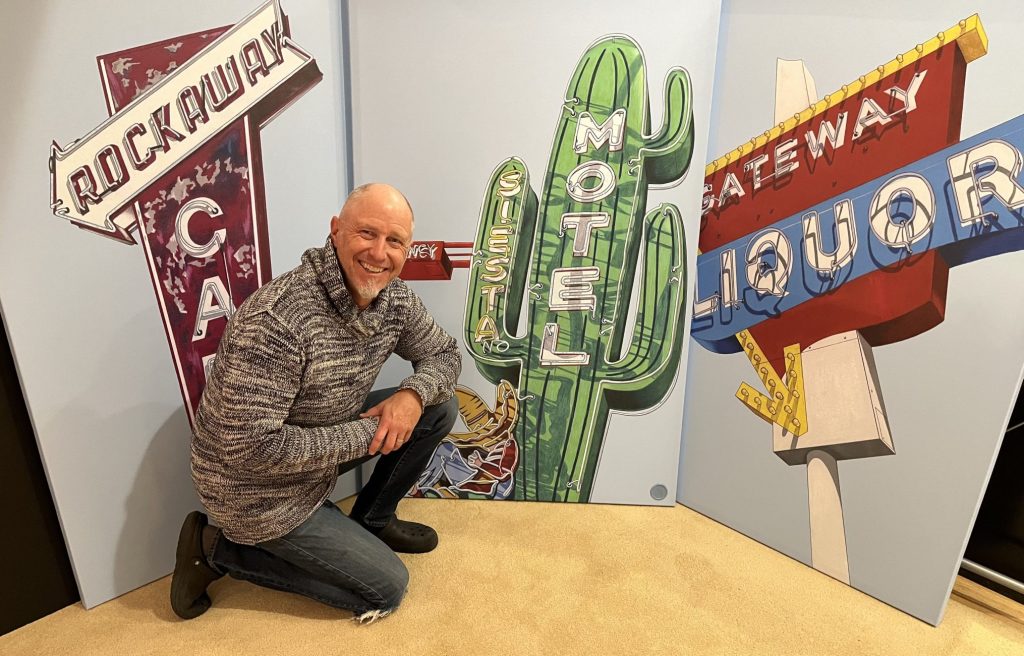
Photo by Joanna Baskett
If Steck and Lippard evoke Colorado’s past through wearable logos and dreamlike streetscapes, fine artist Austin Baskett preserves the state’s mid-century neon signs on paper.
For Baskett, it all started on a quiet afternoon in Boulder. He was sitting in his car at the Ideal Broadway Shops on Baseline, and was struck when he glanced up at the shopping center’s sign framed against the sky.
“I’ve always been fascinated by architecture and typography, and I’ve always drawn,” Baskett recalls. “Looking at it from that angle, I thought, ‘Man, that is so dramatic and cool. I wonder if I could draw that.’ So I snapped a picture with my phone.”
That one sign took him about 100 hours to finish, and it kicked off what turned into a genuine calling. With some encouragement from his wife, he started drawing other classic signs. In 2020, while driving part-time for Via Mobility Services, he crisscrossed the metro area, spotting and photographing old roadside emblems to add to his list, including the Aristocrat Motor Hotel off West Colfax, which has since been torn down.
Why do these old neon signs have such a hold on people? Baskett thinks it’s because they add a whole extra layer to the landscape. “In Colorado, in particular, you have stretches like Colfax, where these signs were everywhere, but now they’re disappearing,” he explains.
The emotional pull of these pieces runs deep. Baskett remembers a man who approached him at the Pearl Street Arts Festival in Boulder, visibly moved by his drawing of the demolished Circle Motel sign in Lafayette. Turns out the man had lived in that motel as a kid with his single mother. Although she was struggling to get by, the sign held nothing but warm childhood memories for him. The man had since done well for himself, and he bought the drawing to hang in his new home as a daily reminder of where he came from and to always stay humble.
Baskett’s to-draw list now sits at nearly 100 signs, the Bonnie Brae Tavern among them. And he doesn’t really think of the finished pieces as his. If he were to pass away tomorrow, he says, his drawings “really belong to the public history,” and should go to History Colorado, or another museum, for posterity.
Photographer Jamie Rogers comes at Colorado’s history from a different angle, literally. His work explores the interplay between old structures and the ever-taller modern skyline, Through Captain Colorado Photography, he tries to capture the soul of the classics. “Photography is about style and capturing things from a unique perspective. … I’m always looking for another angle I haven’t seen the building from or adding unique foreground items to give the photo more depth,” he shares.
Rogers has taken some stunners over the years, including his drone shot of downtown’s Wells Fargo Building (aka the Cash Register building) at sunrise, but his all-time favorite Denver subject is the historic Union Station, thanks to its architecture, trains and constant flow of people through it.
When he’s after pure personal nostalgia, though, Rogers heads to the iconic Brown Palace Hotel, which has been standing since 1892.
“The Palace Arms and Ship Tavern inside the hotel will definitely transport you back to another time,” Rogers says. “If you haven’t been there, you need to add it to your list now!”
See it for yourself
Want to go all-in on the mid-century Rocky Mountain West? Head to History Colorado in downtown Denver. The museum’s long-standing exhibition, “Forty Years on the ‘Fax,” covers 1926 to 1966 and gives visitors a ticket down “America’s Main Street,” the 26-mile stretch of Colfax running from Lakewood through Denver and into Aurora.
From the moment it was designated as US Highway 40 in 1926 until Interstate 70 diverted traffic in the 1960s, Colfax Avenue was the place to eat, drink and be entertained. The exhibition, guest curated by Jonny “the Velvet Elvis” Barber, founder of the Colfax Museum, gathers an incredible collection of physical relics from that era. When a devastating flood forced Barber’s original museum to close in 2018, History Colorado stepped up to give his treasures a new home.
The “Forty Years on the ‘Fax” exhibition spotlights the 1950s and ’60s, when Colfax was a culinary destination that had something for everyone. Classic menus, matchbooks, place settings and other memorabilia will remind visitors of legendary spots like Lande’s at Steele Street, which proclaimed itself “A restaurant for the discriminating.”
The exhibition has highlights from restaurants, diverse and varied, but all part of Colfax’s very unique fabric and history. They include places like Eddie Bohn’s Pig’N Whistle barbecue at Wolff Street, the Yucca, El Rancho, the Apple Tree Shanty, the Chicken Box Drive Inn, Gus Schwalb’s Chat and Chew, the Denver Drumstick, Nob Hill Inn, “and too many more to name all along the ‘Fax,” Jason Hanson, Chief Creative Officer for History Colorado, says.
For any Coloradan feeling the sting of all this change, these creators, artists and historians give us a sanctuary. So bust out that vintage Celebrity Sports Center tee. Hang a Pete’s Kitchen drawing in your living room. Pull up a sunrise photo of Union Station, or spend an afternoon wandering the storied halls of the Brown Palace. Colorado’s nostalgia isn’t going anywhere. It’s alive, it’s vibrant, and it’s waiting for you to come find it.