
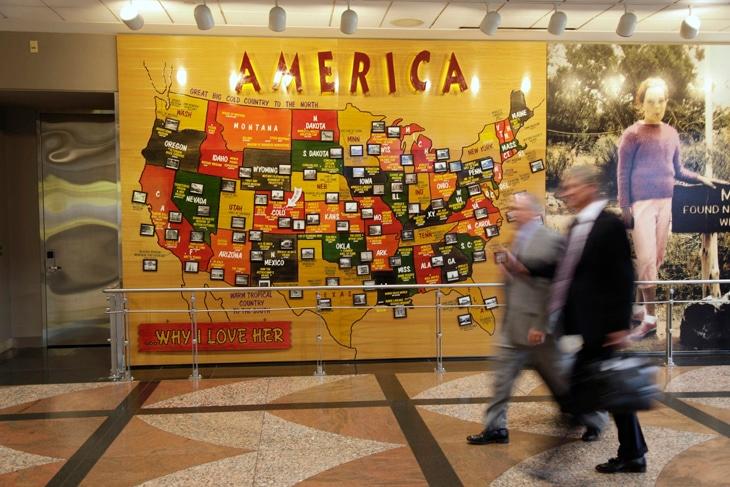
Photograph provided courtesy of Denver International Airport

Audio By Carbonatix
While the public art at Denver International Airport has inspired numerous creepy conspiracy theories involving everything from the giant horse that killed its creator to the New World Order soldiers rounding up children, one of the original pieces in the collection is as American as apple pie…or the World’s Largest Coffee Pot.
And it’s about to return to the Great Hall, now that construction is almost complete there. On the afternoon of Aug. 14, the restored “America, Why I Love Her” will be reinstalled on a wall on the northeast side of Level 5.
Gary Sweeney was a member of the renegade Pirate art cooperative and a baggage handler for Continental Airlines when Denver annexed land way out on the plains in the late ’80s in order to build the country’s largest airport (in land size, at least). Under the city’s 1% for public art program established by then-Mayor Federico Peña, a big pot of money was set aside for public art commissions. Sweeney decided to go for one.
At Pirate during “my term-paper years,” he recalls, “I would do these things on really lofty subjects — Moby Dick, a Japanese mountain climber.” But then he found some of his father’s old photographs, and “what sparked the whole thing was that in 1964 my dad had an Econoline van and we drove 9,000 miles across Route 66, and we found some of these weird places.”
He decided to focus on “nostalgia” for his DIA proposal, creating something that would reduce the stress for travelers waiting for their luggage by diverting them with a map celebrating some of the country’s oddest attractions.
Sweeney, who’d only done two small public art commissions, remembers being up against five blue-chip artists for this one. “I got in there and completely oversold myself,” he admits. “I couldn’t believe how cocky I was.”
But “America, Why I Love Her” triumphed, “and it completely changed my life,” Sweeney says.
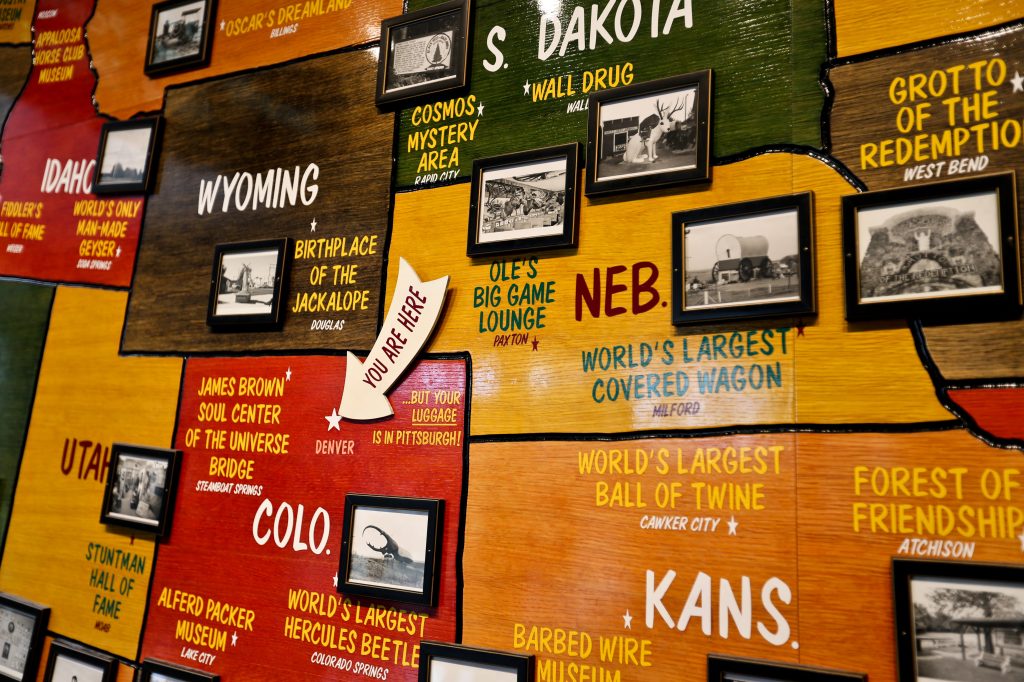
Photograph provided courtesy of Denver International Airport.
A $100,000 commission wasn’t the only change coming.
While Sweeney had grown up in California (a decade ago, he redecorated a childhood home in Manhattan Beach destined for demolition as another art project), he’d definitely made his mark in Denver in the ’80s. But the airport project that gave him his big break also made him move: Continental, originally one of five airlines that were to be mainstays at DIA, decided the project was too expensive and pulled out. If he wanted to keep his job, Sweeney would need to move. His partner, Janet, was a flight attendant based in Houston; ultimately, they decided to move to San Antonio, which was “very affordable, with a very good art scene,” Sweeney recalls.
They were gone by the time the airport finally opened on February 28, 1995.
While continuing to work for Continental even after it merged with United, Sweeney’s artistic career kept growing, with shows around the country as well as in Cuba and Europe. Right now, he’s in Berlin for his first residency. “We haven’t lived in Denver in thirty fucking years,” he says. “Blink of an eye.”
But he hasn’t forgotten Denver, and Denver hasn’t forgotten his famous work. While he and Janet sold off the real estate they’d acquired here — one LoHi bungalow had been turned into a secret pot ranch by a tenant — “America, Why I Love Her” remained a constant reminder of their time in Colorado. Until it was taken down during the seemingly endless Great Hall reconstruction project.
“I was supposed to go back there three summers ago to fix it,” Sweeney says, but then the airport said it had found a company that could do it professionally, although the colors might be a little different. “I’m fine with that,” he adds. “I’m not going to be a prima donna.”
After all, the contents remain the same….and they’re what count. “A lot of those places aren’t there anymore,” Sweeney notes. Not only is the Tragedy in US History Museum — which had “Jayne Mansfield’s death car” as well as Lee Harvey Oswald’s bedroom furniture — gone, but when Sweeney asked about the whereabouts of the St. Augustine facility, “the chamber of commerce denied that it had existed,” he says.
But Tiny Town and the Steve Canyon statue are still just a quick drive from Denver, and the World’s Wonder View Tower in Genoa reopened this summer. The Garden of Eden is still going strong, too but another Kansas curiosity is gone. “We went to one place where they had 5,000 telephones,” Sweeney remembers. “By the time we got there, they had died and their children had rented a dumpster for the collection.”
And some attractions never made the map. For example, Sweeney didn’t include the Museum of Menstruation in Baltimore, created by the grandson of the man who started the Miss America pageant. There’s no giant pencil sharpener, a landmark in Minnesota, and the Museum of Questionable Medical Devices in Minneapolis didn’t make the cut, either. But it did make an impression: On one flight, Janet was telling another attendant about an item in that museum’s collection that blasted X-rays at your foot to show how a shoe fit, and an eavesdropping passenger told her that “my neighbor was sterilized by one of those,” Sweeney says.
“America, Why I Love Her” isn’t the only piece returning to the airport.
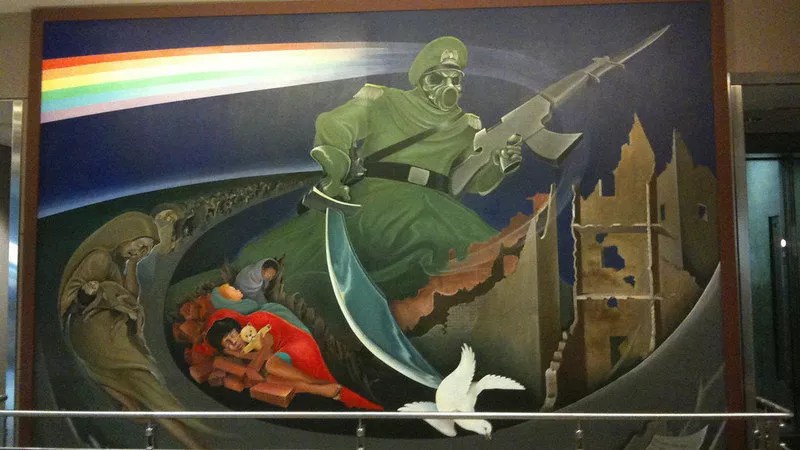
flydenver
Leo Tanguma’s “In Peace and Harmony with Nature,” the most controversial airport art this side of “Mustang,” is back on Level 5 this week. This time, though, it’s behind protective barriers to deter those critics who demanded it be removed permanently.
Two works that were part of Denver’s Cultural Perspectives Project — the mural “La Memoria de Nuestra Tierra (Our Land Has Memory),” by Judith Baca, and “Mile High and Rising,” by Marcus Akinlana — will both return to Level 5 this month.
Other art that’s been in storage, including “Spirit of the People: A Native American Exhibition” and the sculpture that’s a tribute to entrepreneur Elrey Jeppesen, namesake of the terminal, will be back this fall.
They’ll join still more art that’s been added to the airport’s collection through the years.
Sweeney is a fan of “It’s Not What You Take, It’s What You Bring Back,” an installation of suitcases by Thomas “Detour” Evans that was installed on Concourse B in January 2025. He’d thought about working with baggage, too, but the Art Guys had already done that with a piece in the San Antonio airport. “It was so well-engineered, I could never have done that,” Sweeney says.
Among the original commissions, he likes Betty Woodman’s ceramics and “Gargoyle,” the monsters in suitcases by the baggage area created by Terry Allen, one of his teachers back in college. And then there’s Luis Jiménez’s legendary “Mustang,” although by the time it was finally installed outside the airport, Sweeney was long gone from Denver. And Jiminez had been killed by his own creation.
Then, too, he’ll always have a soft spot for “America, Why I Love Her,” and all the eccentric attractions that inspired the piece. “And it didn’t kill anyone,” Sweeney concludes.