Laura Shape

Audio By Carbonatix
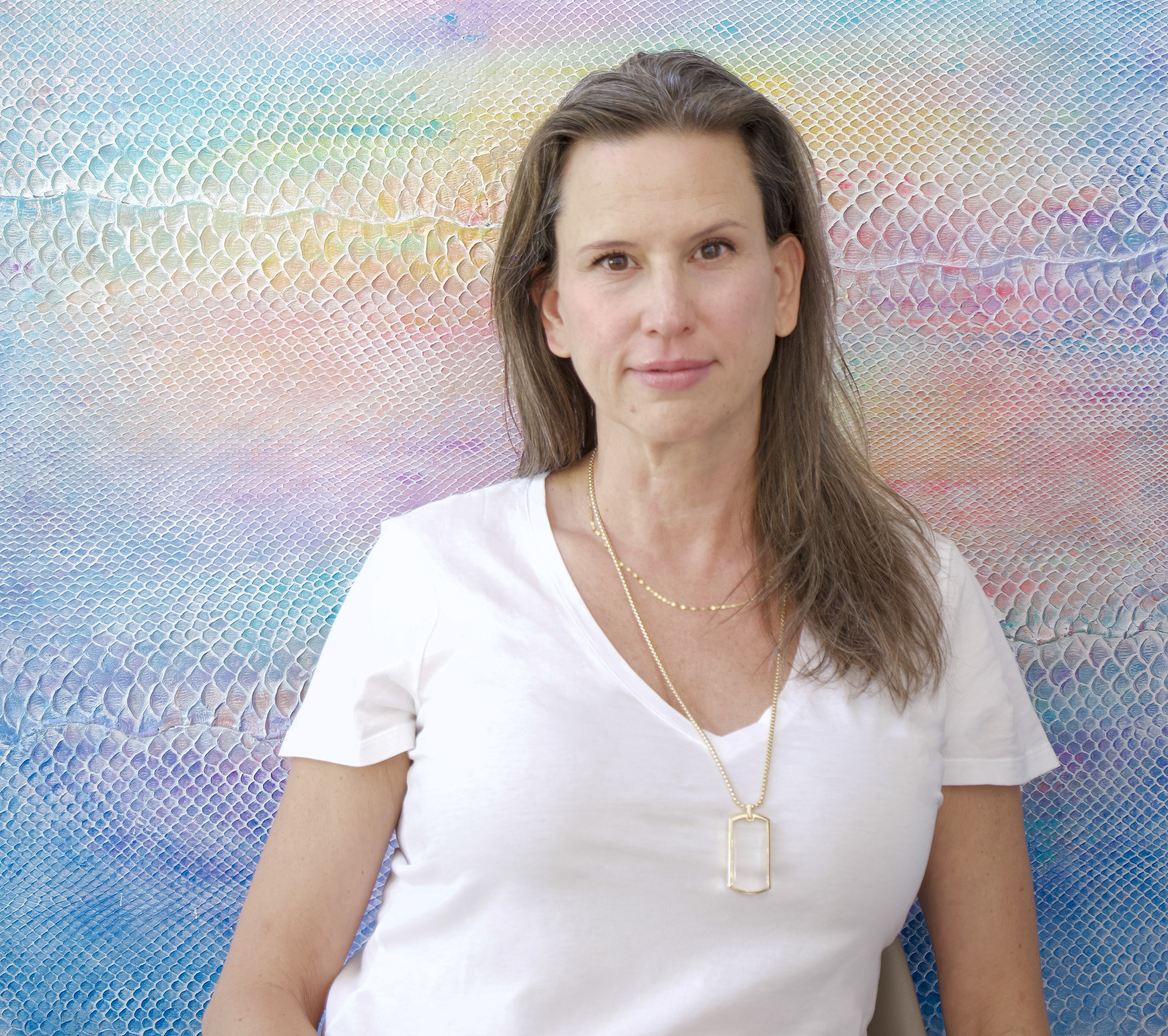
“I didn’t set out to be an environmental artist,” says Denver creator Laura Shape. “But that’s what I became. Still, I don’t really make art about the environment. I make art about a problem that exists within the environment, art that in turn helps to solve that same problem.”
The problem Shape is talking about is a serious one: the issue of what to do about invasive species that actually endanger other species, and the earthly ecosystems they inhabit. Specifically, she takes the skins of these culled invasive species — primarily Burmese pythons from the Everglades, Lionfish from the Atlantic coast of the Americas, and Asian Carp from the Mississippi River. Each one of those species was in some way introduced artificially into its respective environment and has come to threaten it with both behavior and reproductive speed.
Shape has made partnerships with several small businesses in America that work in the purposeful and conscious culling of those invasive species, in order to protect the rest of the environment from their deleterious effects; if possible, those culled animals’ meat is used as a food source, and Shape buys some of the skins for use in her art.
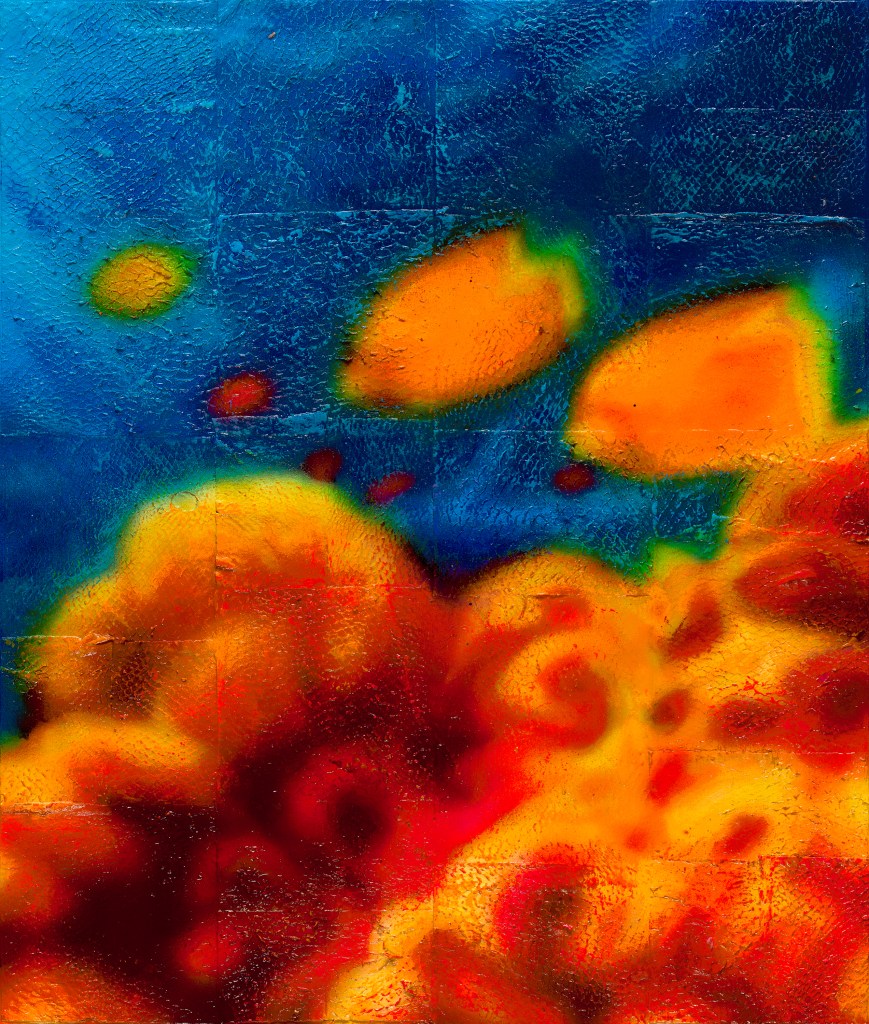
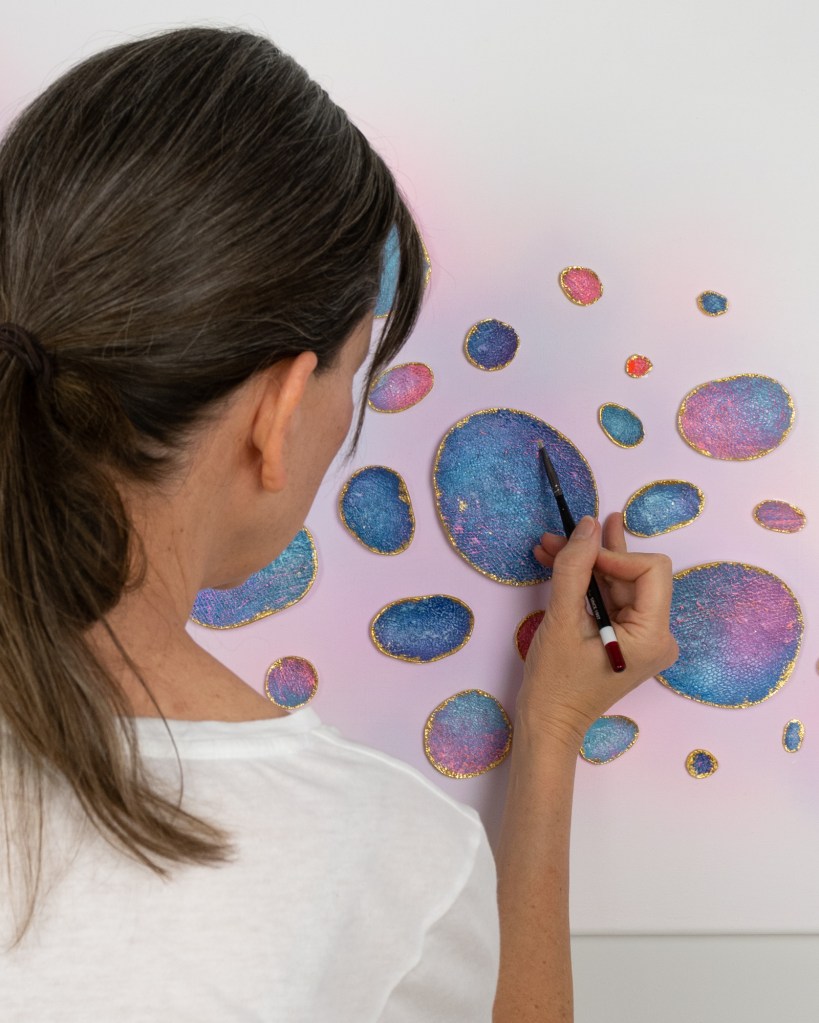
Shape uses the skins in such a way so as to showcase their texture while manipulating the size and shape to an artistic end. She cuts squares of the hide, and then arranges them with an artistic eye, following up with a paint treatment. “When I tried it for the first time, one of the first things I noticed after deciding that it could work was that it was also infinitely scalable,” she says. “I could cut and tile as many as I needed to make any size of piece. That’s when it clicked for me; this was how to do it.”
Shape says she tried out different painting techniques once the individual pieces of the hides were arranged to her satisfaction. “I airbrush these pieces because I learned if I used a brush, it just skimmed the surface, and the paint couldn’t really get in,” she explains. “Airbrushing forces the color in deeply, to great effect. And then if I want to, I can rub in another color on top, to highlight the texture.”
The process Shape uses to create the works is ever-developing, too. “For example, my latest piece is made from Lionfish,” she says, “and I discovered that the fall-off from the airbrushing actually caught on the various ridges and textures. So that showed up naturally, a new thing.” Like artist Bob Ross’ happy accidents. “I use that phrase all the time,” Shape laughs.
Happy Accidents
Laura Shape
A series of happy accidents is exactly how Shape describes her career and its many phases. “I was often very lucky to be in the right places at the right times,” she admits. She says she owes the early part of her career, a notable graphic design gig in California that she worked at for two decades, to just happening to go to school at the Rochester Institute of Technology. “It was one of the only places I knew that was using computers to do art back in 1988,” she says. “And in my senior year there, Photoshop came out, and I had a professor who was into it, and I got to be one of the early adopters of that technology. By the time I graduated, I was one of the few who were already proficient with it. That kind of made my career.”
Her first career, anyway. After a score of years working successfully in that field, Shape felt it was time to do something else. “I got burnt out,” she says. It was around that same time that she met her now-husband, and marrying him was the reason she relocated to Denver in 2015, where she could become a full-time artist.
But Shape didn’t know what exactly she wanted to do just yet. “I started sculpting belt buckles for women in their 40s and 50s, but that didn’t work because women of that age don’t necessarily want to draw attention to their midsections,” she laughs. “So I abandoned that.”
Shape says she worked across several different kinds of media, and during the pandemic, she learned how to hand-stitch luxury leathers, which she initially put to use crafting handbags. “I found I liked working with exotic leathers,” she says, “but I also learned that it took so much time, so labor-intensive, that I wasn’t going to get to create all the ideas I had in mind.” So she embraced more artistic goals, starting with art piece bowls and eventually the wall art for which she’s now becoming known for.
“This Is Something I Can Help With”
Throughout this process, Shape admits that she was always uncomfortable with using something else’s skin as her art medium. “It makes sense when you need that durability for a product in use, like shoes or a handbag,” she says, “but for art, it seemed questionable. There’s a lot of art media; you don’t need something’s skin. So I went looking for a natural leather that I could feel fully good about using.”
Again: right place, right time. Shape stumbled upon an article about invasive Burmese Pythons in the wetlands of Florida; they’d become the apex predator in an environment to which they’d been introduced by mishaps and purposeful release from the pet trade, and were now decimating the wildlife in their hunting ranges. “It’s really a big problem,” says Shape. “There are an estimated 100,000 pythons down there, and only a few thousand a year are caught.”
Shape was lucky in getting in touch with Amy Siewe, the “Python Huntress,” who was looking for a way to use the carcasses of those killed. “You can’t eat them, because they’re full of mercury,” says Shape, “but Siewe figured out a way to turn their skins into a leather, and I was able to buy some from her for some of my early art.”
While Shape liked the effect she got from the python skins, she was still searching for other options to provide more variety in texture. “I had just started to consider fish as an option when I ran across another article,” says Shape, “this one about a small startup called Inversa. They were working with Lionfish in a similar way, culling the non-native species and making leathers from their skins.”
Lionfish are native to the Indo-Pacific, but are now plaguing the Atlantic coast of the Americas, “from Boston to Brazil,” according to Shape. “Lionfish are one of the worst marine invasions in history, so far as we know,” she says — and all, again, from escaped pets. What’s worse is their massive reproduction rate; one Lionfish can lay tens of thousands of eggs every few days — about 2 million per year. “They eat all the smaller fish that would normally feed on the algae on coral reefs,” Shape explains,” which lets the algae proliferate, and that suffocates the reefs.”
A similar problem happens because of the introduction of carp, also called Silverfin, which is ravaging the Mississippi River Basin, a system that touches 31 U.S. states and two Canadian provinces. Those carp can grow to be several feet in length, and weigh upwards of 60 pounds. They can also leap almost six feet above the surface of the water when startled by something like, say, a fishing boat motor.
“Just from that, it’s caused both property damage and personal injury,” Shape says, “but the real danger is in what it does to the river bottom.” The carp were originally brought in to help clean ponds, but because of rain and flooding, they overflowed into the Mississippi system. “They don’t eat the other fish,” says Shape, “but they do outcompete. And worse, they stir up the silt in the water, which makes it more opaque, which means no sunlight can get through. The river becomes starved for oxygen.” Shape works with another small business for the carp, Two Rivers Fisheries out of Kentucky.
Courtesy of Laura Shape
“Politics are part of the reason I’m doing this,” Shape says. “I often feel overwhelmed by all of the ills of the world. All of the things I can’t fix. The environment. Everything. We get inundated, and we feel powerless. But this is why the story of the invasive species appealed to me so much. This is something I can do. This is something I can help with.
“And I’m also painting calm over chaos,” she continues. “If you think of cause-based art, it can often be negative. It’s often awareness-raising, and shock is one of the things that can accomplish that. Which is great, don’t get me wrong, but it creates more of an emotional burden on the viewer. My goal is to bypass that; you don’t even need to know the nature of a piece or the story behind it. You can just like it because you think it’s pretty. The great thing is that even at that level, which is totally valid in terms of appreciation, you’re still participating in the solution to a real problem. This is my small act of resistance. To turn a problem into something beautiful that helps solve it from beneath.”
For more information about Laura Shape’s art and work, see her website.