
akg-images/Laurent Lecat

Audio By Carbonatix
Camille Pissarro wasn’t the flashiest of the Impressionists. He wasn’t the most commercially or critically successful, not like Monet or Manet, Renoir, or Cezanne. He wasn’t a womanizer like Gauguin or an anti-semite like Degas. He wasn’t destitute, heartbroken or tragic like Vincent van Gogh.
So what, or who, was Camille Pissarro, then? The Honest Eye: Camille Pissarro’s Impressionism, which is on view at the Denver Art Museum until February 8, lets visitors come to their own conclusions. Spanning all five decades of the Danish-French Impressionist’s prolific and influential career, the retrospective brings together the largest and most exhaustive survey of Pissarro’s work ever seen on this side of the Atlantic.
Camille Pissarro, Public domain, via Art Gallery of Ontario, Toronto
“There have been wonderful Pissarro shows,” reflects DAM director Christoph Heinrich. “But there hasn’t been a complete survey, anywhere, of his work in almost fifty years. He’s one of the great masters who was there from the beginning until the very end. He was always pushing the boundaries, constantly reflecting on what it means to be an artist.”
With works from the Musee d’Orsay, the Met, the National Gallery and more, the show offers Denver visitors the chance to experience something that rarely happens outside of the world’s major museums — the feeling of getting completely lost in art. Rarely do you see the full landscape of an artist’s life laid out in front of you in paintings, sketches, and letters. Rarely do you see how, over a lifetime, an artist became and remained himself. Rarely do you see such an impressive beard.
Born on the island of St. Thomas in the French West Indies, the show starts with paintings from Pissarro’s adolescent years in the Caribbean, where he captured the color of life in his tropical home. The early paintings have the quality of those from many young, naturally gifted painters: impressive technical aptitude, undermined by a lack of identity or point of view. “He was just finding his path here,” explains guest curator Claire Durand-Ruel. “At the beginning, he was inspired by the generation that came before him.”
It wasn’t long before Pissarro was doing most of the inspiring. In Paris, he fell in with a group of young, ambitious artists who were eager to make a name for themselves in the cafe and art house scene. Though just a few years older, they looked to Pissarro for both technical and philosophical guidance, making him the unofficial father of a budding movement.
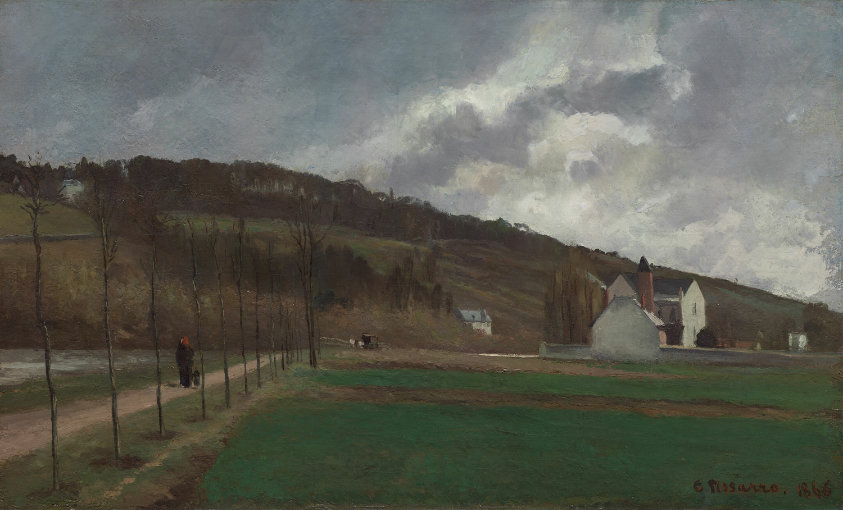
“There was a striking authenticity to his work,” says Heinrich. If honesty was Pissarro’s defining attribute as an artist, it’s visible in those paintings that don’t exactly leap out of their frames, taken alongside the ones that do. One canvas bluntly depicts a landscape in the French countryside on what appears to be the shittiest weather day of the year — heavy gray skies and naked trees, muddy rows of dormant crops.
“He was very inspired by unpicturesque landscapes. Rain, snow, inclement weather,” explains curator Nerina Santorius. “His colleagues didn’t do that.” It takes courage to paint a groggy landscape.
Camille Pissarro, Public Domain, via The Art Institute of Chicago
The center of the show highlights Pissarro’s devotion to his family, another quality that separated him from many of his Impressionist peers. Quotes from letters to his children and wife shed light on the painter’s exuberant but pragmatic personality. To his children, he wrote, “When you feel the impulse to make something, do it no matter the cost…you can be sure of reward. So rare a thing is it to have a desire that it is one’s duty to act on it, and at once, for desire evaporates if one delays. Forward, go to it! Be advised, act!”
On politics, he wrote: “All arts are anarchist when they are beautiful and good. That is my opinion.” And we thank him for sharing.
A lifelong anarchist, he was less convinced than his peers that art could make a political impact. Whether or not he’s right, his belief that art was antithetical to politics may have helped him stay truthful in his depictions of nature. He didn’t force it. For all the brilliance and beauty in Monet’s landscapes, we can be honest: some of it was over the top.
Camille Pissarro, Public domain, via Musée Marmottan Monet
No, Pisarro’s work isn’t always the explosion of color and movement you might expect from the man whom Cezanne called “the first Impressionist.”
If Pissarro was the father of Impressionism, laying the groundwork for a new style characterized by fast, imprecise brush strokes and vivid colors, it was his offspring who took it to the next level. They also took most of the profit.
“His wife had to cook the cabbages that he painted for the family to survive,” Heinrich says. He made a living, which is a feat for an artist in any era, but never had the breakthrough success of his younger peers, moving his family from the city to country and back again several times, in search of new landscapes, political peace and lower rents. C’est la vie.
Even as the most consistent figure in the movement, he wasn’t immune to influence or insecurity, perhaps due to his lack of commercial success.
The show covers several eras in his career, including an unenthusiastic foray into pointillism — a tedious style that became fashionable for a short period. Sensing that his mentor was caving to a fad, Monet intervened to tell him to cut it out with the little dots. Pissarro admitted his heart wasn’t in it, thankfully.
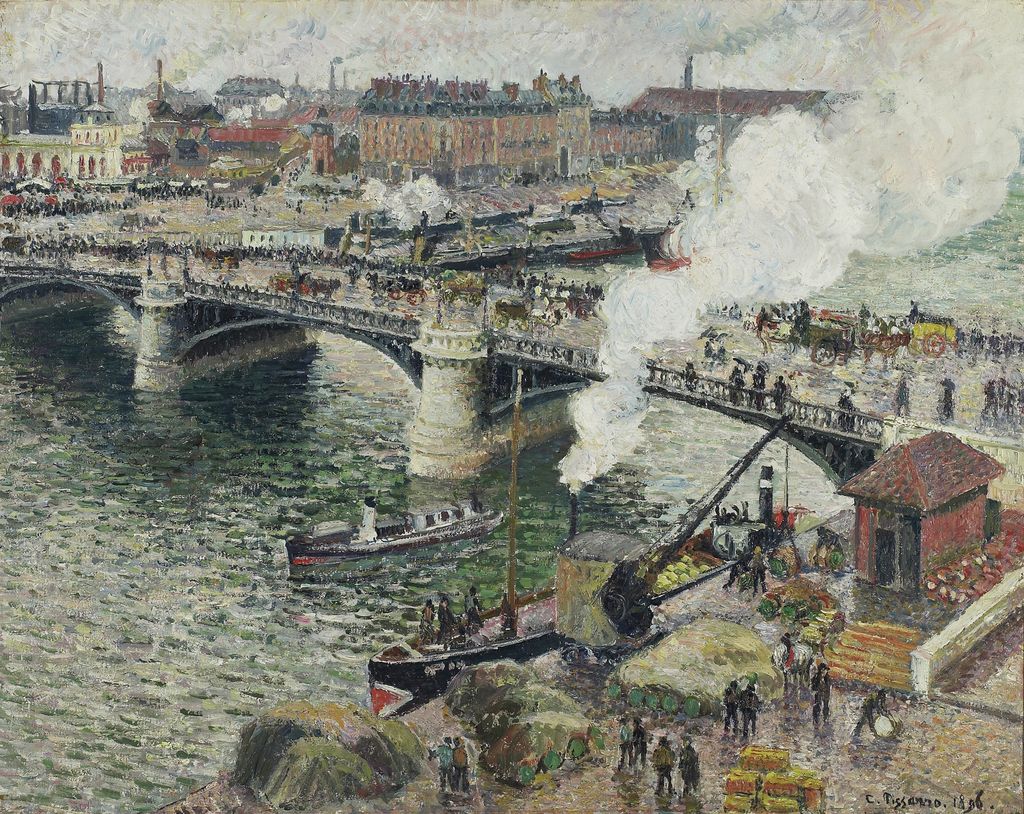
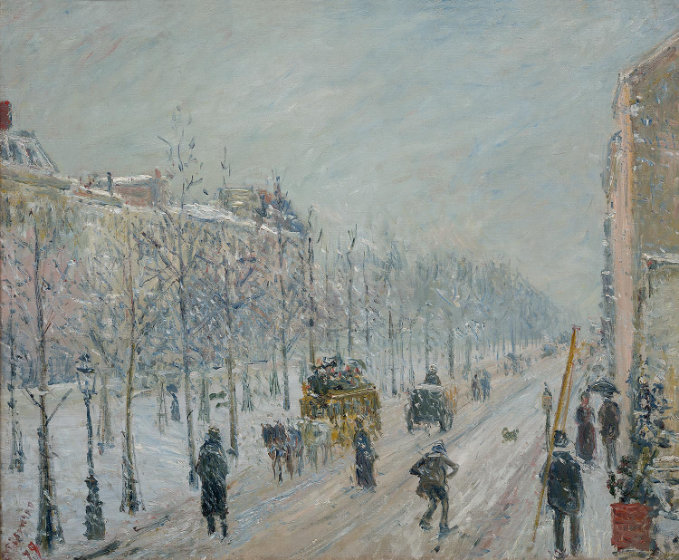
From there, visitors are treated to two rooms full of some of Pissarro’s greatest and most mature paintings. Sweeping panoramas of Paris in the snow, hues of pink and light blue shimmering on the rooftops. Taking the huge body of work into account, the paintings in the final rooms convey an artist in full command of his powers. They say that the journey of creative expression takes a lifetime. A fishing boat pulls into a harbor, billowing blue steam. A washerwoman takes a moment’s rest. The sun rises over a foggy meadow. Every painting matters, even the ones that don’t.
Who was Camille Pissarro? You’ll have to see for yourself.
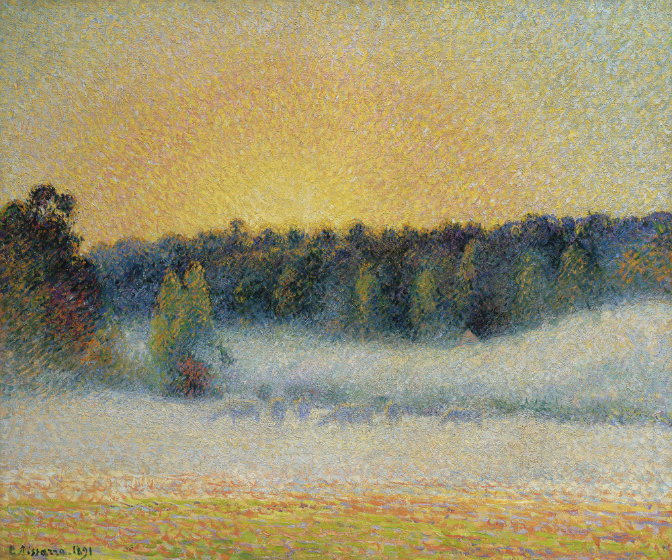
Public Domain, via private collection
The Honest Eye: Camille Pissarro’s Impressionism is on view at the Denver Art Museum until February 8. Tickets are $5, in addition to general admission.