
Courtesy of Malek Asfeer

Audio By Carbonatix
Malek Asfeer, an Arab-American artist, didn’t begin the project that became UNSEEN with an exhibition in mind. It started as “a personal act of witnessing.”
“I had been photographing members of the Palestinian community here in Colorado for some time,” he explains. “Slowly, without any clear destination beyond the need to document what I knew was rarely seen. Families whose lives unfold far from the checkpoints and headlines, yet whose histories remain inseparable from them.”
Those early photographs of people living ordinary lives in Denver while carrying memories of another homeland eventually grew into something larger. When the project received support from Denver Arts & Venues and began evolving toward a public presentation, Asfeer realized the work needed to move beyond a single artist’s perspective.
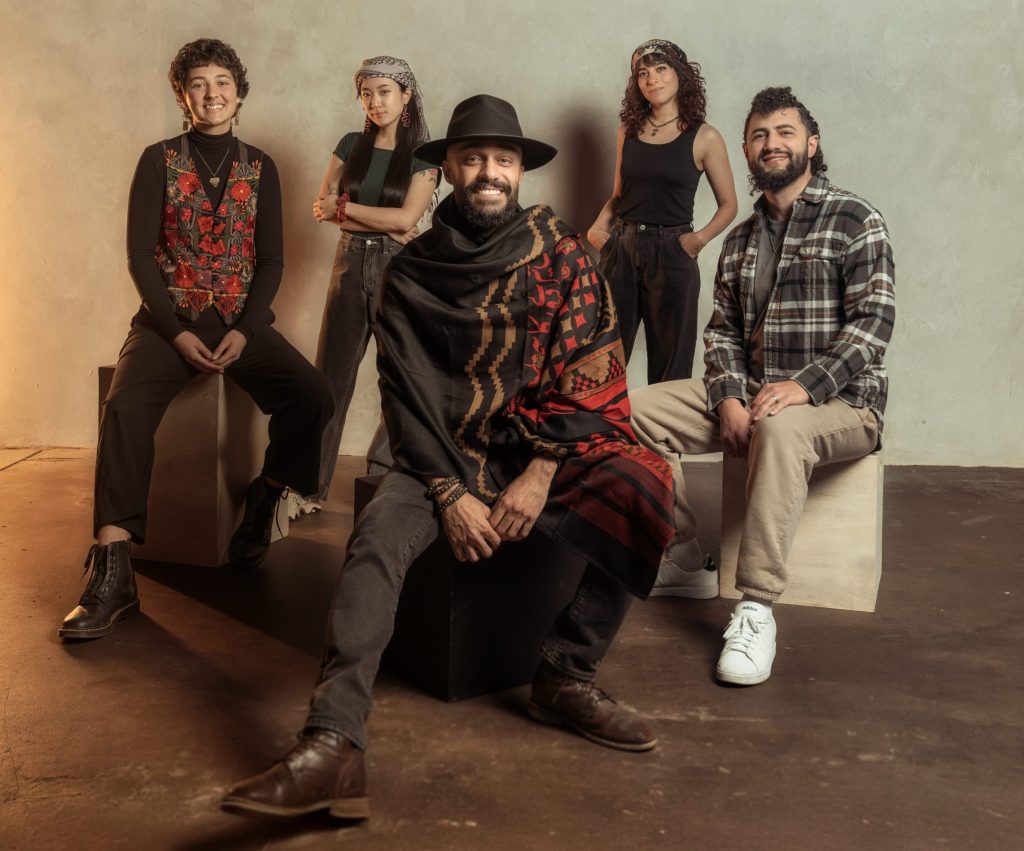
“It became clear that the work required a collective voice,” Asfeer says. “Not simply an artist speaking about a community, but a community participating in how its stories are held, framed and shared. The Sumud Artist Collective was formed with the intention of centering our Palestinian neighbors by using art as a vehicle to engage the larger community.”
That realization led to the creation of the Sumud Artist Collective, which now serves as guest curator of UNSEEN, a photography exhibition that opened March 13 at RedLine Contemporary Art Center and runs through May 17, featuring works by Asfeer, Amanda Villarosa, Armando Geneyro, Molly Olwig Solorzano, Sierra Jeter, Blake Jackson and Elly Michaels. Alongside it, RedLine will present YALLA: You’ll Never Walk Alone, a companion exhibition by Brooklyn-based Lebanese-Palestinian photographer Marwan Shousher.
Courtesy of Elly Michaels
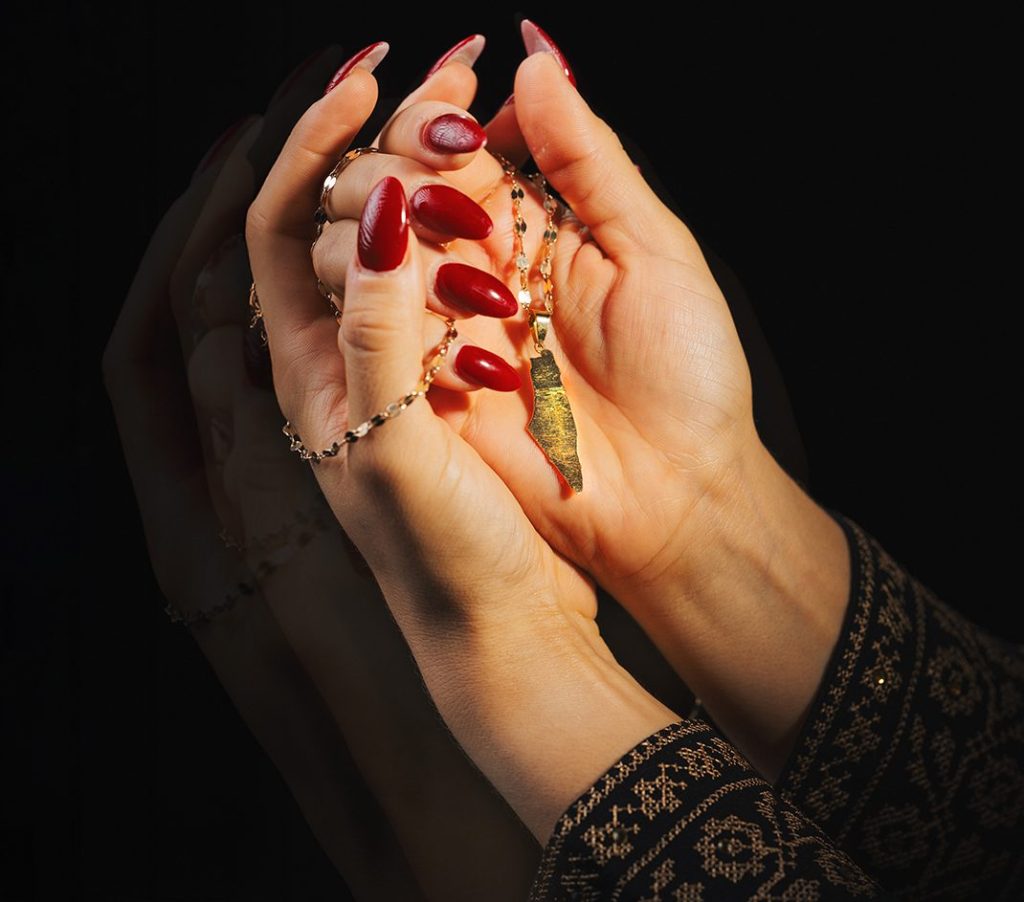
“Palestinians have never been more in the public eye than today, yet still exist in a space of invisibility,” the exhibition’s statement notes, arguing that dominant narratives often flatten people into caricatures of either victim or threat. Instead, the portraits focus on Palestinians’ daily lives.
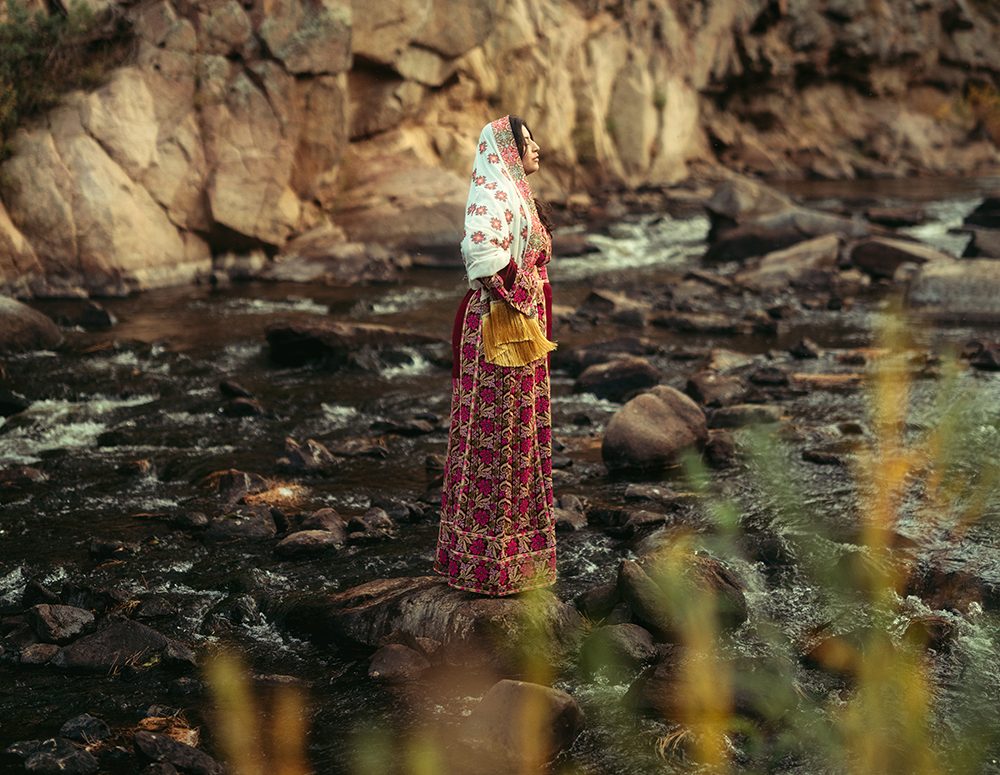
“UNSEEN turns its sight toward the seemingly ordinary moments where identity survives,” Asfeer says. “Family portraits in living rooms. A woman standing in the river under the mountains. Laughter shared around a dinner table. These stories deserve a place in our collective memory. In our collective witnessing of each other.”
The word “sumud,” which names the collective behind UNSEEN, carries deep meaning within Palestinian culture. “It speaks to steadfastness,” Asfeer says. “To the quiet discipline of continuing to live, raise children, cook meals, build homes and remember who you are in the face of erasure.”
Courtesy of the Sumud Artist Collective
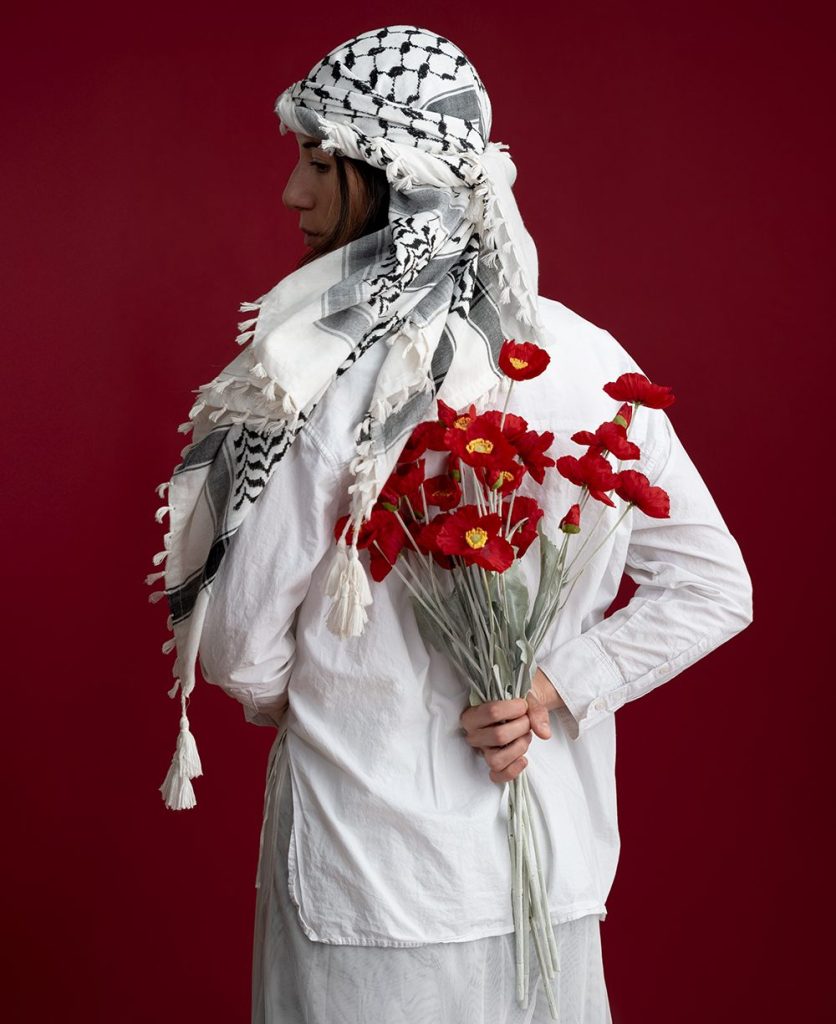
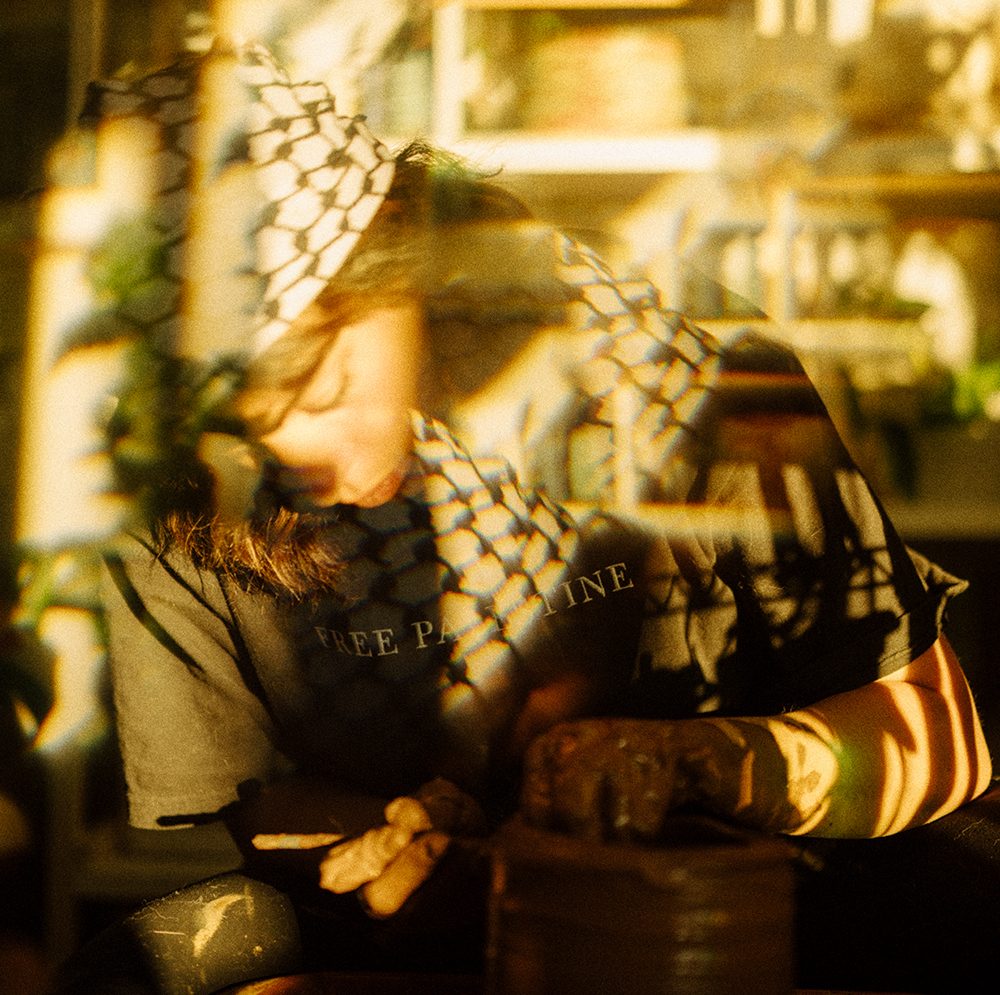
That spirit is reflected throughout the exhibition. UNSEEN features photographs of Palestinian families living across Colorado, captured by a group of local photographers. The images depict everyday moments, such as people working or participating in community activities, as well as portraits taken inside homes.
“Public discourse rarely pauses long enough to see this life,” he explains. “It sees Palestinians through the narrow frame of crisis, war and geopolitics. Never shown as whole. Yet people are never contained within their tragedy.”
For RedLine’s leadership, the exhibition reflects the organization’s longstanding commitment to artist-driven projects that emerge from the community itself.
“UNSEEN actually came to us,” says Robin Alli Gallite, RedLine’s interim executive director. “RedLine has really existed in this community-responsive space. We have an open call for exhibitions and a reputation for accepting proposals from people who come to us with ideas.”
Courtesy of Molly Solorzano
Leigh Kargol, RedLine’s arts program manager, first began working with the Sumud Artist Collective on the concept nearly two years ago.
“They really wanted to pair local photographers with local Palestinian families in this moment of solidarity and visibility for this community,” Kargol says. “It came to us in the early stages of an idea, and we’ve been figuring it out together through trial and error for the last year and a half.”
The process required patience. According to Kargol, photographers spent months meeting with participating families before taking pictures.
“They did a lot of intentional work to really understand who these people were holistically,” she says. “Not just their personalities, but their interests and how they navigate life.”
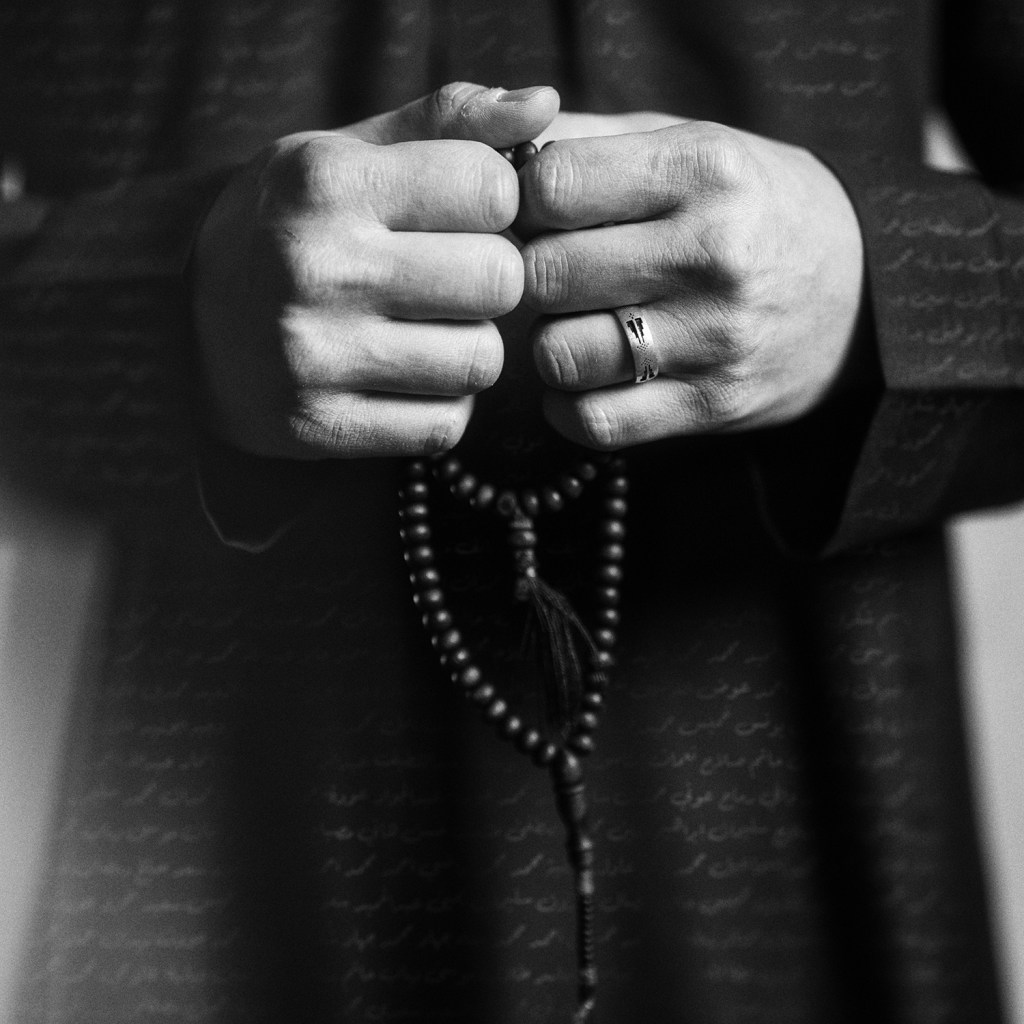
Courtesy of Malek Asfeer
Together, the images and installations challenge the limited ways Palestinians are often portrayed in public narratives.
“The public image of Palestinians tends to oscillate between two poles,” Asfeer says. “The victim. The threat. Both flatten the human being into a simple narrative. Photography can participate in that flattening, but it can also resist it. In UNSEEN, the camera lingers. It allows the viewer to sit long enough for the layers to emerge.”
Asfeer believes that “intimacy” is missing from the conversation surrounding Palestinians. “These images insist on depth. Insist on complexity,” he says. “They remind viewers that identity is not built from headlines but from a generational thread of lived life.”
While UNSEEN centers local stories, RedLine’s curatorial team wanted to place those narratives within a broader global context. That impulse led Jane Burke, the organization’s art director and chief curator, to pair the exhibition with YALLA: You’ll Never Walk Alone. Burke encountered Shousher’s work during a lecture he gave at the Museum of Contemporary Art Denver about the cultural significance of the keffiyeh, the traditional Palestinian scarf.
“What struck me about his talk was that he was talking about this cross-cultural solidarity among soccer fans,” Burke says. “That really helped me zoom out and be able to see from this global perspective.”
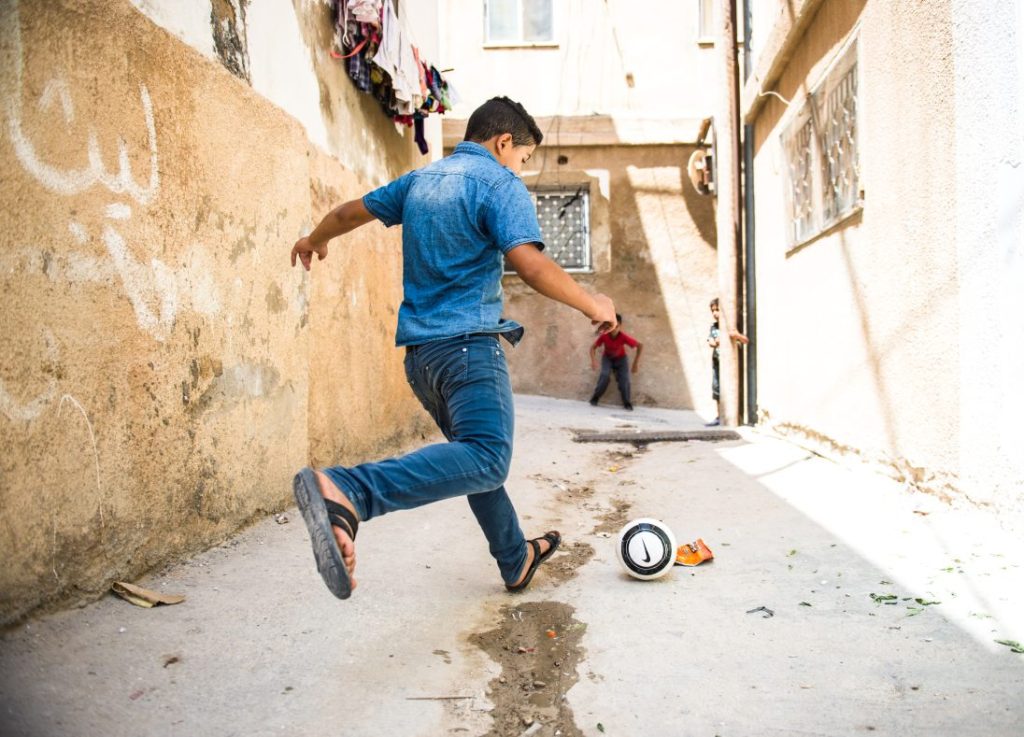
Courtesy of Marwan Shousher
Shousher’s photographs capture the culture of “Ultras,” a group of highly organized soccer fans known for their elaborate stadium displays and political activity. His photographs capture the spectacle of massive banners unfurling across stadiums, crowds chanting together, and symbols of solidarity emerging in fan culture throughout Europe, Latin America and the Arab world.
At the same time, his work includes photographs of refugee children playing pickup soccer games in camps across Palestine, Lebanon and Jordan. Those games were organized over a decade alongside Hearaide, a nonprofit founded by his mother, Dr. Randa Mansour-Shousher, which provides hearing care in regions affected by conflict.
In the gallery, these photographs are presented on large-scale banners inspired by those used by Ultras in stadiums. Video installations help visitors unfamiliar with soccer culture understand how these visual displays function within the sport’s global fan communities. The RedLine team emphasizes that the pairing of the two exhibitions is deliberate.
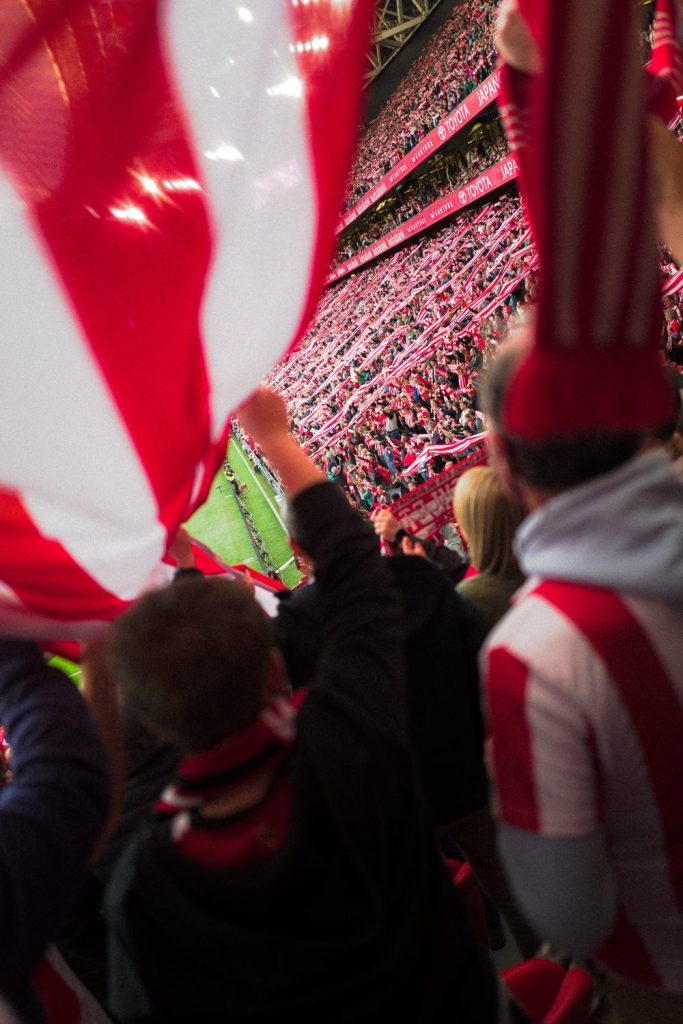
Courtesy of Marwan Shousher
“UNSEEN is really this localized effort,” Burke says. “We’re looking at our own community first. But YALLA helps zoom out and show that this story exists within a global movement of solidarity.”
She describes the exhibitions as “nested within each other,” with visitors moving from intimate portraits of Denver families to scenes of international activism. “It’s important for audiences to see multiple perspectives at once,” Burke says. “How something impacts your immediate community, but also how it resonates globally.”
The curatorial team acknowledges that presenting exhibitions centered on Palestinian identity during a period of ongoing conflict carries its own challenges. Burke emphasizes that the goal is not to present geopolitical arguments but to humanize lived experiences.
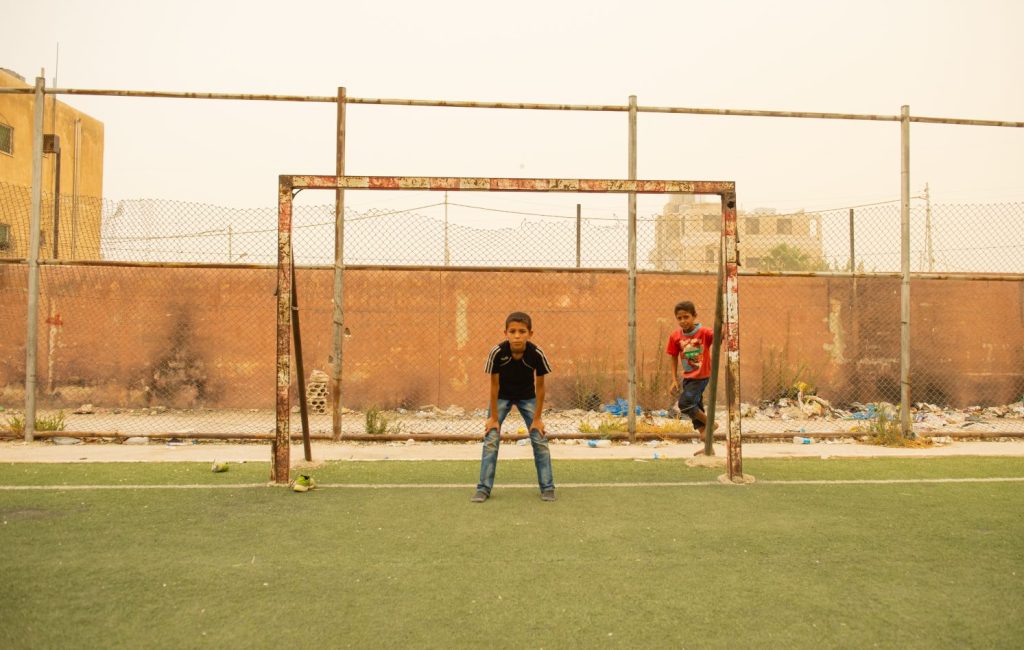
Courtesy of Marwan Shousher
“The Palestinian cause is obviously fraught with a lot of opinions,” she says. “But our goal is to bring a humanitarian lens and to give voice to the artists and communities sharing their lived experiences.”
For RedLine, the exhibitions are part of a larger commitment to creating space for discourse. “RedLine is a place for dialogue,” Gallite says. “We believe in letting artists speak. We don’t censor, and we allow that to lead the conversation.”
That openness also means leaving space for the exhibitions to evolve after they open. Aside from the March 13 reception, additional public programming has not yet been finalized. Organizers say they want to see how the participating families and artists feel about further engagement before planning additional events.
“We’re letting it unfold,” Gallite says. “We want to make sure we’re honoring the people whose stories are being shared.”
Courtesy of Malek Asfeer
Through proximity, Asfeer hopes the exhibition will alter viewers’ perceptions of Palestinian identity. “Distance allows suffering to become a statistic or a headline,” he says. “UNSEEN narrows that distance. The photographs invite viewers to stand face to face with lives that might otherwise remain invisible.”
If the exhibition succeeds, he says, the takeaway should be simple.
“Once you have stood there, truly stood there, something changes,” Asfeer says. “The conversation about Palestinians can no longer rest comfortably inside the language of numbers or political slogans. It must contend with human beings whose stories carry weight.”
“It will leave viewers with a simple recognition,” he adds. “That the people they have just encountered were never truly invisible. Just unseen.”
UNSEEN and YALLA: You’ll Never Walk Alone are on view Friday, March 13, through Sunday, May 17, at RedLine Contemporary Art Center, 2350 Arapahoe Street. Learn more at redlineart.org.