Wheelchair Sports Camp

Audio By Carbonatix
Kalyn Heffernan cares about public transit…so much so that affordable and accessible public transportation was a cornerstone of her Denver mayoral campaign in 2019. Heffernan, who has osteogenesis imperfecta, has been a Regional Transportation District rider since she was a kid, and as a power chair user, she finds that the service is often her only option for getting around the city.
But does RTD really care about Heffernan and other Denver residents living with disabilities?
If the agency does, it has a funny way of showing it.
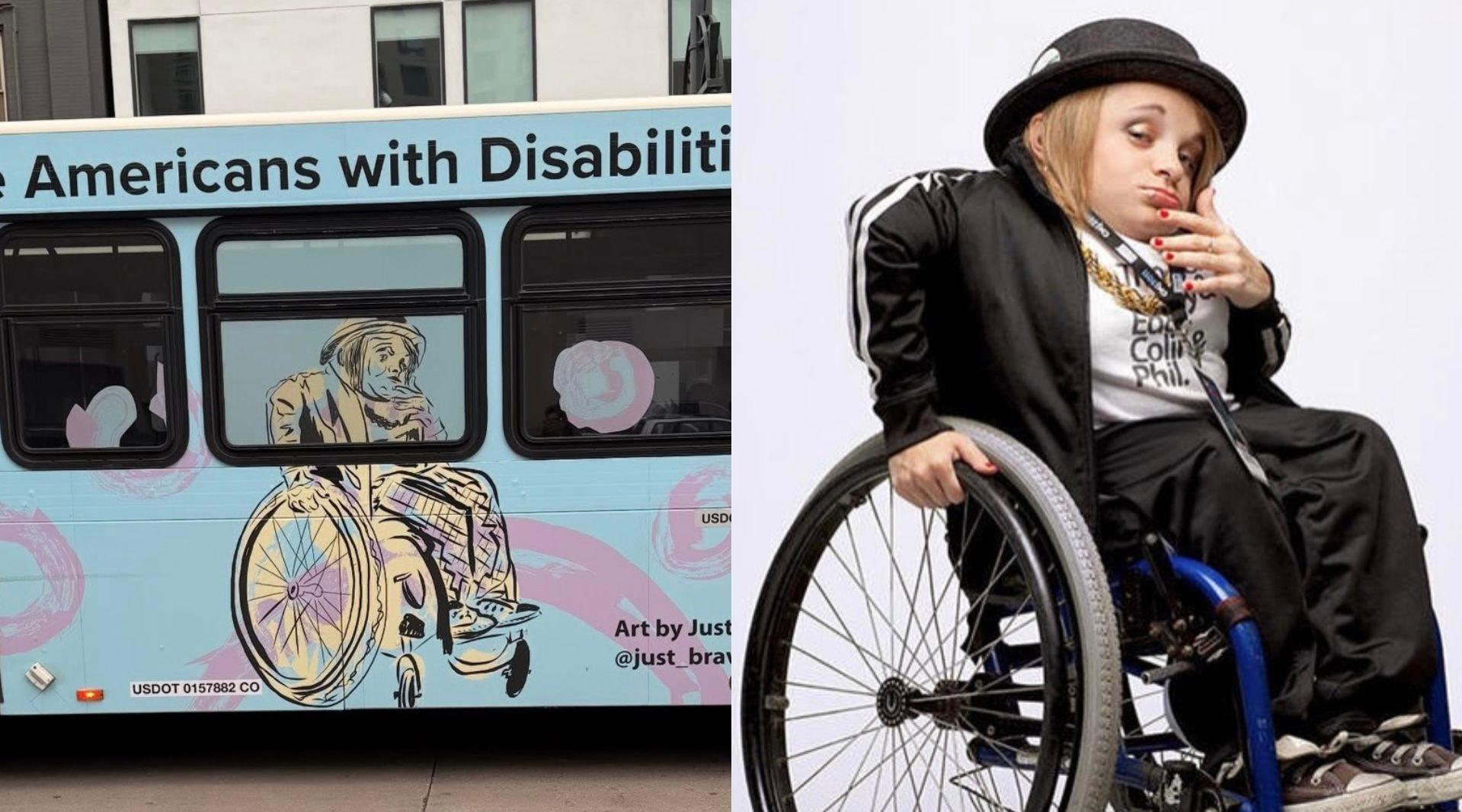
A few days ago, Heffernan’s ex-girlfriend was in Denver and saw a bus roll by with a drawing of Heffernan on a wrap celebrating the Americans with Disabilities Act; she snapped a picture and sent it to Heffernan. “I had no idea,” says Heffernan, an artist, activist and frontperson of popular local hip-hop band Wheelchair Sports Camp.
This is not the first time RTD has neglected to consult the subjects it’s allegedly honoring. In January, RTD changed the name of Civic Center Station to Wade Blank Civic Center Station; Blank was the activist who founded the disability rights organization ADAPT and, in 1978, led the Gang of 19 — many of whom were wheelchair users — in their protests for accessible public transit. The group’s members threw themselves in front of RTD buses at the intersection of Colfax and Broadway in a historic and impactful event for disability rights in the United States, ultimately leading to the Americans with Disabilities Act.
According to Blank’s daughter, RTD pushed the renaming without consulting Blank’s family; she says it seemed like a publicity stunt amid controversy over rising costs for Access-on-Demand, a subsidized ride-share service.
And now history is repeating itself.
“It’s so tokenizing, it’s exploitative, it’s performative,” Heffernan says. “It’s like, ‘Oh, look, we care about the communities we’re not serving.’ …You’re not honoring the legacy Denver has and the legacy of being the first transit company to be forced to be made accessible. You’re not honoring that history by being a transit entity that has some of the highest fares in the country, some of the most limited services. I can’t tell you how many times I’ve been left stranded downtown because it’s past 10 p.m. in this cowtown. I remember when I was rolling for mayor, [Michael] Hancock used to love saying, ‘We’re a world-class city,’ and it’s like, how are we a world-class city and I can’t get transportation past a certain hour?”
Heffernan learned that her likeness was being used on a bus without her knowledge — much less consent — the same week she heard that RTD could cut its services by at least 20 percent next year if an anticipated $40 million state grant doesn’t come through.
“You’re not going to do me like that,” Heffernan says. “You’re not going to pimp my face and my name and my brand and my activism. They obviously know who I am, and I’ve been out and loud about this stuff my whole life. [The cuts] would be devastating. We’re struggling to have transit as it is, let alone with 20 percent less. Are you kidding me?”
And this wasn’t the first time RTD had used Heffernan.
“I did get flagged last summer that there was an ADA celebration or event via RTD that had that illustration on it,” Heffernan says. “My friend was like, ‘Are you playing this, are you involved in it?’ And I was like, ‘No, why would they use me? I wasn’t invited.'” At the time, Heffernan was busy prepping for her Artist Takeover event at the Denver Art Museum, a July 25 program packed with art, performances and unique immersive experiences celebrating Disability Pride Month and the 35th anniversary of ADA. She says she figured one RTD event wasn’t worth fighting about when she had a much bigger one of her own to plan.
The illustration depicting Heffernan used at that event and on the current bus wrap was drawn by local artist Justin Bravo. “Sorry for the fuck up,” Bravo says in a statement. “Overall, the goal of the work is to create dialogue and awareness. As a daily rider of both bus and light rail, it’s my hope RTD will not shy away, but utilize this conversation to continue to honor its commitments to disabled voices and the underserved. The recent proposed cut in services will have a larger impact on these members of our community.”
Bravo has not responded to questions regarding whether he let Heffernan know he was drawing her.
“It’s not great artist protocol. However, as a working artist, I’m not trying to drag him,” Heffernan says of Bravo. “Ultimately, RTD is the one with the state funding and the responsibility and the power and the decades-long service — or lack thereof.”
She doesn’t want people to attack Bravo, but she is exploring her legal options regarding RTD.
In a statement, RTD says it only recently learned the wrap depicted Heffernan’s likeness. “The design was part of a community contest to commemorate the 35th anniversary of the Americans with Disabilities Act of 1990. Designer Justin Bravo created and submitted the artwork,” the statement reads. “The design was selected from six submissions by a panel of community members reflective of the intersection of accessibility, disability, diverse communities, lived experiences, and personal identities, fostering an appreciation and celebration of our social and cultural similarities and differences. …RTD is committed to advancing equity by ensuring that the agency’s services, decisions, and partnerships promote fair access, remove barriers, and support the diverse communities the agency serves.”
The statement adds that submissions were evaluated by a ten-member panel; it did not provide answers to Westword’s specific questions.
In a perfect world, Heffernan says, the best reparations RTD could make would be to not cut services, but to add more of them.
“A majority of people with disabilities are on a restricted income, and to get a van equipped for somebody like me…my friend’s adaptation to her car was like $80,000, and that’s not including the vehicle. RTD is it. We rely on public transit, and a lot of people with disabilities have to use it,” Heffernan says. “That’s the legacy of ADAPT. They finally broke out of a nursing home and got to live independently, but they couldn’t go anywhere. They couldn’t get to doctors’ appointments and grocery stores and these regular things that we need.
“And the brown cloud is back,” she adds. “The city needs public transit so bad.”
The timing of the situation is frustrating for Heffernan, whose band is about to release an album. “Doing all this press stuff is amazing, but I’d rather be talking about my art,” Heffernan admits. “That’s another part of why this feels so insulting. I’ve spent my whole life learning how to be represented and be in the public image in a non-exploitative and non-patronizing way, and not be tokenized. My campaign for mayor, everything about me, is trying to represent disability in an empowering way that benefits not just me, but the rest of my community, and it feels like such a slap in the face to be exploited and tokenized by the same system that I’ve worked so hard to advocate for.”
And Wheelchair Sports Camp is on a roll. It made headlines with its immersive “Wheelchair Space Kitchen” installation that has been at Meow Wolf Denver since it opened in 2021; last year, the band released the songs it had made for the exhibit. This month, Wheelchair Sports Camp will be back at Meow Wolf to release a new album, oh imperfecta. The band’s first video from the album, “EAT MEAT!” is out now.
Another one of Meow Wolf Denver’s original installations is a bus that’s devoted to the Gang of 19. “This bus is not accessible to everyone,” reads a sign inside. “Learn more about the Gang of 19, who fought for better accessibility.”
That’s a lesson RTD could use.
Wheelchair Sports Camp’s album release party is 8 p.m. Saturday, May 23, at Meow Wolf Convergence Station, 1338 First Street, featuring guest acts Dressy Bessy, BRŪHA and RAYANN! Get tickets here.