
Tom Cross

Audio By Carbonatix
“I just always have.”
That is how 76-year-old Colorado artist Tom Cross explains a lifetime spent making art. Sitting inside his Westminster studio, Cross traces that impulse back as far as he can remember. His childhood was defined by constant movement: New Jersey, Maine, Illinois, Wisconsin, Oregon, Washington.
“Creation is as far back as my memory goes,” Cross says. “I moved a lot growing up. I saw a lot of kinds of places, people and cultures — and that input inspired me. I have a learning disability, a dyslexia kind of thing, so I struggled in school and kept moving so much that I had teachers who gave up on me. They knew I was moving soon, anyway, so I would just sit in class and draw pictures. Art has always been my thing.”
One early classroom memory sticks with him decades later. After struggling to read aloud in class as a first grader, Cross was given the task of drawing his breakfast later that day. He carefully illustrated a piece of buttered toast.
“My teacher said, ‘This is unbelievable because the toast looks buttered,'” Cross recalls. “And in that moment, as a little kid, you go, ‘My toast is buttered. I could do this.’ It was good in that moment because I had nothing else. It encouraged me to do good. I found a place in it. I could draw well, and because I could do this thing well, I fucking did it. A lot.”
Cross never really stopped creating after that. Over the decades, he worked across painting, tattooing, drawing and other art forms while building a fiercely independent creative life that largely existed outside of traditional gallery systems.
Tom Cross
But for all of his projects, the most unusual may be what he calls “the pit.” Located on his property near Hartsel, the underground chamber began as a place for meditation and sensory experiences.
“I had dug these pits, which I initially enjoyed just going down for chunks of time to meditate,” Cross says. “I then decided to frame the pit, stretch a canvas through it, and go down to paint in the dark. I’ve had visions down there. I went down there in my first painting, going, ‘Okay, I’m basically going to paint with my eyes closed. I can reach either side enough to be working it all the way around.’ I found that, no, you’re not just painting with your eyes closed. This is another thing.”
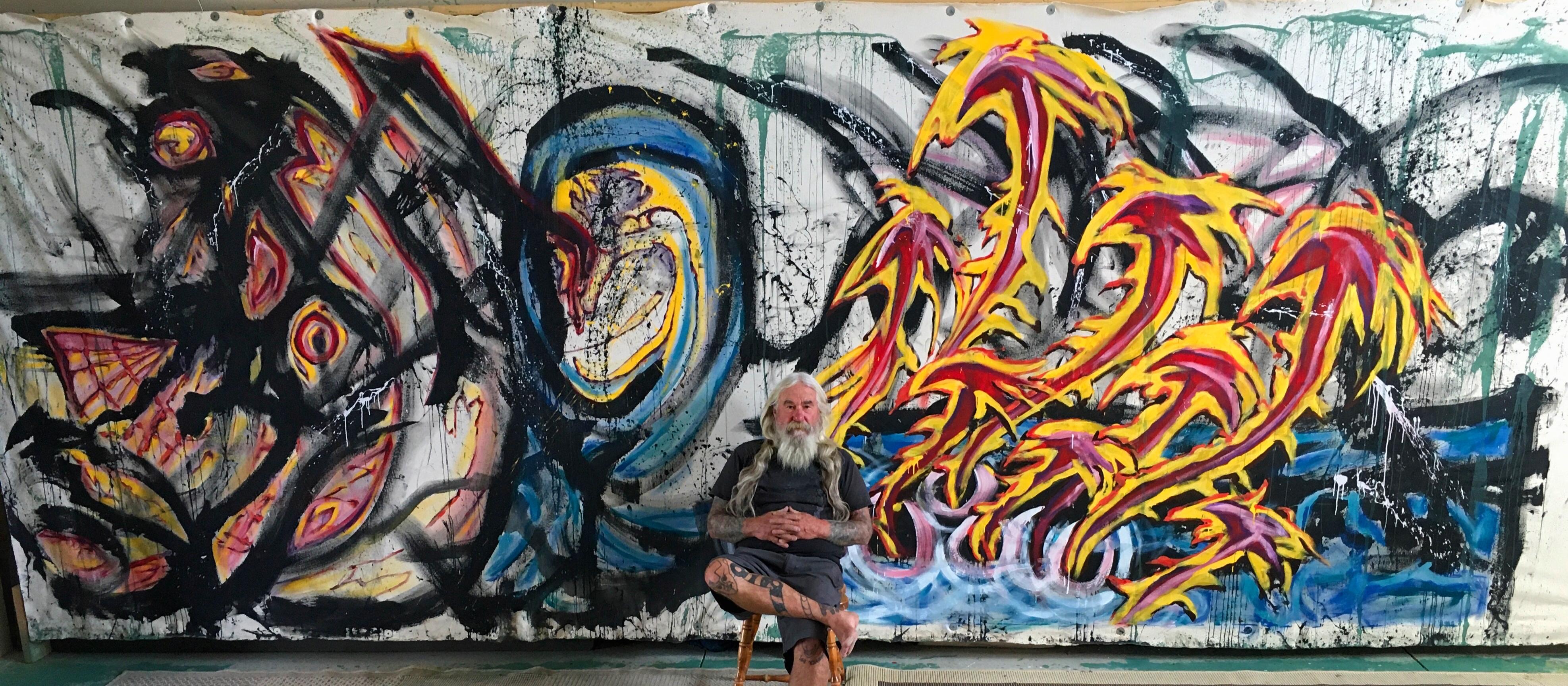
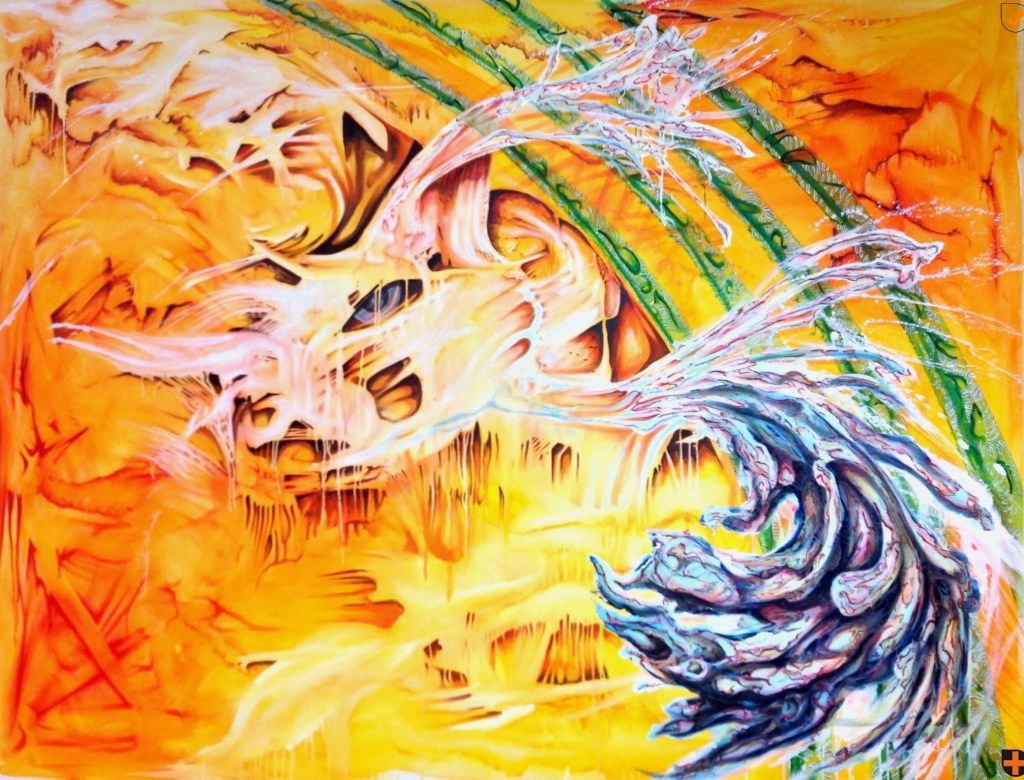
Inside the hand-dug, ten-foot-deep pit, Cross paints massive canvases 22 feet long and 8 feet high without ever seeing the image. Instead, he uses bodily sensations to do the work.
“I could feel that wetness coming up my body as I would walk past that,” he says. “I started going, ‘This is tactile.’ You’re in the dark, but you’re still relying on your other senses. They hop up intensely.”
The experience changed how he understood painting itself.
“When I do a painting that I’m seeing, that I’m looking at, I am constantly having to make a decision about values, about hues, about colors,” Cross says. “Well, down in the pit, you can’t see. You’re not in that intellect, that judgment of yourself.”
Cross compares the process to the trust required when participating in an extreme sport. “It’s like jumping out of a plane,” he says. “As soon as you step out, you realize that it doesn’t matter what happens now, because I can’t stop what’s going on.”
He’ll spend hours working in the pit before emerging and seeing what he’s been up to in the underground world. The results often astound him.
“Absolutely,” Cross says when asked whether he’s sometimes surprised by what emerges from the darkness. “Because I’m not down there intentionally making a composition, making particular images.”
Tom Cross
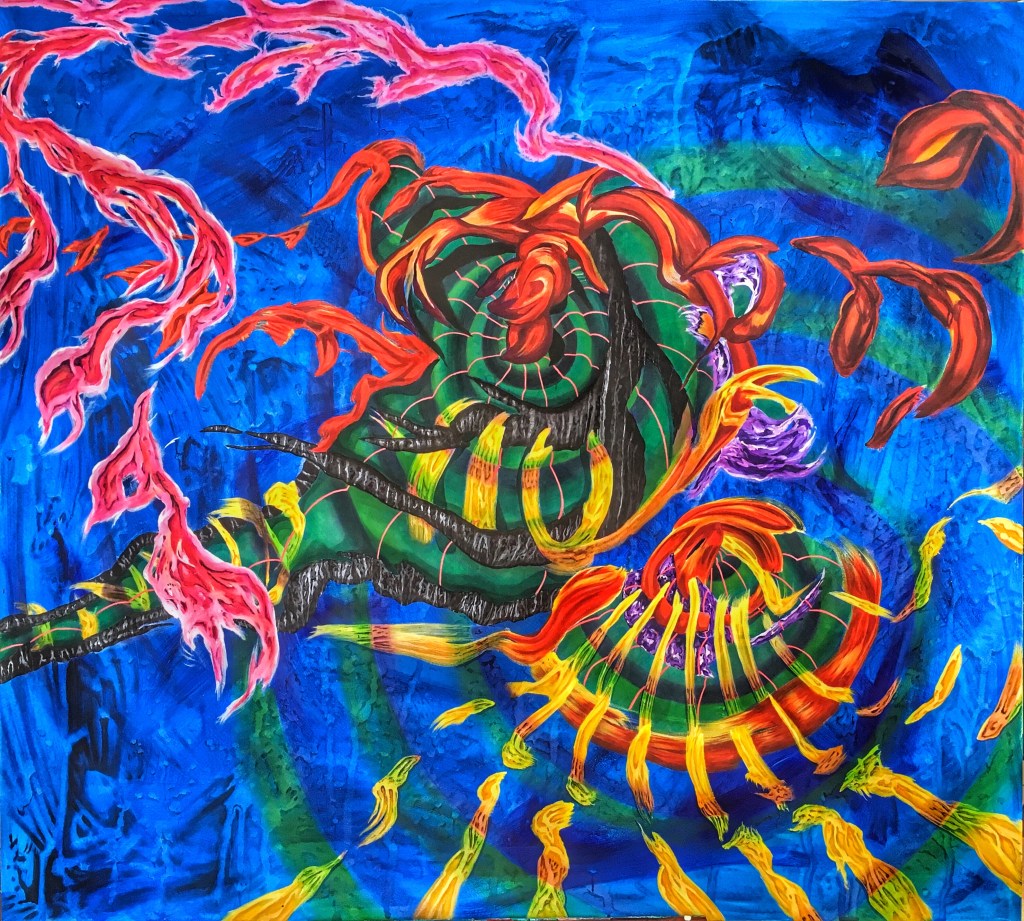
After bringing the canvases into a larger studio space where they can finally be viewed, Cross sometimes adds additional paint to emphasize forms and imagery he discovers within them. Other pieces remain untouched.
“It’s hard to explain,” he says. “Some I have colorized from that point, bringing out the images that were seen. A couple years ago, I went up, and I had no black, just a lot of colors. I went down and just did it in color, then added black when I brought it up.”
The pit connects with Cross’s long fascination with ancient cave paintings and humanity’s oldest artistic traditions. Watching Werner Herzog’s documentary “Cave of Forgotten Dreams” deepened that feeling.
“I’m watching it going, ‘These paintings are 30,000 years old,'” Cross says. “Watching this movie, I go, ‘I’m supposed to do this.’ I’m a cave painter.”
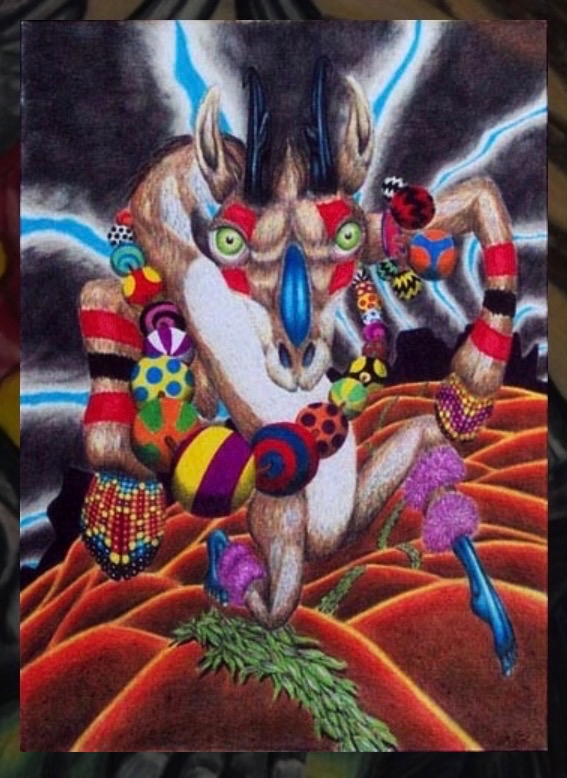
That idea now drives one of his largest ongoing projects: a giant geoglyph carved into the prairie at the Bigfoot Wildlife Sanctuary near Hartsel. Using a large rototiller, Cross etched a recurring spirit figure he has drawn throughout his life directly into the landscape.
“A few winters ago, I planned it out,” he says. “Then in the spring, I went up and plotted it out using a big rototiller.”
The work has become physically harder as he ages.
“It’s just so fucking big,” he says. “And I’m not the man I used to be. So now I’d like to get a crew of guys and have them maintain it.”
Cross’s resistance to artistic conformity stretches back decades. Earlier in life, he worked around the Art Institute of Chicago and briefly held a faculty position there. But the experience ultimately pushed him away from institutional art spaces.
Tom Cross
“I was in a place that had a shitload of famous artists, and I saw a good majority of those doing the same shit that had made them famous,” Cross says. “That scared me.”
He recalls bringing new work into a gallery connected to the school, only to be told people preferred the style he had shown the previous year.
“They really liked what you did last year,” he remembers hearing.
“I can’t fucking remember what I did last year,” Cross says. “I was in a facility where you could do shitloads of stuff, but it struck me that this is the game. They don’t want my shit unless it’s what I did and they know people liked.”
He eventually got fired, Cross says, but by that point, he already knew he wanted out.
“I left there going, ‘I’m gonna do my shit,'” he adds. “They’re a business. They want to show what they know will sell. I get it, but I’m not gonna do that.”
Instead, Cross pursued a career outside of the traditional art world. He tattooed out of a converted school bus before eventually opening Smokey Banana Tattoo in Broomfield back when tattoo shops were still controversial.
“I loved tattooing at the time,” he says. “At that time, people who got tattoos were really stepping out. It was really still a ‘My mom’s gonna kill me’ kind of a thing.”
Today, Smokey Banana Tattoo operates out of a converted service station run by his children that also doubles as his art gallery. Cross no longer tattoos full-time, though he still occasionally works on friends and family.
Between the pit paintings and geoglyphs, Cross has continued pursuing whatever strange creative idea interests him. He has painted tipis using Super Soaker squirt guns, created an original cologne brand called URSUS, and filled sketchbooks with observations from decades of hitchhiking and train travel across America.
Tom Cross
Rather than chase gallery approval or commercial trends, Cross built a life that allowed him to keep experimenting.
“I can’t stop, and I love it,” he says. “I’ve not sold many things, and I don’t care. I tattooed, and that did me fine. I haven’t had to sell things to support what’s next. I can just finish whatever I’m on and then go, ‘What’s next?’ And that’s important to me. I’m a free man.”
Learn more about Tom Cross and his artwork at tomcrosssmartist.com.