
Justin Criado

Audio By Carbonatix
Making it big in metro Denver’s entertainment industry has never been easy. For every success story like that of club king Regas Christou, who opened many popular nightspots over his lengthy career, there are countless tales of entrepreneurs who entered the scene with red-carpet fantasies only to wind up being swept under the rug. That’s especially true today, when financial realities are at their grimmes.
Against this backdrop, the City of Denver is doing something it hasn’t undertaken since the 1980s: revising the way entertainment businesses are licensed in the Mile High City.
Specifically, the Department of Licensing and Consumer Protection (formerly the Department of Excise and Licenses) is reimagining the way licenses are granted to commercial entities ranging from venues specializing in live music to pool halls. DLCP executive director Molly Duplechian hopes the result will be a significant reduction in the red tape that causes costs to spiral and dissuades creatives from launching projects in the first place. “One of our goals,” she says, “is to make it simpler and easier for people to access the license they need.”
The latest step in a process that began last year was the first-draft release of Council Bill No. CB26, an ordinance “amending…outdated amusement and cabaret license types, modernizing licensing provisions relating to entertainment licenses, updating application and license fees, and making conforming amendments” to the Denver Revised Municipal Code.
Beginning this week, members of the public can share their views about the new approach. And this initial version has raised a slew of concerns for ONE Denver, a 501(c)(3) nonprofit that describes itself as “Denver’s liaison for the nightlife industry, community and city agencies.”
ONE Denver, which consulted with the DLCP prior to the draft’s publication, outlines its worries in a massive online analysis. Over the course of more than 6,000 words, the critique breaks down fourteen passages from the document, pointing out “potential issues” and sharing the organization’s belief that the document doesn’t do much to “increase entertainment offerings, culture or vibrancy within the city…. If anything, it may put certain cultural spaces in a quasi-defined space, making it questionable if they are allowed to operate without one of these broad-reaching entertainment licenses.”
Stephen Brackett, a founding member of Flobots and ONE Denver’s executive director, applauds Denver for taking on this particular challenge. “It’s encouraging to be in a city that’s making this effort even in an economic downturn,” he says, but adds that the draft “doesn’t have the specificity that we need.”
“I think we’re lucky to live in a city where they want to address these things,” adds Alex Berryhill, ONE Denver’s director of marketing (and a onetime Westword music contributor). “But we want to make sure the definitions are succinct, so there’s no confusion and we encourage people to dream and open up more of these places.”
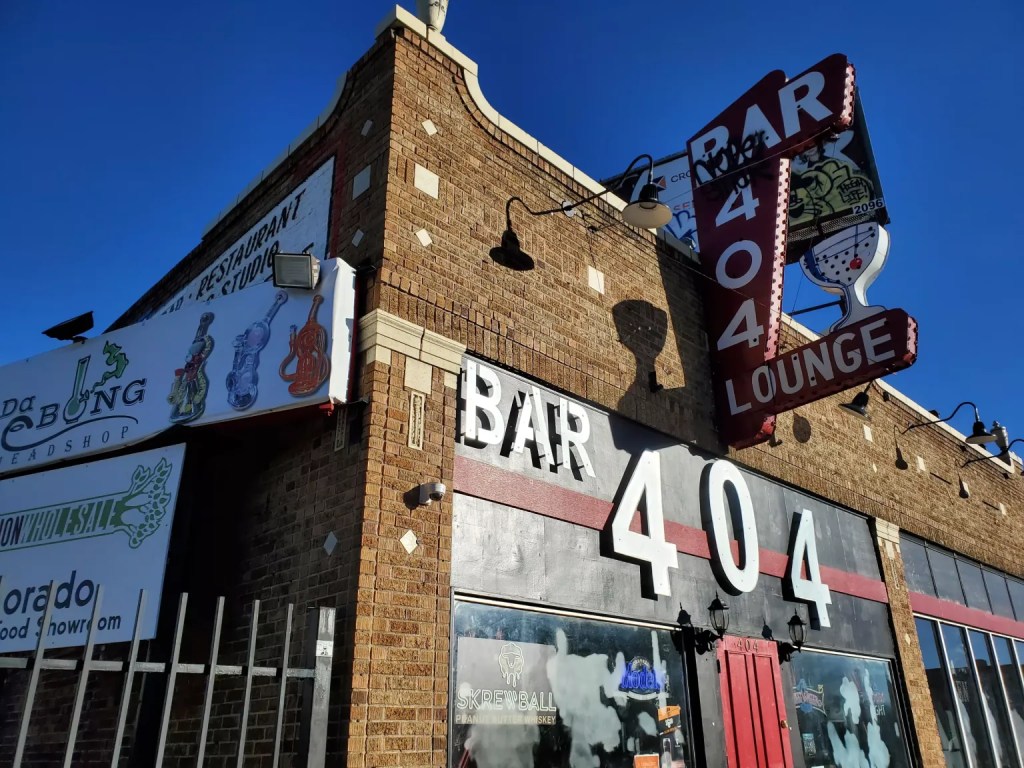
Bar 404 offers live music most nights.
Molly Martin
Under the present regulatory structure, people who want to launch an entertainment-oriented operation can quickly get lost in the weeds. “Right now, we have fourteen different license types from two categories: cabaret licenses [for places that serve liquor] and amusement licenses [for ones that don’t],” Duplechian notes. “And between those, there are several subtypes of licenses,” so many that “some people can’t tell what kind of license they need to apply for.”
In contrast, Duplechian continues, the draft “takes those fourteen licenses and narrows them down to just three: a limited entertainment license, a nightclub license and an adult entertainment license.”
These tweaks eliminate the licensing requirement entirely in many cases, she emphasizes: “If it’s just an unamplified single performer, the business won’t need a limited entertainment license in this proposed model. Same thing with a coffeeshop that has an acoustic guitar player in the corner once a month on Saturday. And going forward, things around games and recreation activities won’t need licenses, either. Trivia and bingo need a cabaret license now, but going forward, they won’t need any entertainment license.”
What about outdoor musical performances like the kind Wax Trax Records staged prior to running afoul of Denver’s noise ordinance? Duplechian suggests that a limited entertainment license might be required, but stresses that those rules would be considerably different from requirements for nightclubs. But the details in the draft are vague, and that raises questions for ONE Denver’s Brackett.
“No license would be required for places that don’t amplify music,” he acknowledges, “but there are very few places where you would have people coming together to hear music that wouldn’t be amplified. That might accidentally bring in a whole lot of places being required to get limited entertainment licenses, which is not the intention when we’re talking about art galleries, coffee shops and non-private organizations doing open mics. Those spaces wouldn’t typically be doing music all the time, but would like to do it occasionally — and due to our analysis, that’s the level of ecosystem that’s missing for most people in Denver. Those are entry-level opportunities for new musicians and the way our entertainment substrata helps people get trained. They’re areas that are most accessible to young people before they can drink. So I applaud that the City has identified the need, but we’re afraid the current draft won’t allow that to exist in any way that would be culturally useful.”
Berryhill also flags the definition of a nightclub, which he sees as “kind of broad. It’s basically any place that operates after 10 p.m., has live entertainment, and has a capacity of over 100 people — and if you have all those things, you’re required to hire security and implement weapons screenings. I’m not saying that’s a bad thing. There are places downtown where a lot of people congregate where that should absolutely be a thing, because you don’t want people to carry weapons into a venue. But there are smaller venues, more underground places, that don’t have a history of violence and don’t have a high profit margin, because they’re doing it more for the cultural experience than to make a lot of money. Now they’ll have to hire security guards and get weapons screeners like metal detectors. That’s a lot of added expense, and that’s a problem at a time when we’re losing venues left and right. We think certain places should have this, but there should be caps and thresholds for when you require licensed security. We need to have flexible understanding for that.”
The city is open to this idea, Duplechian responds — but how it could work isn’t clear yet. “The number of security guards would be determined through rulemaking,” she notes, and that process wouldn’t start unless and until Denver City Council approves the bill. “But we’d want to have a conversation about if 10 p.m. and an occupancy of 100 are the right triggering points. We’re putting it out there as a starting point, but we want to get feedback.”
There are many ways to provide that feedback. The DLCP has created an online survey about the proposal, and has scheduled a virtual meeting from noon to 1 p.m. on Friday, April 17 (register here). And Duplechian emphasizes that additional platforms will be available.
“We’re hoping to bring this to the first city council committee in June, which gives us two months to get feedback and put out an updated draft,” she says. “Then, if it passes and is adopted, several other things will be determined by rule during the second half of 2026. We’ll make sure the rules are established in a fair and understandable way, and are hoping they can be effective January 1. And businesses can continue to apply for licenses throughout the year. They won’t have to wait until their license expires, so we don’t expect a bottleneck of new applications. That way, they can transition to the new procedure — and we hope we’ll see more and more entertainment opportunities and options and enhanced safety for businesses.”
Brackett encourages anyone and everyone who cares about entertainment in Denver to take a look at the draft and offer their opinions. “The spirit of this is so right on,” he concludes, “but this office needs to hear from folks as to what all this will mean. And if the community shows up, I think we’re going to get something that’s a huge improvement over what we’ve had in the past.”