Andi Elloway

Audio By Carbonatix
When Mitchell Schellenger was attending the University of Colorado Denver around 2010, he would often walk by Denver Fire Department Station 6, located just off Speer Boulevard. And he would pass the station again when he’d walk to his job working the lighting crew at what was then the Pepsi Center. That’s why, when Schellenger’s career in show and concert stage design took off, he borrowed the name to brand his new company, Station Six.
“Being a native of Colorado,” smiles Schellenger, “it was important to me to have a little nod to where it all started.”
Schellenger’s fascination with the station didn’t involve any thoughts of becoming a firefighter, though. “I was always more into the lights and the sirens,” he says. “The energy of it, that was the thing that I liked. Even later, I remember when I’d walk by the station on my way to class or to work, if the doors were open, I’d catch a peek into the building just to see it. I could feel that connection there. It was almost literally a threshold into my career.”
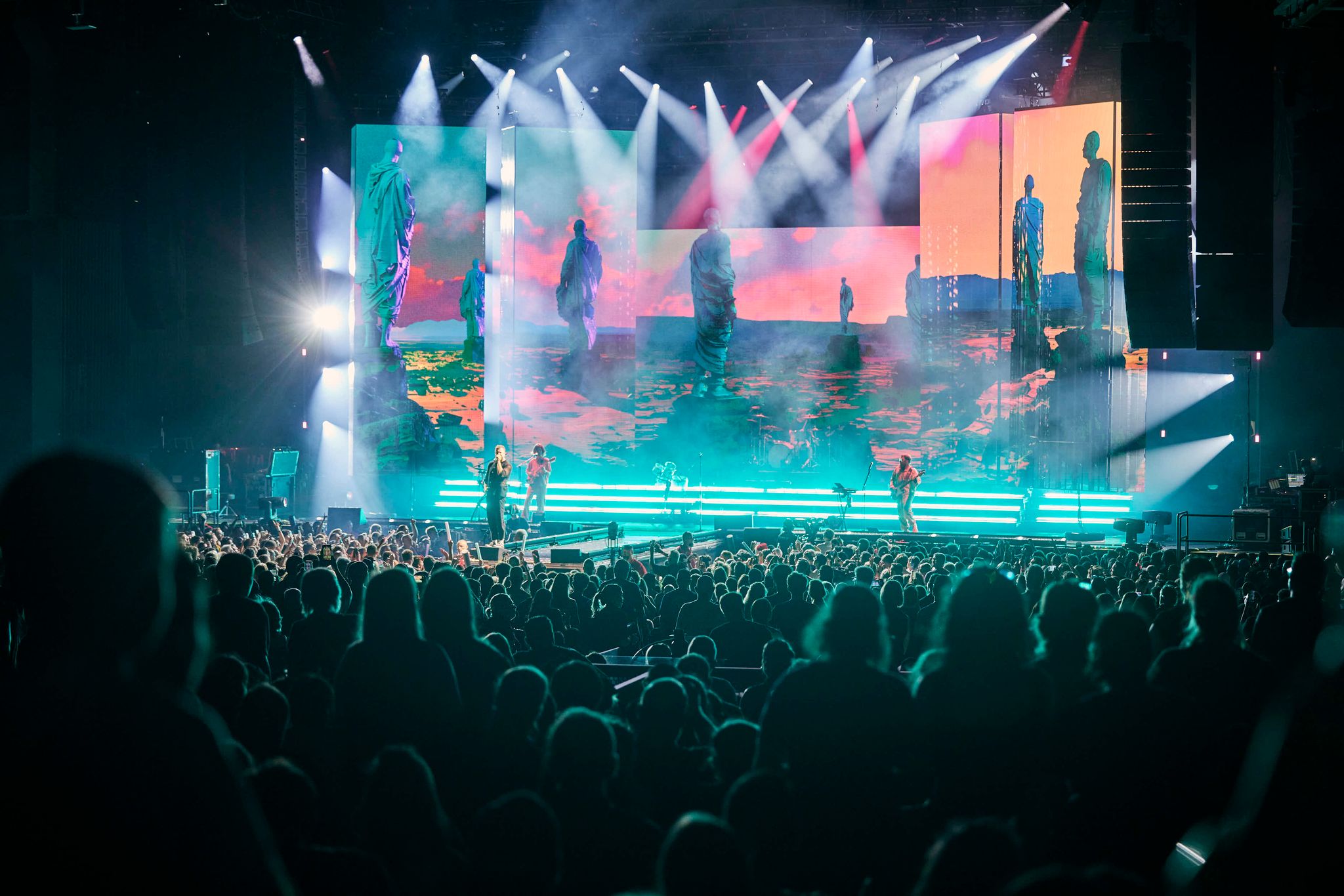
This early fascination with the combination of light and sound eventually wound its way to Station Six. Schellenger’s work there is more than just simple show design; it calls for creating immersive, visually striking environments for live performances, blending the artistic and technical. He develops stage layouts, lighting schemes, digital and video elements, all while working closely with the artists and directors themselves.
Schellenger grew up in Highlands Ranch, and attended Rock Canyon High School. “Even back then, I was doing technical theater,” he says. “I was weird in high school — I was on the football team, and into theater. So I got along with everybody. But my heart was in stage shows even then. Lighting, specifically.”
Despite the distance from downtown, Schellenger says he’d often take the light rail up from Highlands Ranch to catch shows at the Pepsi Center. He’d also head over to Red Rocks. “Or even the Ogden,” he adds. “Some of my favorite concert experiences were at the Ogden. So much more intimate. You could get right up close and really experience the show.”
No matter the venue, Schellenger became known for talking to the crew after each show. “I made a habit of heading up to the front of house where they control everything and saying thanks,” he says, “and also asking them how they got into their line of work. Most of them said the same thing: ‘Be a stagehand. Get your hands dirty. Learn the ropes.’ So as I graduated from high school and started studying theater, film and television at CU Denver, I remembered that advice. I eventually found a company — Rhino Staging — that provides all the stagehand labor for some venues. I applied, and they hired me on the spot.”
Schellenger worked even as he took college courses on theater lighting and the practical application of lighting for shows, small and large. Along the way, he continued to meet as many professionals in the field as he could, asking them about their work, how the job went, any advice they had. That curiosity — and the experience he gained from working the many shows he did during those early years — led him to move from a local crew to a touring crew.
“I started touring as a lighting tech for Christie Lights, which is one of the major North American lighting companies,” he recalls. “That was when I began to make my exit from formal education and started learning on the road. It was the right choice for me: As much as I believe in formal degrees and have a lot of respect for those that do, I’m lucky that my chosen career allows for many paths to get there.”

Mitchell Schellenger
While his career took off from there, there are certain moments in the process, quick as it felt, that Schellenger remembers with stark clarity. “One of my first tours was with LMFAO,” he says with a grin. “You know, every day I’m shufflin’. I was, like, twenty at the time, working as a lighting tech, learning how an arena tour worked. We had sixteen semi-trucks of equipment, and I lived on a tour bus. As the youngest on the lighting team, I was usually the one tasked with putting the harness on and climbing up and fixing lights. One of the stops on that tour was Red Rocks — big moment for me. Such an iconic place. And I learned just how difficult it is to put a show into Red Rocks. It’s a huge headache from a production standpoint…until it’s in the building. And then it’s gorgeous.”
The LMFAO tour was only the beginning. Schellenger went on to do the same for Jack Antonoff’s band Fun, and ran the lighting for an inaugural national Broadway tour, along with several others productions.
“And then I got a message that Third Eye Blind needed a lighting director,” says Schellenger. “This was for a smaller show, like Ogden-sized, so I stepped back a little in scale, but it was a huge step forward in terms of my role. They asked if I was free, and if so, they needed me in New York, like, right now. So I booked a flight that night, and the next morning, we were designing a show.
“At first, it was terrifying. We had such a condensed time to make all this happen,” he continues. “But we did it, we pulled through, and the band recognized it.” So much so that at the end of that tour, lead singer Stephan Jenkins sent out this note: “Mitch saved our tour from mediocrity. Let’s be honest. Hate to think of how a dreary light show would have brought everything down had he not become the sixth man in the band.” Schellenger says that recognition — that small gesture — was a real confidence boost.
It also led to more opportunities. Schellenger went back with Fun on a larger tour, and then worked for two years as lighting director for Enrique Iglesias and Pitbull’s worldwide tour. And then Matt Miley, whom hed worked with on the Fun tour and other projects, reached out. “He called and said, ‘Hey, we’ve got this new upcoming band called Imagine Dragons starting to do some stuff,’ and asked if I was interested,” Schellenberger recalls. “He still gives me shit that my first reaction was, ‘Eh, I don’t know.’ But he convinced me. We did a one-off show down in Mexico on some beach, and I thought that would be it. By thatfFall, their song ‘Radioactive’ had hit and they were doing arena shows. So Matt called me back and asked if I wanted to come on tour. This time I said yes, and that tour ended up being another worldwide, years-long thing.”
Schellenger’s involvement with Imagine Dragons is now pretty extensive, even granular. “I meet with the band to talk about everything from set-list choices to what color the confetti will be,” he explains.
That connection helped firmly establish Station Six, and Schellenger took on more artists: The Killers Live in Vegas; AJR’s Maybe Man and OK Orchestra tours; Shinedown, Bebe Rexha, Dolby and others. And the list keeps growing.

Mitchell Schellenger
“I relate much of what we at Station Six do to architecture more than anything,” Schellenger says. “Everything we do is in CAD [Computer Aided Design]. When it comes to this sort of work, we can close our eyes and have a crystal-clear picture of what a show could be, but it’s all about articulating that vision. It’s putting something in front of someone so they can have a look inside your mind.”
In addition to architecture and fire stations, Schellenger takes inspiration from the natural world, especially in his home state. “I do well when I step away from the technical aspect of the work,” he says. “Touch grass, as they say. Ideas have to come organically. When a band sends me an album, I’ll go for a drive and listen in my car. I want to experience it in the same way many fans probably will. I’ve got to feel it.”