
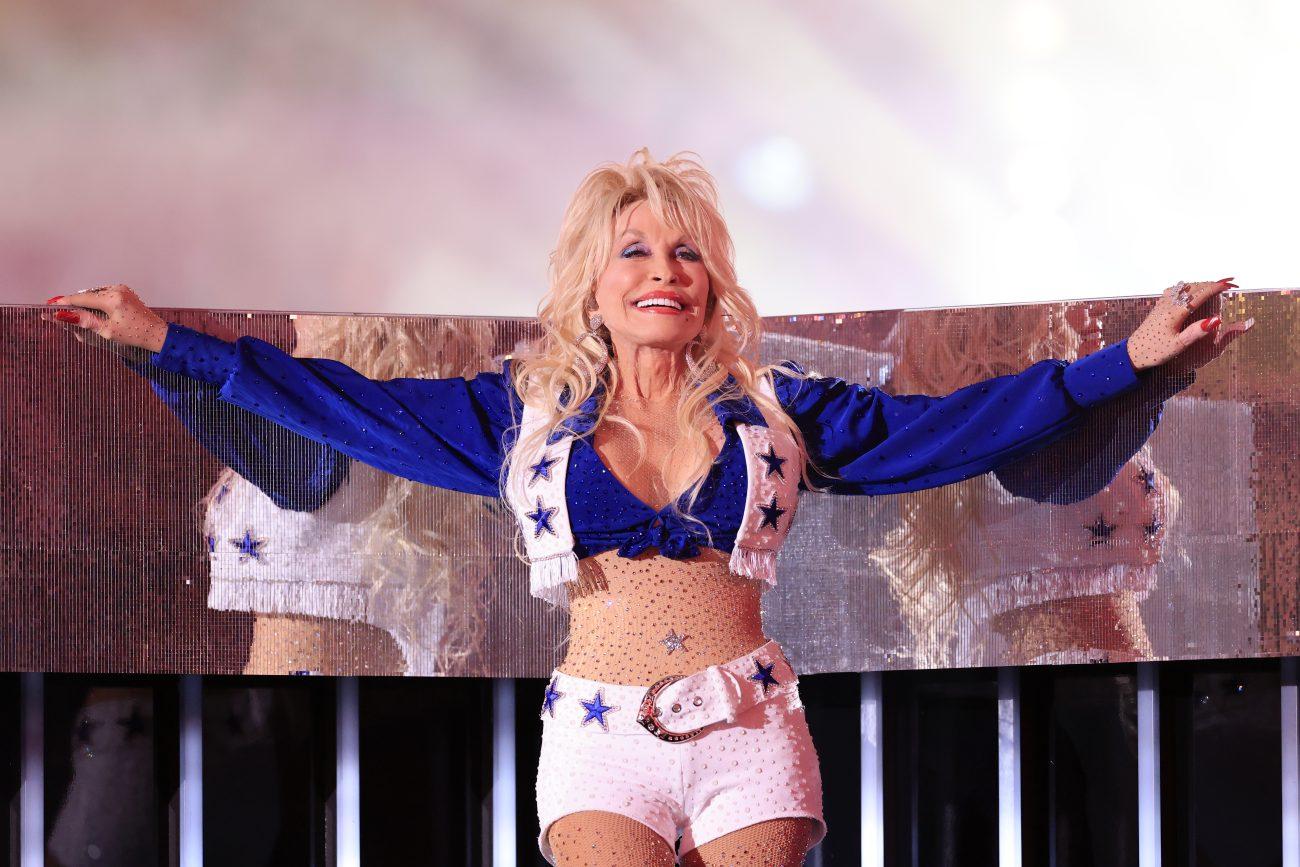
Ron Jenkins/Getty Images via Stringer

Audio By Carbonatix
When I saw the first report earlier today about the death of Dolly Parton at age 80, I had difficulty processing the news. After all, Dolly seemed as permanent as flowers and sunrises in America. But as the truth of the situation sunk in, I flashed back to the moment just over 34 years ago when I sat across from her for half an hour or so, during which she chatted with me and a handful of fellow journalists as easily as if she’d popped over to Aunt Martha’s in Pigeon Forge to grab a slab of lard she needed for a fish fry.
At the time, I was more knowledgeable about Parton as a pop-cultural phenomenon than as an incredibly gifted songwriter. I’d heard “Jolene,” of course, but hadn’t really dug into a lyric that stands as among the most evocative in any genre. Neither had I taken the time to really investigate her oeuvre as a whole. Only later would I be emotionally destroyed by the poignancy inherent in “Coat of Many Colors,” or startled by the potent storytelling at the heart of “The Bridge” about the apparent suicide of an abandoned woman who also happens to be pregnant.
Music doesn’t get any more hardcore than that.
Still, when I was contacted by a publicist handling press for a Parton junket on behalf of 1992’s “Straight Talk,” a romantic comedy whose makers had the terrible idea to pair Dolly with James Woods — best known for gritty thrillers such as “Salvador” and “Ghosts of Mississippi,” not to mention the David Cronenberg freakfest “Videodrome” — I was smart enough to say yes immediately. I had no agenda other than to spend a few minutes with her and write about the experience. After all, as the music editor of Westword at the time, I was accustomed to interviewing famous or fame-adjacent people over the phone, not in person. And there’s a significant difference between, say, chatting with Jane’s Addiction guitarist Dave Navarro while he stumbled around a room in an apparently drug-inducted haze and actually watching him do it. (That’s a story for another day.)
The interview took place in a suite at a Denver hotel — I can’t remember which one — and my first thought upon seeing Parton was that she couldn’t possibly be human. Instead, she seemed to have been constructed in a lab that employed the latest in space-age plastics and polymers to achieve a look that couldn’t be duplicated by mere flesh. Her skin had no pores that I could see, her complexion was buffed to a shine like the fenders of a classic Rolls Royce headed for the showroom floor, and her hair and her physique defied physics, gravity and every other law of science understood to date.
I assume that my jaw was on the floor, but, fortunately, she didn’t trip over it.
Under typical circumstances, my surprise would have rendered me totally incapable of speech. But Parton instantly put me and the others present at ease. I remember the conversation zipping along as quickly as the time, and when it was over and Parton had breezed away to charm the next group of scribblers, I felt as lightheaded as if I’d just spent the afternoon sniffing glue.
Here’s what I wrote about the incident in the Feedback music column for a March 1992 issue of Westword, issued prior to the start of the paper’s online archive:
Monday, I met with Dolly Parton.
Why? Parton was in Denver to promote “Straight Talk,” a not-very-good movie made tolerable by her likability. But that didn’t explain my presence. After all, I wasn’t planning to review the movie (or the soundtrack album, which isn’t very good, either, despite her likability). Let’s put it this way: If you were invited to meet Dolly Parton, wouldn’t you go?
What I remember about it: I remember that when the Dollster came into the room, she let out a squeal that made me think someone had just killed a muskrat. I remember thinking that, even from two feet away, she looked like a special effect. I remember that she’s planning to start a clothing line to be called Dolly’s Dailies and Nighties. I remember her admitting that she only added rock influences to her music so she could make a better living. I remember that she said she looked artificial. And I remember her claiming that she wouldn’t want to run for president because “them tabloids would find out about my affair with Bill Clinton and that would be it.”
Man, this is a bizarre job.
Times have certainly changed. Today, a Parton dalliance with the president occasionally referred to by the nickname “Bubba” would be treated as a charming anecdote — just Dolly being Dolly. Plenty of folks have noted that Parton may be the only entertainer who appeals equally to Democrats and Republicans, and they’re right. She no longer needed to make misbegotten movies to remain in the national conversation. No, Parton transcended the trends to become not just an icon, but an eternal.
Like everyone today, I’m sad that she’s gone. But I’m grateful that I was briefly able to bask in her light.