
Audio By Carbonatix
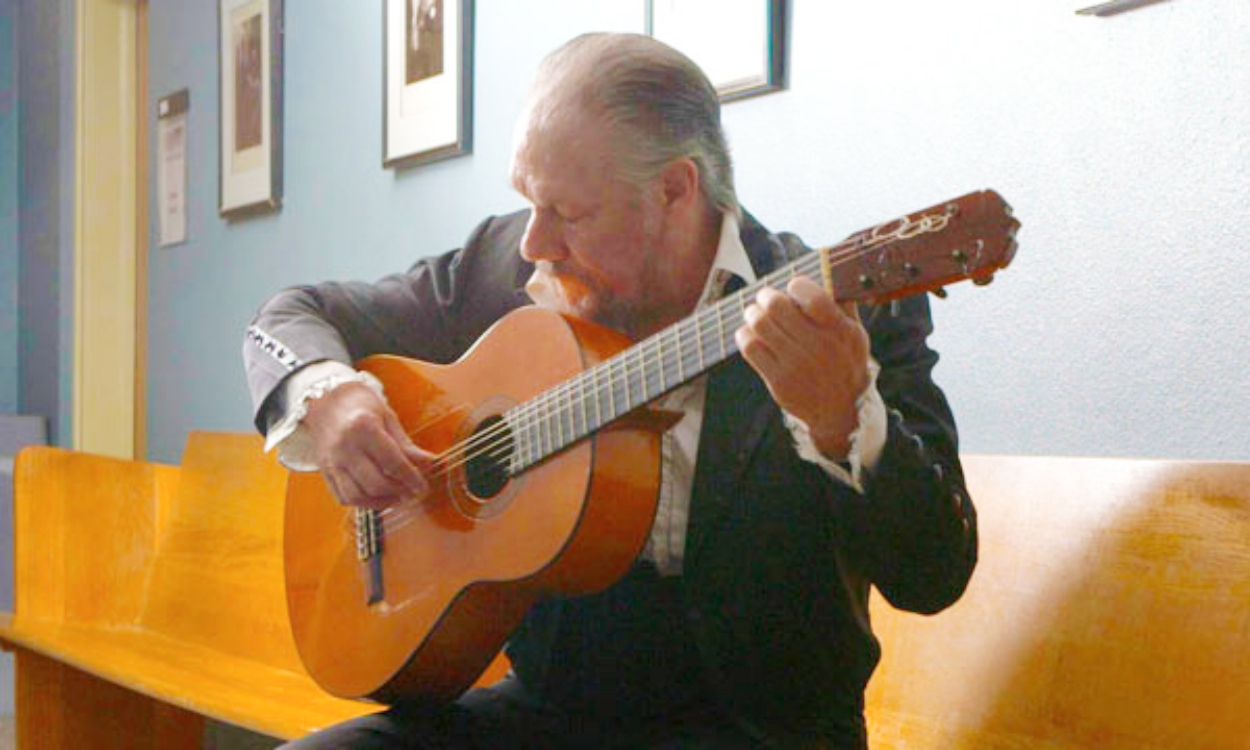
Guitarist and educator René Heredia, known as Denver’s “Godfather of Flamenco,” died on March 1 at the age of 87 — but not before receiving one final laurel in a life filled with them.
Over the years, Heredia had collected scads of accolades for many achievements, including the Colorado Governor’s Award for Excellence in the Arts, the Denver Mayor’s Award for Excellence in Arts & Culture, the Colorado Dance Alliance’s lifetime achievement award, and induction into the Latin Chicano Music Hall of Fame. So it was no surprise that when Colorado Music Hall of Fame introduced its Community Impact Awards, a new category saluting retail businesses and their owners, Heredia, the founder and guiding light of the Flamenco Fantasy Dance Theater & Center for Guitar and Dance, was among the first five honorees.
Unfortunately, news of this recognition arrived as Heredia’s health was rapidly declining. Time was of the essence when his niece and protégé, Andréana Cortés, arranged for me to speak with him as background for the online biography that will live on The Hall’s website. The conversation, which took place by telephone on February 12, would be Heredia’s final interview.
Heredia spoke from his room at an assisted living facility in south Denver, with Cortés at his side, and at the outset of the chat, his voice was weak. When asked how he was feeling, he answered, “I’m just trying to stay alive.” But as the dialogue continued, he gained strength, displaying the passion and pride that characterized his best work.
“It’s a great honor for me to be recognized after 45 years of living in Denver and bringing flamenco all over the world and to all the different cities that I could,” Heredia said of The Hall’s Community Impact Award.
His renown was indeed international in scope. Over his decades in the spotlight, he played command performances for two presidents (Gerald Ford and Jimmy Carter), as well as Prince Rainier and Princess Grace of Monaco, Princess Noor of Jordan and Prince Bandar of Saudi Arabia. But he retained a soft spot for his roots in Granada, Spain, where he learned flamenco at the knee of his father and began performing in Los Heredia, a dance troupe co-starring five of his siblings, at age thirteen. Four years later, he was hired to play guitar behind Carmen Amaya, the most popular female flamenco dancer of the era, and the renown he achieved gave him an opportunity to see the world.
“I played a club in Palm Springs in 1957 and toured all over the United States,” he recalled. “I also did Tijuana, I did Nogales, I did El Paso, I did Miami and worked in a big-time, five-star hotel. I went to Cuba and was working in a five-star hotel there when they told us Castro was going to come in and we had to leave. I said, ‘What about our contract?’ They said, ‘Forget about the contract. You have to get out.’ We flew from Havana to Madrid. Then we took the rest of the company on a tramp steamer and we went to the Canary Islands. We also went to the south of France. I lived in Paris for three-and-a-half-years and toured the whole country of France two times. We took the train all the way to Switzerland. We worked at the Tivoli Gardens [in Denmark] for a whole month. Then I flew back to Los Angeles and started working at a nightclub that was basically for beatniks, which is what they were called before they were called hippies. I worked with Cannonball Adderley, Lightning Hopkins, Jose Feliciano. We would share the dressing room and have a bottle of whiskey in a paper bag and pass it around the nightclub. I worked with Groucho Marx, too.”
Another prominent associate was dancer and choreographer José Greco, whom Heredia backed on guitar during appearances on The Ed Sullivan Show and other prominent television programs in the U.S. But he also toured as a headliner — and his first trip to Denver would prove fateful.
“I was contracted out of Santa Fe for four weeks, and we sold out every night,” he remembered. “They wanted us the following year for another four weeks, and the year after that they held us over for eight weeks. That’s when I decided to try my luck in Denver — and it went well for me.”
He relocated to the Mile High City in 1968 and experienced instant success in part, he believed, due to a lack of competition. “When I came to Denver, there were only 500,000 people in the city and there was no culture. They did have the symphony and they had the opera house, but other than that, people went skiing and watched football, basketball, baseball and hockey — and flamenco wasn’t here at all.”
Heredia changed that through his performances, as well as the Flamenco Fantasy Dance Theater, whose origins can be traced to a suggestion from his beloved. “I had been teaching out of my studio on 6th and Emerson for quite a while,” he said. “My house was two blocks from Washington Park, and I told my wife I was going to run around the park to exercise. She said, ‘Why do you want to do that? You should start teaching dance. You know all the dancers, you know all the rhythms.’ So I started teaching dance. At first, there was just one private student. But then there were more, and pretty soon, I had enough people to start a company — and they got to be pretty good.”
Before long, he continued, “we were performing at private clubs and concerts. We did Red Rocks with the Denver Symphony. I did Romeo and Juliet at the Performing Arts Center. I performed at Boettcher Hall and did nightclub work all over.”
In 2021, after decades of such efforts, Heredia passed the torch to Cortés. “She is carrying on the tradition,” he noted with pride. “My mother had eleven children: four girls and seven boys. Out of that pile of people, I had a lot of nephews and nieces, but Andréana is the only one carrying on the banner of flamenco.”
Thanks to Heredia, Cortés has fertile ground to work. In his words, “I kind of seeded the area with classical guitar and flamenco guitar, music and dance.”
On February 26, two weeks to the day after my call with Heredia, Colorado Music Hall of Fame executive director Karen Radman presented Heredia with the Community Impact Award. He is said to have been in great spirits at the time. He passed away three days later.
Services for René Heredia are pending.