Bennito L. Kelty

Audio By Carbonatix
Keep Westword Free
We’re aiming to raise $20,000 by April 26. Your support ensures Westword can continue watching out for you and our community. No paywall. Always accessible. Daily online and weekly in print.
For over a year, a new generation of Denver protesters has been out on the streets, voicing opposition to the return of President Donald Trump. And even though he still has almost three more years in office, local grassroots groups are confident their actions are making a difference.
“What I would say to people if they are feeling down, thinking ‘protesting isn’t working, Trump isn’t leaving office,’ I can tell you protesting does work,” says Tiffany, the founder of Solidarity Warriors, a group that teaches people how to organize protests; she asked that her full name not be used. “Patience is needed, but change is coming. We’re doing a good job.”
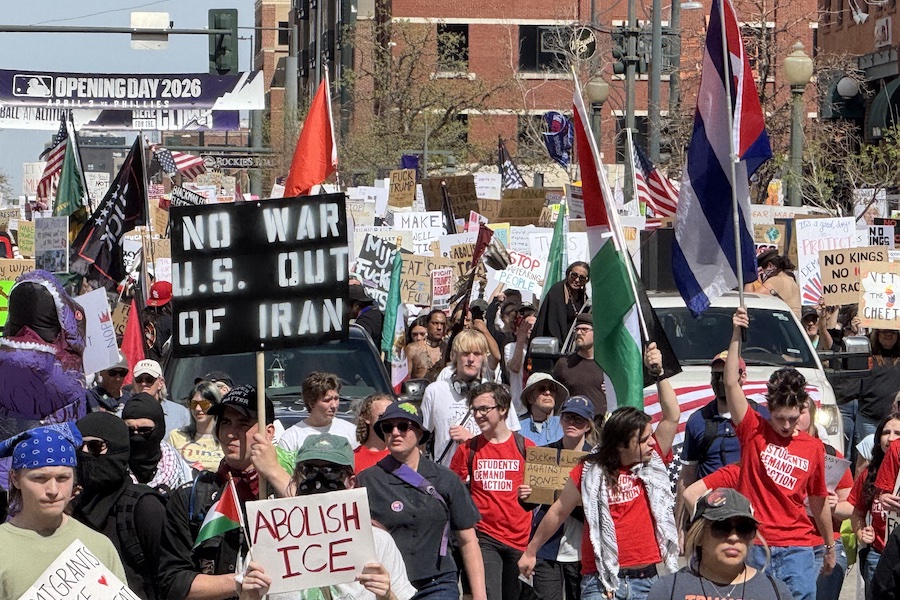
Since January 2025, Denver protesters have gathered at the Colorado State Capitol, often marching from there through downtown — sometimes getting arrested, sometimes threatened — at actions including three No Kings protests, ICE Out! last June, the Hands Off action last April and many more demonstrations. Aggressive acts by Immigration and Customs Enforcement, including killings in Minneapolis, have provoked some of the largest turnouts, but Denver protesters have also decried cuts to the federal government, military action in Iran and Trump’s overreach of power. During the No Kings 3 protest on March 28, the Colorado State Patrol estimated 10,000 people rallied in Denver, while other counts went far higher. Have such actions had an effect?
While ICE has pulled out of Minneapolis, it still plans to open detention centers in Hudson and Walsenburg, despite continued resistance within Colorado. And Trump certainly isn’t listening to Denver protesters who want him to end the war in Iran, protect women and LGBTQ rights, and release the full Epstein files.
“We’re very clear on the fact that Trump and his administration and his lackeys are not going to be moved by protesters,” says Lori, who founded the Colorado Bridge Trolls, a group that protests by dancing over highways and waiving signs, and also asked that her full name not be used. “The reason the Bridge Trolls do what they do is because this environment is soul-sucking. It’s a way of keeping me from being immersed in negativity.”
For Tiffany, the best evidence of the impact of Denver protests is the departure of tech-giant Palantir from Colorado for Miami in February. “Palantir moved to Denver in 2020 because of the protests against them in Silicon Valley, and then left Denver in February because of all kinds of protests,” Tiffany says.
However, the company reported in a February investor filing that it left because of Colorado’s AI regulations, and stories in the national media note that billion-dollar companies are moving to Florida for more tax breaks.
Still, Denver protesters say they see plenty of other ways they have had an impact, and will continue to do so.
A Fool’s Errand?
Tiffany, who lives in a small community near Idaho Springs, drives almost two hours to attend demonstrations at the State Capitol, and says some of the value of protesting lies in solidarity and seeing others support you. She started Solidarity Warriors with a friend in November 2024, right after Trump won re-election, and organizes weekly Zoom meetings to encourage and educate people. She says that about 100 “pissed-off activists” attend each Solidarity Warriors meeting, where they listen to talks by experienced activists, learn their rights if confronted by ICE and catch crash courses on how to safely organize their own protests or activist groups.
Her first protest was in 2003, after she saw pictures of children killed and maimed by the U.S. military’s “shock and awe” bombing campaign in Iraq. She was a teenager living in Boulder at the time and “made a bunch of signs and went to sit on the Pearl Street Mall the next day,” she recalls. She hoped other protesters would come out and show they were just as outraged by the U.S. military action, but after a lonely half hour, she remembers that she began to feel “disheartened.” As she prepared to pack up and head home, defeated, “that’s when I saw this huge crowd of people come around the corner on a march.” she recalls. She still has trouble holding back tears when she tells the story two decades later.
“Just to think that there were so many people who cared like I did. It felt like hope,” she says. “That’s why I organize protests. I want to give people that feeling.”
Jojo, a 24-year-old organizer for the unabashedly weird Trash Heap Collective, gave up on the march-and-chant-style of protesting in October, as she doubts it really makes a difference. “These marches are an outlet for anger in a controlled manner,” Jojo says. “A parade in the streets is not going to make [Trump] seethe with anger.”
She continues to perform witchy rituals to compel the release of the Epstein files, organize Smiling Friends-themed demonstrations, and interview people in the crowd at big demonstrations like No Kings 3 and ICE Out! She believes that more targeted action and sustained efforts, not huge marches in Cherry Creek, led Palantir to leave its planned headquarters there and convinced the City of Denver to ditch Flock in favor of Axon to run its AI surveillance cameras, also reducing the number of those cameras from 111 to 55.
Bennito L. Kelty
“Do I think No Kings 3 was worth it? No. Gathering 10,000 people in a park together to tell them to all make Signal chats to watch out for ICE in their neighborhood, that would be far more effective than parading on a controlled march where police are protecting the route,” Jojo says. “It takes something that can actually protect us from state oppression, or at least showing that we’re not afraid to stand up to it.”
She’s a bigger fan of attempts to march onto the highway, which usually result in clashes with police. Marching onto the highway “would show we’re not afraid of state violence. However, we haven’t really seen any of them manage to take the highway,” she notes. According to the Denver Police Department, eight people were arrested during No Kings 3 after they attempted to march onto Interstate 25 and clashed with cops. Usually, the commotions involve just a few people, and the result is a “badass but stupid” display, Jojo says.
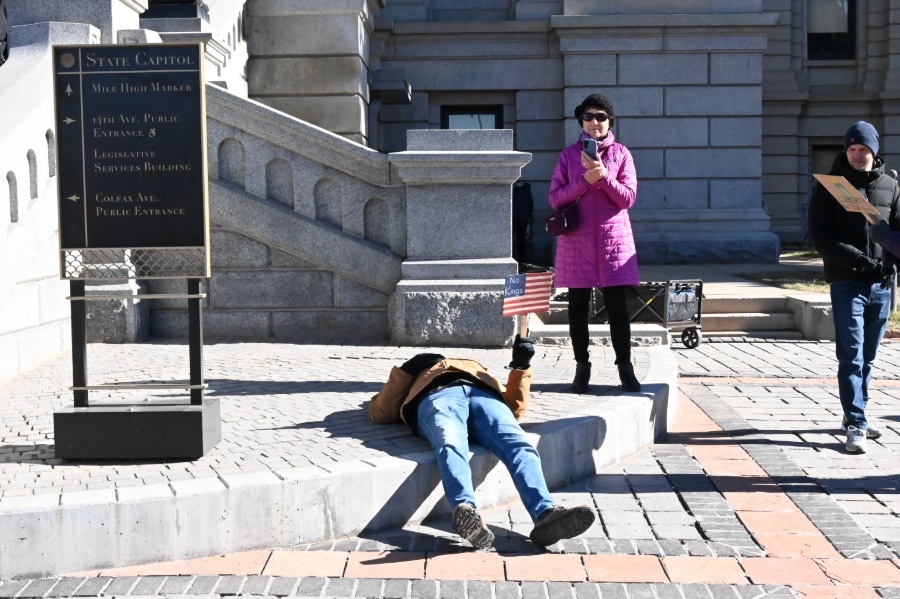
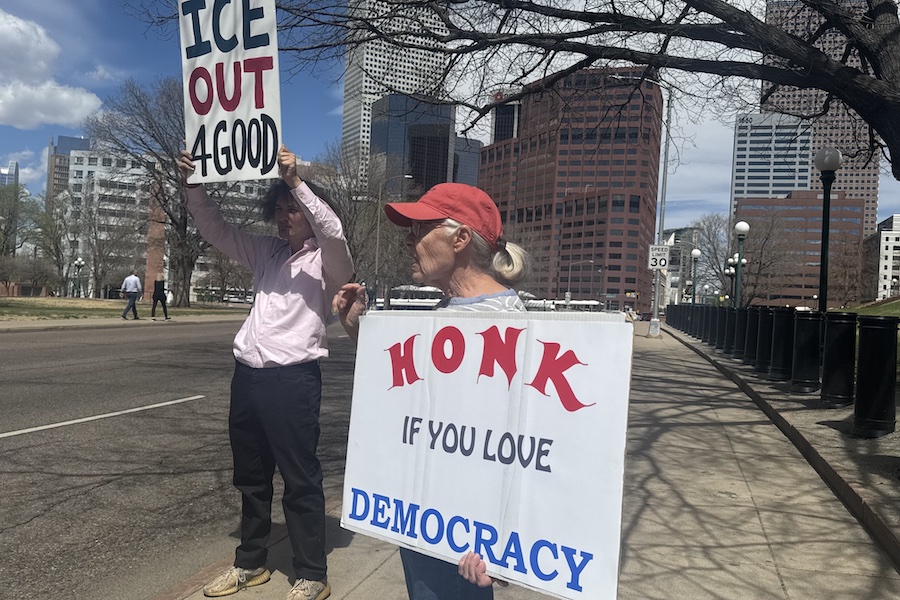
On April 8, Jojo was at the Capitol holding up a sign in anticipation of a small Hands Off protest. Paula Van Dusen, a Quaker who protests every Wednesday and Thursday afternoon outside the Capitol, overheard Jojo talking about why protesting matters, and added: “You’ve got to protest no matter which shoes you wear because what matters is the people Trump is killing people and our democracy.”
Lori, a protester who practices “joy as resistance” by dancing twice weekly with the Colorado Bridge Trolls, says she sees the reaction of people passing under the overpasses and signs where they party. They used to get people flipping them off, Lori says, but after a year, more people are honking in support or flashing more friendly hand gestures.
“When we first started this, you would see people smiling, giving you thumbs up or aloha, and they wouldn’t be honking. I think they were afraid of letting other people around them know how they feel,” Lori says. “It used to be only about a quarter of drivers who saw us would honk; now it’s about three quarters are honking and only about a quarter have no reaction.”
Lori doesn’t always look for the big picture impact. She sees the benefit of protesting at the individual level, and says that protesting is her favorite way to stay in shape as a woman in her sixties, since her style involves dancing all day in an inflatable costume.
“I love the physical activity and the physical release. It’s so much better than so many forms of exercise,” Lori says. “The fact that I can be out there for five or six hours, climbing on the side of a fence, dancing and jumping around, I’m doing my body a lot of good. No Kings was a nine-hour day of consistent, constant movement.”
The 3.5 Rule
At Denver’s No Kings 3, a few signs pronounced that the United States only needed 3.5 percent of its population – about 12 million people — to keep peacefully protesting in order to defeat Trump. According to national organizers, No Kings 3 saw a total of 8 million people across the country demonstrate against Trump.
A protester at No Kings 3 mentioned the 3.5 rule to Jojo; she worries it makes protesting sound more effective than it actually is. “I spoke to this gentlemen who said, ‘Once we get to that 12 million number, that’s when we’ll see real change,’ and it sounded to me like a misinterpretation,” she says. “The way it had seemed to filter down to this gentleman was, ‘If you simply march for a day, the world is going to change.'”
The “3.5 percent rule” was first cited by Harvard political scientist Erica Chenoweth in 2013; she suggests that whenever 3.5 percent of a population has sustained peaceful protesting, it’s always brought about political change.
But Tiffany agrees with Lori that showing up for marches and protests isn’t enough.
“If we get 12 million out at the next protest, it doesn’t mean Trump magically disappear,” Tiffany says. “Protesting is just the beginning. What it means is that we have to be continuously involved.”
Bennito L. Kelty
But the larger the protests, the more they reach people from critical institutions of power like banking, the media, the military, the schools and the courts.
“Trump is not the disease, he’s the symptom. The way that we take down an entire fascist regime is taking down the pillars of support,” Tiffany says. “The reason why having mass protests and getting bigger and bigger is so important is the more people we have, the more connections we have to those pillars.”
Tiffany says that she believes the power of protests lies in influencing “non-compliance” under Trump, as well as “boycotts, general strikes, work slowdowns” and simply motivating people to stay involved.
“That’s each person’s responsibility, rather than just sitting around and being anxious about it, ” she says. “Because others feel the same way, and we’re counting on each other. We’re all in this together.”