Bennito L. Kelty

Audio By Carbonatix
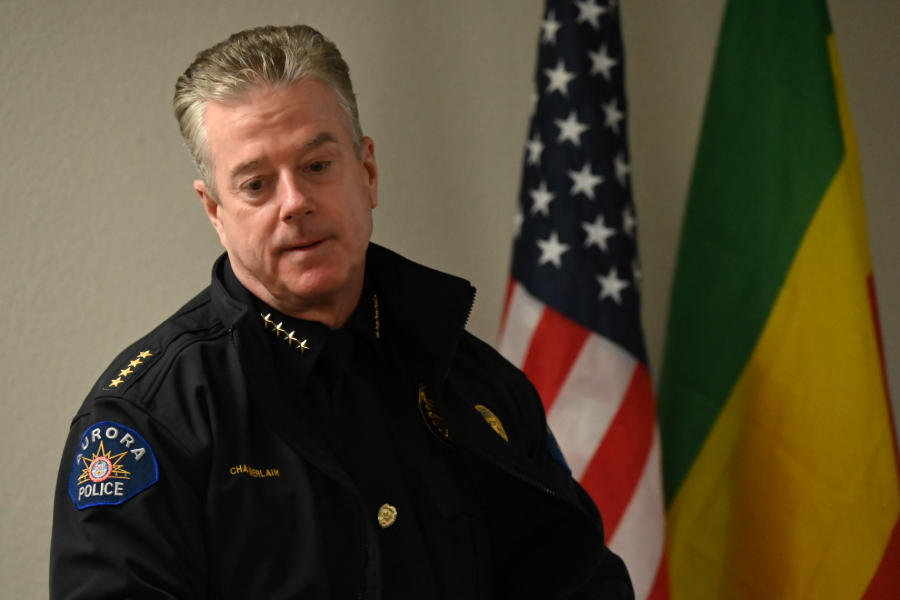
Aurora Police Chief Todd Chamberlain met with Ethiopian residents on Friday, March 6, to talk about safety within the city, telling them that immigration enforcement and surveillance powered by artificial intelligence are nothing to worry about.
The meeting was hosted by the Colorado Ethiopian Community, an Aurora-based group, at their offices on 1450 South Havana Street. According to the United States Census Bureau, nearly a quarter of Aurora’s 400,000 residents are immigrants, fortifying its claim to be “the world in a city.” Mexican immigrants account for more than a third of the local immigrant population, at around 33,000 people. Ethiopians are the second-largest minority group in Aurora, data shows, at over 5,000 people, with over 80 percent of them having immigrated to the U.S. Aurora is also home to 1,000 Eritreans, who identify as Habesha, like Ethiopians, and were part of the same country until 1993.
A woman who said she owned an auto dealership thanked Chamberlain for the police’s role in reducing homelessness, and a man who identified himself as a pastor told Chamberlain that homeless residents loitering and defecating in front of establishments is the biggest problem in his community, but he also thanked the police chief.
“We have been victimized too often,” the pastor said. “But right now, [over] the past year, we had a decrease in crime, and we have a little bit safer working environment. I would like to express my appreciation for what you have been doing.”
Former Aurora City Councilman Amsalu Kassaw, who spent a brief time as a member of the council’s conservative majority, echoed worries about property crime.
“Our Ethiopian community is concerned with theft and crime. A lot of our community is right here on Havana [Street]; they own a lot of small businesses,” Kassaw said. “They do have a lot of homeless that break into their stores. It is getting better every day, but the community is really worrying about theft and crime.”
But much of the conversation tilted toward federal immigration enforcement, inside and outside of the Ethiopian community.
ICE’s Chilling Effect
Immigration and Customs Enforcement (ICE) has incarcerated more than 70,000 people and deported half a million since President Donald Trump returned to office in January 2025, according to White House figures, with some immigration raids resulting in the killings of unarmed people by federal officers. In Colorado, more than 30,000 people were detained and eventually deported in 2025. Just over a year ago, ICE carried out high-profile raids in the Denver metro area, and Aurora is the home of Colorado’s largest active detention facility for ICE.
Aurora police have said in the past that they would not share law enforcement information with federal immigration officers without proper warrants, but local law enforcement data in Colorado has been shared with ICE before. According to Chamberlain, residents still reach out to APD with worries about their own information being shared.
“Are there some concerns by a lot of people? There is,” Chamberlain said, while stressing that APD does not perform immigration enforcement. His message to the Ethiopian community was to trust APD, whether they’re “documented or undocumented,” because “we do not get involved in immigration issues at all.”
“When we come to your home, we do not ask, ‘What is your immigration status?'” he said. “We do not collaborate with ICE. We do not get involved in what ICE does. That is ICE’s mission.”
Chamberlain, who used to work for the Los Angeles Police Department, says that in his forty years of local law enforcement experience, he’s never seen immigration enforcement by municipal police. Kassaw, who works as a GEO Group guard at the Aurora ICE detention center, thought Chamberlain’s response was “perfect” because “the community shouldn’t fear immigration enforcement,” he said.
“ICE has its own thing,” Kassaw said. “The community needs to understand that. The municipal police don’t involve themselves in immigration enforcement.”
The APD chief referenced a December 2024 kidnapping at the former Edge of Lowry apartments as an example of why it’s important for immigrants to report crime. The Edge of Lowry at 1218 Dallas Street, one of the starting points for claims that Venezuelan gangs had taken over the city, was the site of multiple kidnappings in late 2024, but APD didn’t find out until someone reported that they had been kidnapped and tortured shortly after Chamberlain visited the property, he said.
“Other people had been kidnapped, other people had been tortured, other people had been extorted,” Chamberlain said. “The only reason we were able to address that and change people’s lives was because someone had the strength to step forward.”
Defense of Flock Cameras
Chamberlain reassured his Ethiopian audience that law-abiding residents shouldn’t worry about APD’s use of AI-powered surveillance technology, either.
“Unless you are involved in criminal activity, you have no fear of technology,” Chamberlain said. “Because we don’t have the time or the energy or the effort to focus on somebody who’s just trying to live their life.”
Aurora contracts with Flock Safety to track people with AI and data gathered through traffic cameras set up throughout the city. Clearview AI and LexisNexis also have contracts with the city for similar AI-powered facial recognition technology and software.
2025 Hanging at Del Mar Park
Local activist MiDian Shofner was also at the meeting, holding up a banner that said, “Someone was Lynched in the City.” Her sign referenced a man found hanging in July 2025 at Del Mar Park in the heart of Aurora. The Arapahoe County Coroner’s Office later identified him as 45-year-old Mom Krouch. A resident living near Del Mar Park identified him a homeless Cambodian immigrant who had lived with her for a time.
Chamberlain noticed the banner and addressed it by cautioning against the spread of misinformation while offering new details about Krouch’s death.
“He wasn’t Black. He had suicidal ideations,” Chamberlain said. “He took his own life. He hung an extension cord from a tree in Del Mar Park. He hung himself about six to eight inches off the ground.”
Chamberlain expressed frustration with a “false narrative” on social media claiming that a Black man was lynched in the middle of Aurora. The incident has been brought up in social media posts questioning an increase in reported hangings around the country.
“I have people in the City of Aurora and different community groups right now who think that there was actually a lynching in Aurora, and there was not,” Chamberlain said. “What there was was a lie that someone wanted to perpetuate to cause fear and anxiety in a community.”
Shofner left the event early before it finished and didn’t address the topic at the meeting. She tells Westword that her banner wasn’t specific to Krouch, though she is skeptical of Chamberlain’s comments.
“It was in reference to all of the missteps, killings and patterns of injustice under [Chamberlain’s] leadership,” Shofner says. “It wasn’t specific to the man in Del Mark Park, but I will say that our organization does not trust the outcome of that investigation because of the culture of APD.”
Rubber Bullet Through the Wrong Window
Another activist at the meeting, Kevin Detreville, brought up an incident two weeks ago in which an Aurora SWAT officer shot a rubber 40-millimeter bullet through the wrong window. Chamberlain said he knew about the incident, adding that the officer misidentified a suspect’s apartment and shot through a young mother’s window while her twelve-year-old was home alone.
“SWAT was serving a search warrant at a location. There was an officer at the back of the location. There were about five or six windows,” Chamberlain said. “They believed that the suspect was standing at the window and possibly armed, so an officer fired a 40-millimeter into that to try to stop that individual, let him know he was there. It turned out to be the wrong window, which is incredibly unfortunate. Luckily, the room was empty.”
Detreville, a long-time critic of the APD known by his YouTube name, KDot, said that APD released little information about the incident; APD hasn’t shared anything about the issue via a press release or social media. Chamberlain said that he told city councilmembers about it, “and we talked about it in the department.” But it wasn’t worth informing the public, the police chief argued.
“Do incidents and mistakes happen? Yeah,” Chamberlain said. “To be really honest with you, it did not rise to a level that needed to be put out. There are events that, unfortunately, happen. Out of 247,000 calls for service that occur, there are mistakes that happen.”