Courtesy of Jim Goebelbecker

Audio By Carbonatix
In a six-week span after the Aurora Regional Navigation Campus opened, police responded to calls, issued citations and charged people with crimes approximately 140 times, according to records obtained by Westword.
The 600-bed, $40 million homeless shelter opened on November 17 at 15550 East 40th Avenue, to much acclaim from Aurora Mayor Mike Coffman. Unlike at most homeless shelters, residents can move from a cot to a private room at the Navigation Campus by getting a job and staying sober. But the Aurora center has had a rocky first few months.
The forty-year-old building is plagued with maintenance and operational issues, and the Navigation Campus can count increased crime among its problems, too. According to Aurora Police Department data, there has been a significant increase in APD-reported crime and calls for service at 15550 East 40th Avenue since the facility opened.
In response to a records request, APD compiled all calls for service, citations and criminal charges at the address for the past two years. There were 59 total calls, citations and charges in all of 2024, when the Navigation Campus was being built. That number nearly quadrupled in 2025, however, with the APD recording 225 calls, citations and charges at the campus’s address; more than half of those, 140, came between November 17 and December 31.
“When a property is closed for a period of time and later reopens, an increase in calls for service is not unusual,” APD spokesman Joe Moylan says in a written statement for Westword. “However, we do not consider call volume at the Navigation Campus to represent a concerning trend.”
Aurora police records don’t specify whether incidents took place inside the doors of the Navigation Campus or in the outside area, which is a gaping, mostly unused parking lot. APD has yet to respond to a request for comment on the increased calls, citations and charges.
The City of Aurora and APD launched a two-week “pilot program” on February 6 that involves “staffing two officers at the Navigation Campus from 8 a.m. to midnight, seven days a week,” according to Moylan. After February 20, law enforcement and city leadership will consider whether the pilot program should continue.
“These are off-duty, overtime assignments that officers may work on their days off, resulting in no impact to daily department operations,” Moylan adds.
Bennito L. Kelty
More Violent, Unusual Crimes
A call for service doesn’t necessarily mean any criminal activity took place. From November 17 to December 31, more than 25 calls for service to the Navigation Campus were cancelled, meaning no officers were dispatched, but APD included those calls in the 140 incidents it reported at the campus. Aurora police also counted more than two dozen cases that were described only as “contact made,” and eight instances of a “dismissed call.”
Even with those eliminated, the APD data still shows a sharp increase in citations and charges for violent crimes at the Navigation Campus address since it opened.
For more than eight months before the campus opened, APD didn’t document a single violent crime at the location. In less than two months in 2025 after it opened, APD recorded seven cases of violent crimes at the campus, including sexual assault, assault and battery.
Police didn’t record a sex assault there in 2024 and through most of 2025 — until November 20, three days after campus’s launch. On December 31, another sexual assault was reported on the scene.
Most of the calls that brought officers to the area in 2024 and 2025 before the campus opened were for “area watch,” a program that allows Aurora residents to request extra patrols in certain neighborhoods. Area watch calls became less frequent at the campus’s address after operations started there, with only two calls after November 17, records show.
The most common APD citations and charges before the Navigation Campus opened were for non-violent property crimes, such as trespassing (five instances) and larceny (four). After the campus opened, APD has reported eight cases of trespassing and two for larceny.
Assault and mental health crises have also became more frequent, per APD data. Before the Navigation Campus opened, APD recorded two alleged assaults at its location in 2024 and 2025; since the campus opened, there have been five documented allegations of assaults. A single mental health crisis was reported by APD before November 17, and then five after.
APD didn’t record “reckless kindling of fire” during the past two years until the campus opened, either, but police tallied two such cases in December 2025. Similarly, APD issued “obstructing a peace officer or fireman” or “criminal invasion of privacy” charges on December 7, 2025, but never issued such charges before the Navigation Campus.
While the campus was still in development in 2024 and 2025, APD rarely had a day where it reported more than three calls or crimes at the address. But since November 17, there have been just a handful of days where only one police call, citation or charge at the campus took place (November 19 and 20 and December 1, 2 and 25, when APD had to assist the Aurora Fire Department for a call on Christmas). Most days, APD reports three or more incidents at the Navigation Campus, but some days were especially active, with almost a dozen incidents on December 28.
On November 23, APD came to the Navigation Campus to respond to a battery, an assault, an “unwanted person” and a mental health crisis. On December 28, officers arrived for a welfare check, a mental health crisis, to watch the area, to stop a “reckless kindling of fires,” to address “unauthorized camping on public property,” and to respond to an active fugitive or failure to appear (FTA) warrant.
APD has only recorded four fugitive or FTA warrant charges at the campus during the past two years, all in December 2025. That same month, APD had just two days where it wasn’t called to the Navigation Campus at all: December 4 and 10.
The way APD sees it, “the Navigation Campus serves a segment of our community with specific needs,” and “transitioning away from a life on the streets is not always a smooth process,” Moylan says, adding that the police department does “not view the increase in calls as a problem.”
Rough First Months
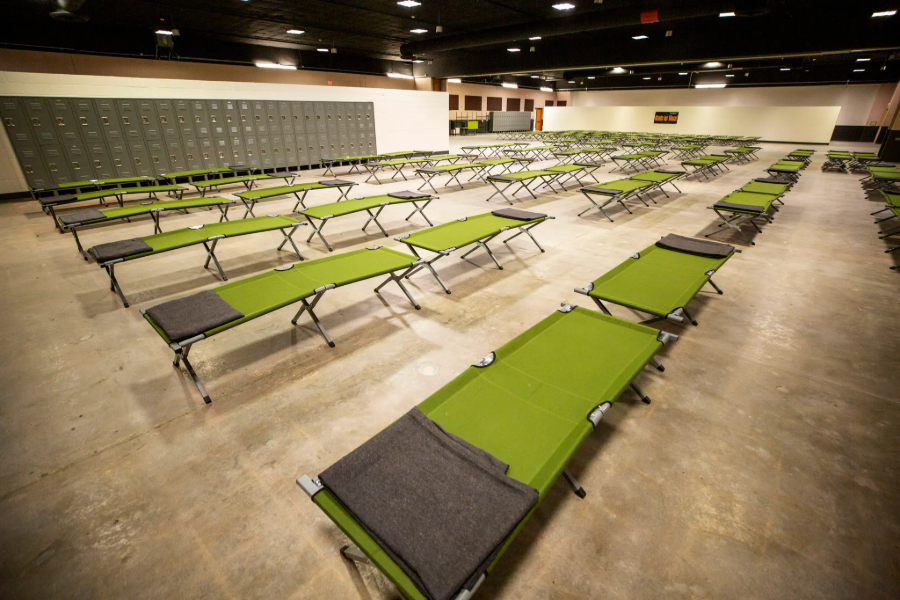
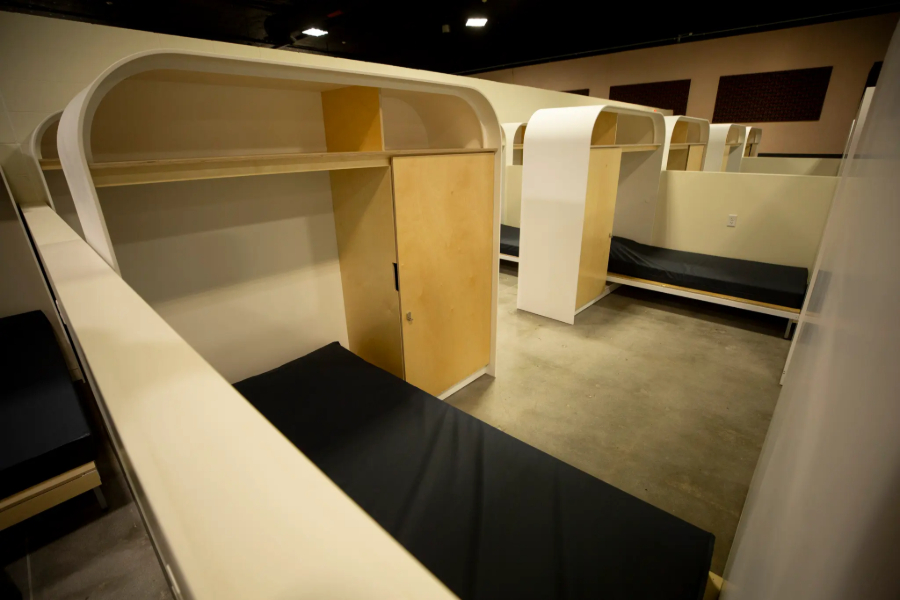
Formerly a Crowne Plaza hotel, the Aurora Regional Navigation Campus is tucked behind a sound well over Interstate 70, near Denver International Airport. The former convention center on the ground floor now houses cots and sleeping pods, which are beds with a couple of drawers and walls around them. A few steps away, local organizations offer addiction counseling, legal help, vaccinations, job training, resume building and help obtaining vital records.
The building was renovated with the help of $25 million in leftover federal COVID relief funding from Adams, Douglas, Arapahoe counties and $15 million from the Colorado Department of Local Affairs.
The campus’s signature quality is the tier system. Anyone can get a cot on the “compassion” tier, but if they’re working with case managers and looking for a job or training, they can get a sleeping pod on the “courage” tier next to the cots. If they have a job and are sober, they can stay in a private former hotel room on the “commitment” tier.
In the months before opening, the Navigation Campus was anticipated as a model for a “work-first” style of solving homelessness and an alternative to a pricier “housing-first” approach favored by Democrat-led cities. While Denver’s converted hotel shelters allow anyone to get a private room, the Navigation Campus hinges on “incentivizing individuals to take the steps they need to stabilize their lives, join the workforce and reach the maximum level of self-sufficiency” through its tier system, Coffman wrote in a November 10 op-ed in the Denver Post.
Coffman declined to comment on the crime data trends. A spokesperson for the City of Aurora instead referred Westword to his comments made at a public workshop on Saturday, February 7. But at the workshop, Coffman only talked about maintenance issues at the campus during the first few months.
According to APD Chief Todd Chamberlain, police responded to thirty mental health crises, eleven “alcohol or drugs” complaints, fifteen “fire needs police” calls, twelve welfare check and upwards of 23 cases where people “were suicidal” or “threatened suicide.” Those tallies are more than what’s revealed in the APD data for November and December.
Chamberlain says APD officers spent an average of 45 minutes at the campus when responding to calls for service there, “with our long one going up to seven hours,” without providing further detail.
The nonprofit Advance Pathways, which used to run sober-living facilities and Aurora’s main day shelter, now operates the campus through a three-year, $6 million contract approved by the Aurora City Council in 2024.
Advance Pathways CEO Jim Goebelbecker declined to speak on the recent crime statistics, saying he has “not seen any of the data so can’t comment.” He has not responded since receiving two copies of the crime report.
Courtesy of Jim Goebelbecker
Goebelbecker told Westword in January that “success has been challenged, for sure, by unforeseen challenges,” but increased crime wasn’t mentioned. Rather, Advance was having trouble with the building and increased scrutiny on the quality of life inside.
On January 12, the Aurora City Council had its first chance to hear updates from Department of Housing and Community Services staff, who requested approval for a $300,000 contract for Advance to hire more security guards and case managers. Councilwoman Angela Lawson took the opportunity to criticize the campus staff for “inhumane” conditions after she heard backed up sewage forced guests to use port-a-potties instead of the campus’s bathrooms.
Councilwoman Alison Coombs said that she heard the guests were confused about how to move up the tiers and lacked hygiene products. She suggested suspending Advance’s contract if problems persist, but the council unanimously approved the $300,000 payment.
Around the same time, Kristin Mallory, a member of the Aurora School Board, shared photos with local media from inside the campus that she said showed water on the floor from backed up plumbing, messy scenes of clothes piled on the ground and broken equipment shoved into a corner.
Goebelbecker said last month that the plumbing issue was expected to be fixed by the end of January, and he said the pictures didn’t show the reality of living on the campus. The building’s elevators weren’t working, either, because the city hadn’t finished installing a security system, he said at the time, but both tasks were expected to be completed before the end of January.
During the February 7 workshop, Aurora deputy city manager Laura Perry told councilmembers that the plumbing issues have been fixed. No one asked about the elevators and security system, however.
“This building was not in good condition,” Coffman said at the workshop. “It has major problems and that hurt the program.” Coffman also said that Advance “doesn’t have the capability” to keep up with the demands Aurora set out its contract to run the campus.
Per its contract with the city, Advance has to file monthly reports on how many people are sleeping at the campus per night on average, as well as how many people have moved into the higher tiers with better rooms and how many reported finding permanent housing. The first two reports available — one that covers November 17 to December 1 and another for all of December — show that less than half of the 600 beds in the campus were in use.
Only about 159 people stayed at the campus per night from November 17 to December 1, records show. According to Goebelbecker, about 150 people showed up on the campus’s first operational night on November 17. The campus opened ahead of schedule to offer homeless residents a place to escape incoming freezing weather that week.
However, tier two remained empty through November because no one could open the locks, which Goebelbecker blamed on the uninstalled security system. According to the city, three dozen people moved into tier one from tier two on December 23, but Goebelbecker said otherwise, adding that no one moved into the second tier until January.
Four people transitioning out of one of Advance’s sober living homes were allowed to stay in the tier three private rooms in November. The average nightly census on tier three increased to five people for December.
The average census on tier one in December increased to 264 people per night, with Goebelbecker adding that January saw about 350 people a night on tier one. According to the city, the average census on tier two in December was ten people per night. However, Goebelbecker said the average census on tier two in January is about 55 people a night, showing month-over-month growth.