Bennito L. Kelty

Audio By Carbonatix
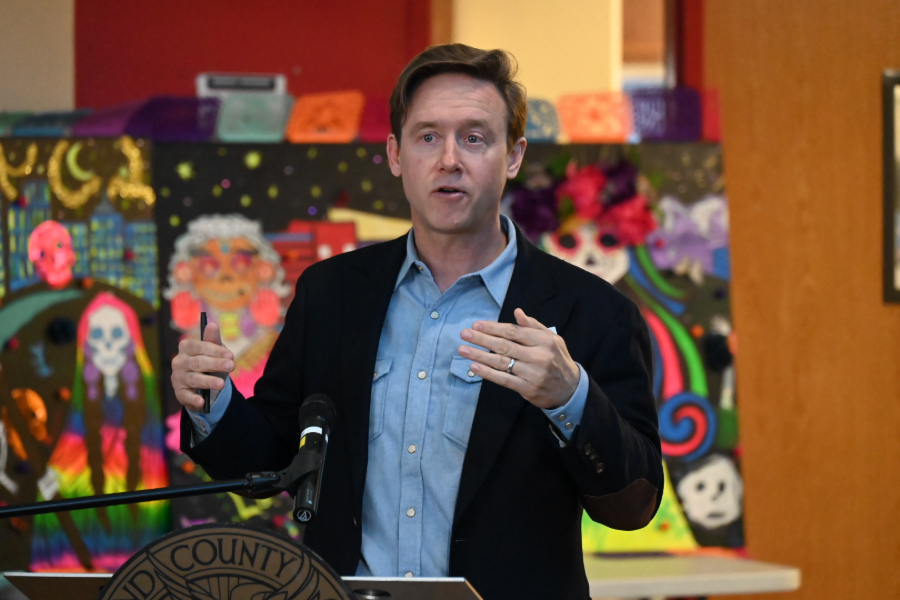
Mayor Mike Johnston explained the final stage of his plan to solve homelessness on Monday, January 26, and laid out other citywide goals for Denver in 2026, like filling downtown office and retail space, opening 2,500 new affordable housing units, and decreasing gun-related homicides by 20 percent.
Johnston is more than halfway through his first term as Denver’s mayor. When he took office in July 2023, he promised to solve homelessness in the city by the end of his first term in mid-2027. During the January 26 press conference at the La Alma Recreation Center, he said he plans to reduce the city’s homeless population by 75 percent in 2026 compared to 2023 levels, and defined solving homelessness in Denver as the city having enough beds to house everyone who is homeless at any given moment.
“It does not look like you will never-ever see a person on Colfax who may have just been evicted from their home or may be in a relapse and struggle with addiction,” Johnston said. “What it looks like is we get to a stage where the total number of folks who are entering or experiencing homelessness in Denver at one time is smaller than the number of available beds than we have to move them into.”
Johnston added that if Denver has 400 people sleeping on the streets in 2027, he believe’s he’ll have ended the city’s cycle of street homelessness.
The mayor’s new definition moves the goal post a little closer, as he had previously been trying to whittle away at the city’s Point In Time (PIT) count, a federally funded tally of how many people are sleeping on the streets during one night in January. Last year, he claimed his office was halfway to solving homelessness, basing the projection on a 45 percent reduction in unsheltered homelessness reported by the 2023 PIT count.
When Johnston took office, the 2023 PIT count estimated 1,400 people were sleeping in the streets. The 2025 PIT count, conducted last January, reported that Denver’s unsheltered homeless count was at 785 people. The 2026 PIT count started just hours after Johnston’s announcement.
New Goals
At the announcement of his 2026 goals, Johnston said he wants to fill 3 million square feet of downtown office and retail space. He hopes to create 2,500 affordable housing units and permit an additional 5,000 affordable housing units, as well.
The mayor’s office will also direct initiatives to decrease gun homicides by 10 percent and reduce shootings in “high-risk” areas by 20 percent, Johnston said. He’s aiming to expand affordable child care and connect 5,000 kids to out-of-school programming or work. Clean energy systems, like electric vehicle chargers and solar panels, are on Johnston’s list, too.
On January 22, the mayor’s office released a 2025 Denver scorecard to follow up on goals set for last year. According to the scorecard, the mayor met all but two of the eleven goals. Rather than create 3,000 affordable units, as the mayor had promised, the city opened more than 2,300, according to the scorecard. The mayor also fell short of his goal to connect 2,000 homeless residents to permanent housing, but the city reported more than 1,700 people finding permanent housing through the All In Mile High program.
Homelessness
Johnston announced his new goals even as the latest PIT count was getting underway. The PIT count estimates unsheltered populations by relying on county governments to deploy volunteers and city staff to report how many people are sleeping on the street or appear to be living on the street; residents self-report their homelessness, too.
The PIT count also tallies how many people are sleeping in shelters. According to the 2025 PIT count, Denver had an estimated 6,500 people in shelters last year, an increase of 1,300 from 2024.
Advocacy groups and nonprofits like the Colorado Coalition for the Homeless and Housekeys Action Network Denver say the PIT count is often an underestimate. According to CCH, the yearly count can overlook people sleeping in their cars or taking short stints in shelters before returning to the streets, while HAND argues that homeless residents hide more and self-report less because Johnston uses law enforcement to deal with homelessness.
Johnston chose to announce his goals at the La Alma Lincoln Park Recreation Center so that he could lead media on a tour of the neighborhood, where residents complained about growing homeless encampments last winter.
Denver Police Officer Aaron Rebeterano spoke during the event. According to Rebeterano, “There were a lot of folks that were pushed from the downtown area and other areas” during the city’s homelessness efforts. Denver City Council members and residents have argued that the mayor’s efforts to clear encampments downtown pushed homeless populations into residential neighborhoods, but the mayor’s office has always refuted those claims.
Asked about Rebeterano’s comments, Johnston explained that “there’s generally a cycle of when people move to different places” and homeless residents follow a “regular pattern” of moving between neighborhoods.
“We see people move to different parts of the city at different times. Sometimes they go from East Colfax to West Colfax, go from South Broadway to downtown, to RiNo,” Johnston said. “Our goal is to find a new location where they’re gathered and provide services there.”
In December 2024, Johnston celebrated the end of veteran street homelessness in Denver. The 2023 PIT count estimated that Denver had about 52 veterans living on its streets; the city had reduced that to “functional zero” the next year, according to Johnston. At this announcement, he said that his goal of “ending the cycle of street homelessness” in Denver will be modeled after his success with veterans.
“There will never be a day that a veteran in the city is on the street. That means we now know who they are by name, we know where to find them and we have a bed for them to go to,” he said. “That is the end goal here, and that is what we will spend the next two years trying to reach.”
Denver Safety
At the announcement, Seth Howsden, the recreation director for Denver Parks & Recreation, said the city had to stop all outdoor programming in La Alma Lincoln Park, including baseball, tee-ball and football leagues, after homelessness and drug dealing in the park “started causing folks a lot of concern” in 2024.
“We don’t really do that, because we feel like we’re taking a resource away from the community,” Howsden added. “But we felt like we had no other choice because we felt it was a safety issue.”
All of the neighborhood’s programming returned last summer, thanks to increased policing by the city and outreach to connect homeless residents to AIMH services. “Since then, things are dramatically different,” Howsden said. “The park is a completely different park compared to what it used to be.”
According to DPD Officer Jacob Herrera, an open-air drug market used to operate outside the Circle K and McDonald’s near West Colfax Avenue and Mariposa Street, on the northern edge of La Alma Lincoln Park. The DPD leveraged business regulation “to ask” Circle K to put up fencing and lighting and hire more security guards, he added, “and that made a big difference.”
The mayor’s 2025 Denver scorecard boasted a 37 percent reduction in shootings from 2024, surpassing Johnston’s goal of a 15 percent decrease. According to Johnston, La Alma Lincoln Park hasn’t had a shooting in more than a year. He credited reductions in violent crime to a method called Place Network Investigations, in which police and the mayor’s office focus resources on areas of the city where reported incidents are most common, including La Alma Lincoln Park and Paco Sanchez Park in West Colfax.
Johnston admitted that traffic safety was notably missing from his safety goals, as 2025 was Denver’s deadliest year on record for fatal car accidents; more cyclists, pedestrians and people on e-scooters died as a result of car accidents than in previous years. Johnston said that road safety is the top goal of the Denver Department of Transportation and Infrastructure, but it’s not a “citywide goal” across departments.
“We have a combination of strategies run by DOTI. We’ve done a lot of slowing of traffic, we do speed cameras, and those have all helped,” Johnston said. “We’re very proud of last year.”
ICE, Flock and Trump
Johnston acknowledged that he’s unrolling local plans under a “chaotic” federal administration. At the press conference, he answered questions about how Denver is looking at protests and violence in Minneapolis, where ICE agents have fatally shot two people since a major operation began there earlier this month.
The mayor said he’s “heartbroken” by recent events, and hopes to prevent President Donald Trump from sending federal agents to Denver by reducing crime and connecting migrants to services through local efforts.
“For us, we worked really hard to make this the city that has the largest reduction in homicide, the largest reduction in street homelessness, a city that has very successfully brought more migrants to services per capita,” Johnston said. “We think that helps make the case that there is no need for any intervention here.”
Denver Police Chief Rob Thomas said that local law enforcement is losing community trust because of ICE, pointing to immigration raids and arrests in the Denver area.
“Any time you now see any uniformed officer, you suddenly have a response of fear,” Thomas said. “We’re reassuring folks about the fact that we’re not sharing your information with federal immigration.”
Johnston was in hot water with the public in October, when he renewed a contract to keep Flock artificial intelligence cameras around the city despite the company’s ties to ICE and a rejection of the contract by council days earlier. Flock Safety is a company that uses AI to sort through data and images captured through its license-plate cameras set up over roads, which ICE can reportedly access to target undocumented immigrants.
Johnston credited Denver’s Flock cameras with being “an effective part in reducing crimes” like auto theft, and said that the city “does not share any data with the federal government,” or with any outside entity.
“My top priority is to protect every resident of this city,” Johnston said. “Here in Denver, we’re trying to keep everyone safe, and we want everyone to know that this is still a welcoming city.”