
Crystal Fountains

Audio By Carbonatix
Reader support matters more than ever
We're in the final stretch of our summer campaign. Our goal is to raise $25,000 to support the journalism our community relies on. Reader support is helping shape the future of local news.
Colorado is in the midst of a record-setting hot, dry season. Governor Jared Polis declared a statewide drought emergency on June 4, over two months after Denver Water declared a Stage 1 drought for the first time since 2013.
Denver Water’s drought declaration came with mandatory water-use restrictions for customers, including limiting outdoor watering to two days per week on an assigned schedule. The company also implemented drought pricing in April, raising rates for outdoor use or excessive increases in average indoor use. The goal is to reduce total water demand by 20% through April 30, 2027.
But do all water-users face the same constraints? Miranda in Denver asks, “With the current water restrictions, how are they being placed on golf courses, fountains (like the one at Union Station) and data centers?”
For the latest edition of our Weekly WTF series, we dove into Denver’s drought response.
Golf courses
All Denver Water customers are asked to reduce their water use by 20%, including golf courses. However, some large irrigators are given more flexibility to achieve this, according to Denver Water.
Many major users entered into a water budget agreement with Denver Water, committing to the 20% reduction while being permitted to deviate from the twice-per-week watering schedule. Users under such agreements include the parks and recreation districts for Denver, Lakewood, Foothills, South Suburban and Cherry Creek Vista, according to Denver Water.
Under the agreement with Denver Parks & Recreation, properties are managed using a systemwide water allotment instead of standard watering schedules. “Because DPR sites span many acres, it isn’t feasible to irrigate all landscaped areas within the same limited watering windows required for smaller properties,” the department says in an announcement.
Denver Parks & Rec runs eight golf courses throughout the city. So if you notice the courses being watered more than you’d expect, that’s likely why.
In addition, some golf courses are not subject to Denver Water’s drought watering schedule because they use other sources of water for irrigation, like recycled water, wells or their own water rights. City Park Golf Course, for example, is irrigated with recycled water, according to Parks & Rec.
“Recycled water comes from reusable supplies, and these users are approved to irrigate any day of the week,” says Travis Thompson, spokesperson for Denver Water. “Currently, some Denver schools, more than 30 Denver parks, a few area golf courses, the Denver Zoo, and some HOAs and commercial property owners use recycled water to keep their landscapes healthy.”
Golf courses that did not enter into a water budget agreement and do not use alternative water sources are required to follow the mandatory watering day schedule.
Fountains
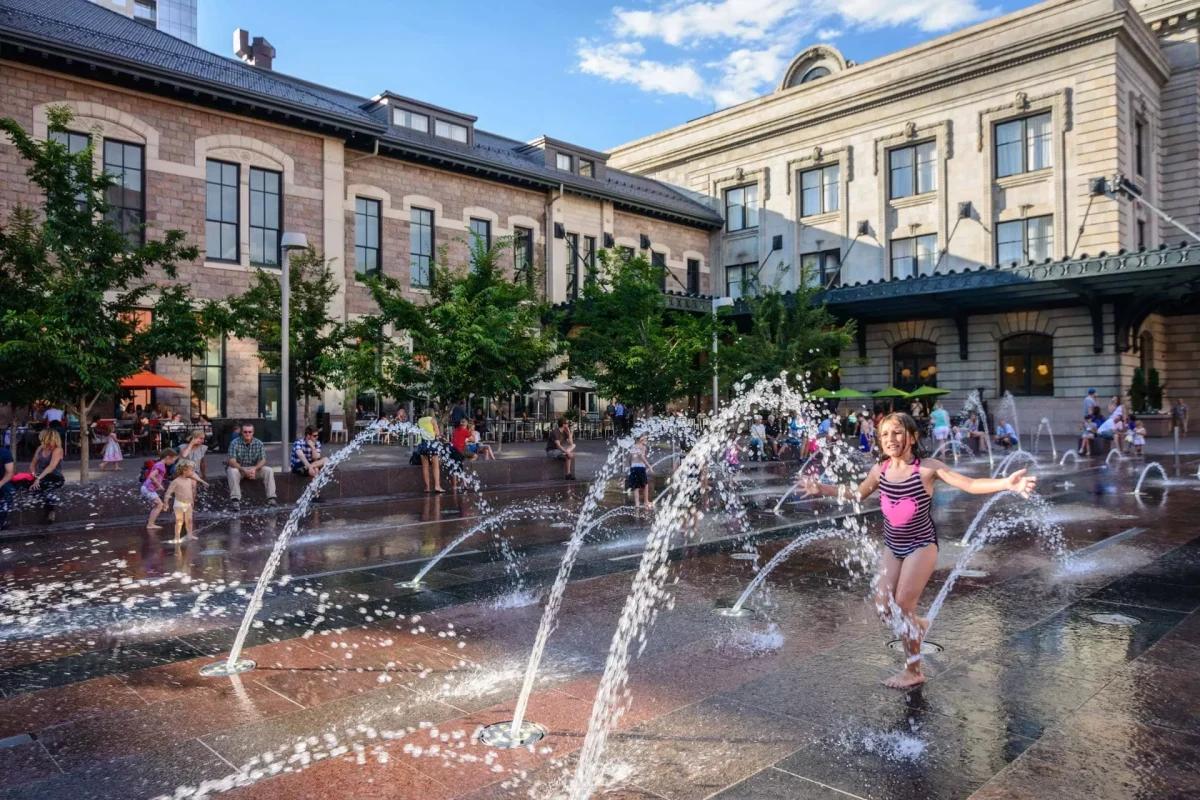
Denver Water customers are “highly encouraged” not to operate outdoor fountains that spray water into the air, Thompson says. But recirculating splash pads — like the one in Union Station — are allowed to operate.
“We understand that splash pads are a benefit to health and safety, especially during hot and dry weather,” Thompson explains. “There are no daytime rules on when these features can/can’t operate.”
Denver Parks & Rec plans to turn off decorative fountains during the 2026 season, but continue operating splash pads and pools, according to the department’s water reduction strategy.
This kind of outdoor water use is subject to drought pricing, according to Denver Water. For users under a water budget agreement, fountains and splash pads factor into their overall water use, so they still have to meet the reduction goal.
Data centers
Data centers are expected to reduce their water use by 20%, just like all other customers.
Nonresidential users (like data centers) are subject to the same drought pricing rate structure as residential users: an extra $1.10 per 1,000 gallons of water used over the average monthly water use during the winter, and an extra $2.20 per 1,000 gallons if the use exceeds 15,000 gallons of water per month above their average winter use.
There are around 15 data centers within Denver Water’s service areas, 9News reported, most using roughly 10,000 gallons of water per day, which is comparable to other commercial customers. However, a new CoreSite data center under construction in the Elyria-Swansea neighborhood is expected to use approximately 235,000 gallons of water per day. The first building of the CoreSite facility was scheduled to open this year, but two additional buildings CoreSite planned for the campus were delayed by Denver City Council.
In May, council passed a one-year moratorium on more new data center development in the city, while officials work to draft rules addressing water consumption, among other standards.
Do you have a question you want Westword to answer? Submit it here, and we may respond in our next Weekly WTF column.