
Bennito L. Kelty

Audio By Carbonatix
Independent Journalism in Denver Needs You
We need to raise $25,000 by August 9 to support the reporting our community depends on. Reader support keeps us independent and is playing a larger role in funding local journalism and shaping what comes next. If you believe independent local journalism matters, make a contribution today.
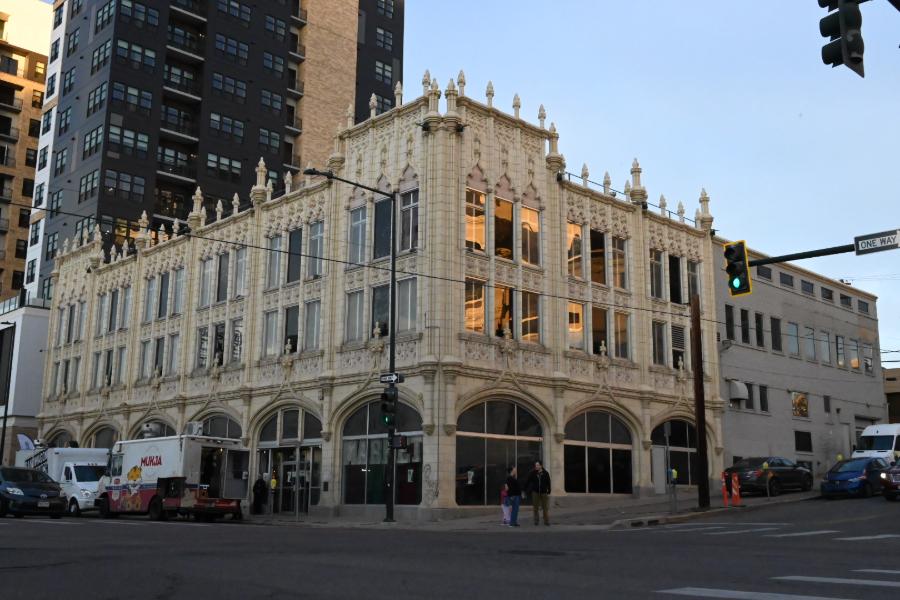
Life won’t end at 100 for the Sports Castle, an unofficial landmark at 1000 Broadway.
Longtime Denver residents might remember buying discount skis or Converse shoes at the Sports Castle, a giant sporting goods store founded by the Gart family that ultimately merged with Sports Authority, which shut down in 2016. After that, the three-and-a-half-story structure was used for a variety of parties and events. Non Plus Ultra, a San Francisco production company, started booking the building in 2021; for the first two weekends in December, it hosted a Christmas market. These events gave people a glimpse of what was inside the Castle’s gothic exterior, and hinted at its century-old history.
The day before the market reopened on December 12, BusinessDen broke the news that Seattle-based outdoor gear and apparel retailer Evo hopes to buy the iconic property. In an email to Westword, Evo CEO and founder Bryce Phillips says that the best way to get a sense of what’s coming to the Sports Castle is to look at Evo’s existing projects around the country, including the Granary Campus in Salt Lake City and the existing Evo outlet at 860 Broadway.
“We are really inspired by the opportunity to bring the Sports Castle back to life, love the building, love the location, and want to be a part of making the corridor more vibrant over the years to come,” Phillips says. “That said, we have work to do with regards to ensuring it’s viable from a redevelopment perspective, so we’ve started that process.”
Evo would be buying the property from Hyder Construction, which paid $6.5 million for it in 2021. The retailer reported about $200 million in total revenue in 2024, largely through online sales.
The new ownership would be coming in just as the Sports Castle marks its 100th anniversary, in a year that coincides with Colorado’s quincentennial and the nation’s semiquincentennial.

Bennito L. Kelty
The Cathedrals of Automobile Row
The Sports Castle started out in 1926 as the Cullen-Thompson Motor Company, a Chrysler dealership. It opened at a time when Broadway from 14th Avenue to Cherry Creek was known as “automobile row.”
Several of the auto-oriented buildings from that time remain. At the corner of Sixth Avenue and Broadway, the Leeman Auto Company sold DeSotos and Plymouths; today, the former dealership hosts a Chipotle and Cava Mediterranean. The current Westword offices at 1278 Lincoln Street occupy the 103-year-old Dodge Building, which was a prestigious Dodge dealership. Before Westword moved, it was located kitty-corner from the Sports Castle in a former Willys-Overland dealership.
Howard Lorton Furniture & Design at 12th Avenue and Broadway used to be a dealership for Studebakers, the curvy cars popular in the 1940s and ’50s, before the building became a furniture gallery. According to the Colorado Automotive Hall of Fame, Frank C. Cullen commissioned that building in 1921 as the Automobile Sales Corporation. In 1925, Walter Chrysler started the Chrysler Corporation, and Cullen partnered with one of his top Studebaker salesmen, Ward J. Thompson, to bring the new luxury brand to Denver.
Although J.M. Hyder had designed the Studebaker dealership, for their new enterprise Cullen and Thompson went with Chicago-born architect Jacques Benedict, who had been living in Denver since 1909 and was a student of the Ecole Beaux Arts.
By the time Cullen and Thompson came to him in 1925, Benedict had already designed the Washington Park Boat Pavilion, Park Hill Elementary School and the south wing of the Richthofen Castle, among other sites now on the National Register of Historic Places. In 1926, Benedict lost a bid to design the new Denver City and County Building after he suggested a 35-story, gothic skyscraper similar to Chicago’s Tribune Tower. (Then-Mayor Benjamin Stapleton chose Edward Bennett’s Neoclassical design instead.)
Benedict’s Baroque European style was ideal for the Cullen-Thompson Motor Company, though. At the time, auto dealers “were fiercely competitive for customers, and a new architecture, dubbed ‘cathedrals of commerce,” emerged to showcase and sell the automobile,” according to the Golden Triangle Creative District.
Benedict gave the new dealership at Tenth and Broadway stained-glass windows, a grand white staircase, and ornamental columns and arches inside its spacious 100,000 square-foot interior; the exterior was surrounded by plaster and terra cotta. It cost $71,000 to design and build, or about $1.3 million today. Walter Chrysler attended the building’s opening in the spring of 1926, and the structure’s elegance helped it become one of the most successful Chrysler dealerships and distributors in the country, according to the Colorado Automotive Hall of Fame.
Thompson managed the dealership for 28 years, expanding its offerings to Plymouths and Dodges. He died in 1954, and Cullen ran the place until he sold the business in 1963 to successful car dealer Fo Farland and Temple Buell Jr., the son of well-known Denver architect and namesake of the Buell Theater, Temple Hoyne Buell.
The dealership continued to sell Chryslers and Plymouths. It was the oldest Chrysler dealership in the country when it was sold in 1971 to a well-established, locally owned sporting goods company, Gart Bros.
That ended the building’s 45-year history as a car dealership.

Denver Public Library
From Chyslers to Converse
When Gart Bros. bought the Cullen-Thompson Motor Company building, the sporting goods company had been around for about as long as the dealership, starting with a downtown pawn shop in 1928. According to a 1998 entry in the International Directory of Company Histories, Nathan Gart, the son of a Russian immigrant, started the store in a rinky-dink 12-by-17-foot spot at 1648 Larimer Street that he bought for $500.
“With $33 in fishing equipment as his inventory and high hopes, he opened Gart Bros., a family sporting goods store specializing in hunting, fishing, and camping supplies,” according to the 1998 directory. “Gart was creative in his use of the cramped store. He, for example, lined boxes of ammunition on the floor, thereby creating both storage space and a new floor at the same time. His first sale was a pocket knife.”
Along with brothers George, Kirby and Melvin, Nathan Gart incorporated the business in 1946 as Gart Bros. Sporting Goods Company. The group got its house in order just before the rise of a new recreational industry that would transform Colorado: skiing.
Some of Colorado’s ski areas opened in the 1930s, including Winter Park, which was founded by the City of Denver. But the end of World War II brought a boom in skiing as soldiers who’d trained to fight on Europe’s snowy slopes as part of the 10th Mountain Division came back to Colorado to jump-start ski areas in old mining towns like Aspen and Breckenridge and brand-new towns like Vail.
Gart Bros. met the demand for ski equipment and apparel by expanding the original store, adding 100 feet to the front. In 1954, Gart Bros. held its first-ever sale of discounted ski equipment: SNIAGRAB.
According to the Colorado Business Hall of Fame, Nathan’s son, Jerry Gart, wrote “bargains” on a napkin and flipped it over, revealing “sniagrab” — capturing the idea of a Labor Day, pre-season sale of last year’s leftover ski inventory to attract customers who can’t afford the latest gear and apparel.
Through the 1960s, Gart Bros. continued to expand and opened four new outlets. By 1971, the family business felt like it needed a new headquarters, too.
That’s when Gart Bros. bought the Cullen-Thompson Motor Company building and renamed it the Sports Castle. At the time, the company was shifting leadership into the hands of Jerry Gart, who is credited with opening “the sport of skiing to countless people” by the Colorado Snowsports Hall of Fame. The Sports Castle became the headquarters and flagship store of Gart Bros., with an indoor ski ramp leading up from the first floor and basketball and tennis courts on its roof.
Gart Bros. opened its first store outside of the Denver area in 1976, in Fort Collins. By the time Nathan Gart died in 1981, Jerry had expanded the company to a dozen stores. By 1986, Gart Bros. had grown to sixteen stores and about $30 million in annual revenue, and Jerry was looking for cash to fuel a national expansion.
The Los Angeles-based Pacific Lighting Corporation bought Gart Bros. for about $20 million and kept Jerry in position to run the business. The deal allowed him to take the company out of Colorado for the first time in 1987, when it opened a 65,000-square-foot superstore in Salt Lake City and five other smaller outlets throughout Utah.
Under Jerry’s leadership, Gart Bros. bought the Hagan sports stores in Denver in 1987 and then Dave Cook Sporting Goods Co. (a longtime Gart rival) and the St. Louis-based Casey’s Sports Stores in 1988. Annual sales revenue had ballooned to $140 million by the time the Pacific Lighting Corp. sold Gart Bros. to Leonard Green & Partners, a Los Angeles private equity firm, in 1992.
At that point, six Gart family members (Jerry not included) decided to try and buy back the company; after failing, they resigned and entered the real estate business as Gart Properties.
By the time Jerry Gart died in 1996, Gart Bros. owned about 150 stores nationwide, all overseen from the Sports Castle.

Bennito L. Kelty
From Sports Authority to Evo
Once the dust settled, Gart Bros. owned stores exclusively in mountain states like Colorado, Idaho, Utah, Wyoming and Montana. (In 1991, it sold the Missouri stores it had bought from Casey’s in 1988). According to the Los Angeles Times, Leonard Green & Partners took Jerry Gart’s expansion up a notch and in 1997 merged the company with the national chain Sportsmart and then Oshman’s in 2001, bringing the portfolio up to 180 stores nationwide.
By now, Gart Bros. was one of the two largest independent sports retailers in the country, but it was still struggling to compete with giant retailers like Walmart. Its main rival, Sports Authority, controlled more than 200 stores nationwide, mostly in metro areas. So in 2003, Gart Bros. merged with Sports Authority, creating an outdoor retail Goliath with 385 stores in 45 states and an annual sales revenue of $2.5 billion.
Since Gart Properties was now getting busy with its own very public projects, like the Denver Pavilions that opened in 1998, the merged sporting-goods companies decided to keep the Sports Authority name and ditch the Gart banner altogether. (Gart Properties is now headed by Evan Gart, great-grandson of Nathan; it’s in the process of selling one of its major assets, Denver Pavilions, to the City of Denver.)
Sports Authority was now the national outdoor retail king, and its castle was in Denver where it kept the Sports Castle as its flagship store.
But in February 2016, Sports Authority announced that it would close the Sports Castle along with 140 stores nationwide; it filed for Chapter 11 bankruptcy that March.
In 2021, a new owner took over the building through a partnership led by Hyder Construction, which paid $6.5 million for the empty space and surrounding land. While the plan was to build commercial projects in the parking structure and vacant property around the Sports Castle, the new owners said they would put the Sports Castle itself on the National Register of Historic Places.
Four years later, the property is still not on the national register, although that’s reportedly in process. Nor has it been declared an official Denver landmark. “That doesn’t mean it’s not hugely important,” notes Historic Denver head John Deffenbaugh, adding that designation is also a “policy tool” that also offers protection from demolition, unlike national designation. So far, though, no one has applied for city landmark status for the Sports Castle.
But Evo, which reported $200 million in sales in 2024, hopes to continue the Sports Castle legacy. Phillips says Evo, which came to Denver the same year Sports Authority went bankrupt and opened a store just a block away from the Denver flagship, plans to “lean into the historic feel” of the Sports Castle and “bring a mix of vibrant uses, meant to engage all types and ages.”
The company aims to revive the Sports Castle as a “regional hub” for outdoor retail, bringing in “complementary retail tenants” and putting in a new outdoor entrance ramp and roof. It’s already filed preliminary plans with the city. Evo’s renovation will include cleaning and restoration, with new lighting and the installation of a bar, an equipment service shop and a “grab-and-go” food option, according to the concept plan submitted to Denver. A “limited” remodel of the exterior would include repairs, resealing and repainting.
The new owner also plans to host events at the building, inviting all to experience the revived Sports Castle. “Events are central to Evo,” says Phillips. “We always look to celebrate the history, character and soul of the building while breathing new life into it, creating spaces for the community to come together.”