
Evan Semon

Audio By Carbonatix
It’s incredibly easy for a cemetery to enter a death spiral.
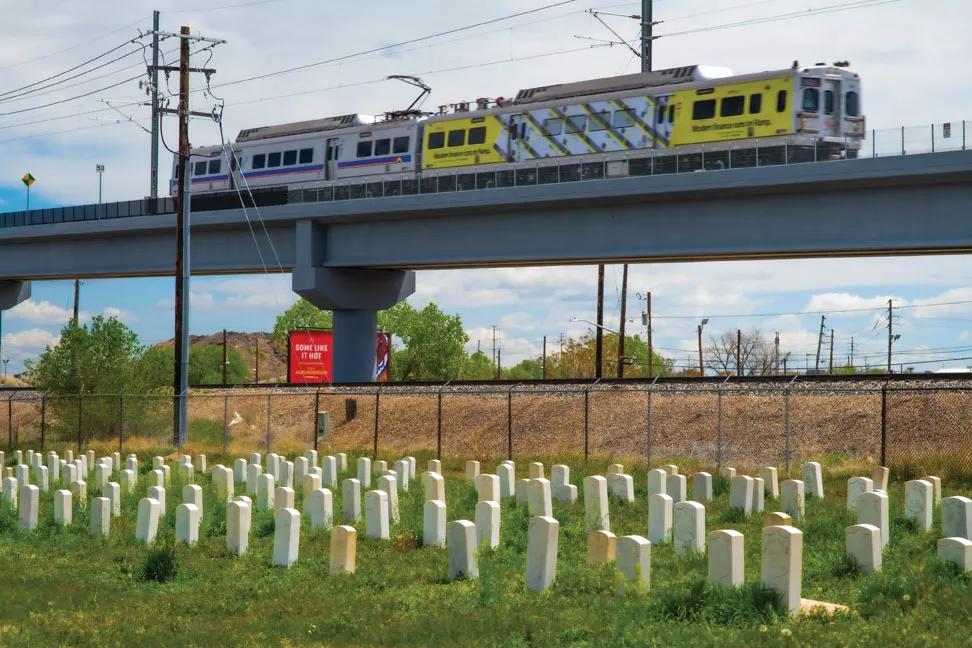
Look no further than Denver’s oldest continuously operating burying ground, Riverside Cemetery, celebrating its 150th anniversary this year.
Amble around the 77-acre site and you’ll come across some of the boldest-faced names in Colorado history without even trying. There are the namesakes, such as Gov. John Long Routt, Gov. Samuel Hitt Elbert, Mayor Richard Sopris, Del. Miguel Antonio Otero and Judge John Silverthorn. There are the trailblazers, including suffragist leader Eliza Pickrell Routt; Colorado’s first poet laureate, Alice Polk Hill; and early Black entrepreneurs and philanthropists Clara Brown and Barney Ford. And don’t forget the heroes: three Medal of Honor recipients; 1,200 Civil War veterans, and one Silas Soule – the Union Army captain who refused orders and blew the whistle on the Sand Creek Massacre.
What you won’t find is much in the way of water and, in its absence, even less of the lush greenery that draws people, dead or alive, into cemeteries. As Westword reported in May 2024, at first glance, Riverside appears to be moldering away, with mountains of weeds taking the place of manicured lawns as forlorn tree stumps hint at the place’s unlikely history as Colorado’s first park-like cemetery.
“We’re in the hole about a quarter of a million dollars a year,” says Kendra Briggs, president and CEO of Fairmount Cemetery Company, which owns Riverside and its leafier, upscale counterpart, Fairmount Cemetery. “Because nobody wants to be buried there.”
What’s killing Riverside? First came industry, led by the nearby Burlington and Colorado Railroad in 1881, and all the smoky, smelly rendering plants that followed the tracks. Then came Fairmount Cemetery. Founded in 1890, it quickly established itself as a tony, bucolic alternative to Riverside’s industrial warren ten miles to the northwest. Burials, and money, followed, and Fairmount snatched up Riverside formally in a December 20, 1899, sale.
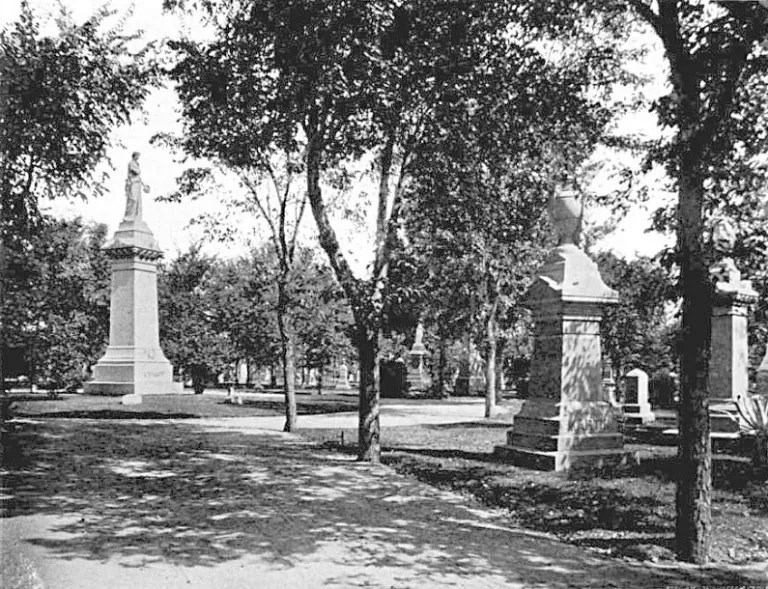
By 1920, the scales had tipped so much in Fairmount’s favor that the family of John Wesley Iliff, the “Cattle King of the Plains,” moved his remains to Fairmount – taking with them the 65-ton monumental obelisk that was once Riverside’s centerpiece. The marquee space where it once stood has been empty ever since.
Grave Reservations
Evan Semon
For years, Denver’s papers took turns prematurely mourning a cemetery that was gasping for air.
In 1965, the Denver Post’s Empire Magazine lamented that Riverside was the home to “forgotten graves” and the “impoverished dead.” And in a column that year for the Rocky Mountain News, Pasquale “Pocky” Marranzino wrote that after regular acts of vandalism, “a group of citizens requested that the cemetery be designated as an historical site and its monuments be repaired and its trees and lawns be improved.”
Still, the grass was alive, at least. In November 1970, Olga Curtis wrote for Empire that “Riverside Cemetery looks like a green oasis in an industrial desert. Inside the cemetery, the sights and smells of the nearby slaughterhouses and oil refineries vanish. In silence, except for the rustle of leaves and the swish-swish of water sprinklers, stretches a peaceful panorama of green grass, gray stones, and bright flowers, shadowed by 50-foot-high elms and maples.”
That, too, would change. An elm blight killed many of Riverside’s trees in 1970. A bark beetle infestation devoured most of what remained by 1974. By 1981, several court judgments rising all the way to the Colorado Supreme Court held that Riverside didn’t own its 1879 water rights to the nearby South Platte River. Thereafter, Fairmount Cemetery Company purportedly negotiated a flat, discounted rate for Riverside from Denver Water.
That handshake agreement evaporated by 2001. “You don’t have handshake agreements in Colorado around water,” says Alan Salazar, the 16th and current leader of Denver Water. By the historic drought of 2003, Riverside couldn’t afford the going rate for water, so the taps were turned off completely – and for 23 years, Riverside has lurched between tangles of weeds in the wet months and piles of dirt when it’s dry.
That should’ve been the end of the story, one not uncommon for Colorado: death by drought. In the West, they say, “Whiskey is for drinking – and water is for fighting over.” We drink for the dead, but who fights for them?
Liquid Assets
Perhaps whiskey is also good for dealmaking. Shortly after the publication of the 2024 cover story on Riverside, Westword editor Patricia Calhoun joined then-newly minted Denver Water CEO Alan Salazar for drinks (though she’s more a Mexican lager type than a whiskey snob).
“Patty acquainted me with the history of the water challenges at Riverside, and she said, ‘Is there anything Denver Water can do?’” Salazar recalls. “I said, ‘Well, I think it’d be a great opportunity for us to look at the transformational landscape efforts that Denver Water funds and encourages. And in time for the 150th anniversary, it seems like a cool idea for us to engage.’”
Salazar took the idea back to Greg Fisher, Denver Water’s manager of demand planning, and Bea Stratton, the utility’s landscape transformation program manager. “I asked them, ‘Is there anything we can do in a collaborative way to help the appearance of the cemetery and celebrate the history of that place – and also, to bring to closure, in a positive way, Denver Water’s involvement?’”
At the same time Denver Water was looking for a graceful way back into the cemetery, Fairmount Cemetery Company CEO Kendra Briggs was dealing with something that had nothing to do with grace or grass: toilets. To get the bathrooms at Riverside’s main building back up and running, Briggs needed to hook the cemetery up to sewer lines. To do that, the city required Riverside to first bring the aging building up to accessibility codes, a fix Briggs pegged at more than a million bucks.
As Briggs mulled renovation options, her husband and predecessor, former Fairmount CEO Kelly Briggs, weighed in. “He asked me, ‘You’re going to fix up this building, but you’re going to let the rest of the place look the way it does?’” she remembers. “He goes, ‘You need a master plan for the whole thing.’”
“As I was contemplating that,” Kendra Briggs continues, “that’s when I get the call from Rick Marsicek,” Denver Water’s chief of water resource strategy, who’d been talking to Alan Salazar. “There’s something you have to do with Riverside. And we want to help you,” she recalls him saying.
Briggs smiles. “I was like, ‘Well, Rick, why do you want to help us now? You’re the ones who took the water away.’”
“Well, you don’t need water,” Marsicek told her.
Improbably, Denver Water is all about selling less of the stuff. “It’s an interesting business model to try and get people to use less of your product,” Salazar says.
Skyler McKinley
Doing More With Less
With roughly half of what Denver Water delivers going to irrigation, and half of its own supply drawn from the drought-stricken Colorado River Basin, the utility now works to talk Coloradans out of thirsty lawns. It coined the word “Xeriscape” in the 1980s, and in 2022 joined other Colorado River cities and utilities to cut “nonfunctional turf,” the decorative grass on medians and office parks that nobody walks on, by 30%. Stratton runs the Landscape Transformation Assistance Program that does it, helping cities, parks and institutions rip out ornamental grass and reseed with native, low-water plantings – something the utility calls a “ColoradoScape.”
Because nature wrested away Riverside’s own grass years ago, there was no lawn left to rip out. There was no irrigation to wean off. What there was, instead, was history – and ironically, the right kind of ruin.
That was the takeaway for an ecological study of Riverside commissioned by Denver Water and authored by Matrix Design Group, a Colorado engineering and environmental consultancy, led by Joshua Eldridge. He’s a restoration ecologist who has spent more than 20 years coaxing life back into landscapes most people don’t want to think about – from Superfund sites to spent mines, oil-and-gas pads, and other brownfields. Compared to places that could kill you, a place where the dead rest is a relatively plush assignment. “Good work leads to more work,” he says, explaining how a man who reclaims industrial ruin winds up among the headstones.
Eldridge and the Matrix team assessed the grounds in the spring of 2025. For a place too often shrugged off as terribly forlorn, there was a lot of life. The ground cover was made up mostly of the usual non-native opportunists that move in when nothing holds them back: redstem filaree, field bindweed, kochia, lambsquarters and Russian thistle (the iconic Western tumbleweed, which, like most things out West, isn’t from out West).
Scattered through the weeds were native plants that outlasted 20 years without irrigation, such as sand dropseed, buffalograss, blue grama, slender wheatgrass – the short grasses that stood here long before the cemetery did and thrived long before Kentucky bluegrass crept its way into Colorado. To revitalize Riverside, the job was not to truck in a new landscape but to coax back the one hiding in the ground.
In all its years without irrigation, Riverside was not without care. The old approach? “Mow and go. We would pay for three mowings a year,” Briggs says, so that folks could find the headstones. “We’d watch if we had a wet spring. Then we’d try to mow for Memorial Day. Then we’d watch it throughout the summer and mow it when it got bigger. And then at the end of the year, if it needed another mow, we’d mow it.” Eldridge will tell you that’s about the worst thing you can do. When you whip a mower across a site, you can destroy what you ought to save and spread the seeds of the stuff you’re trying to root out.
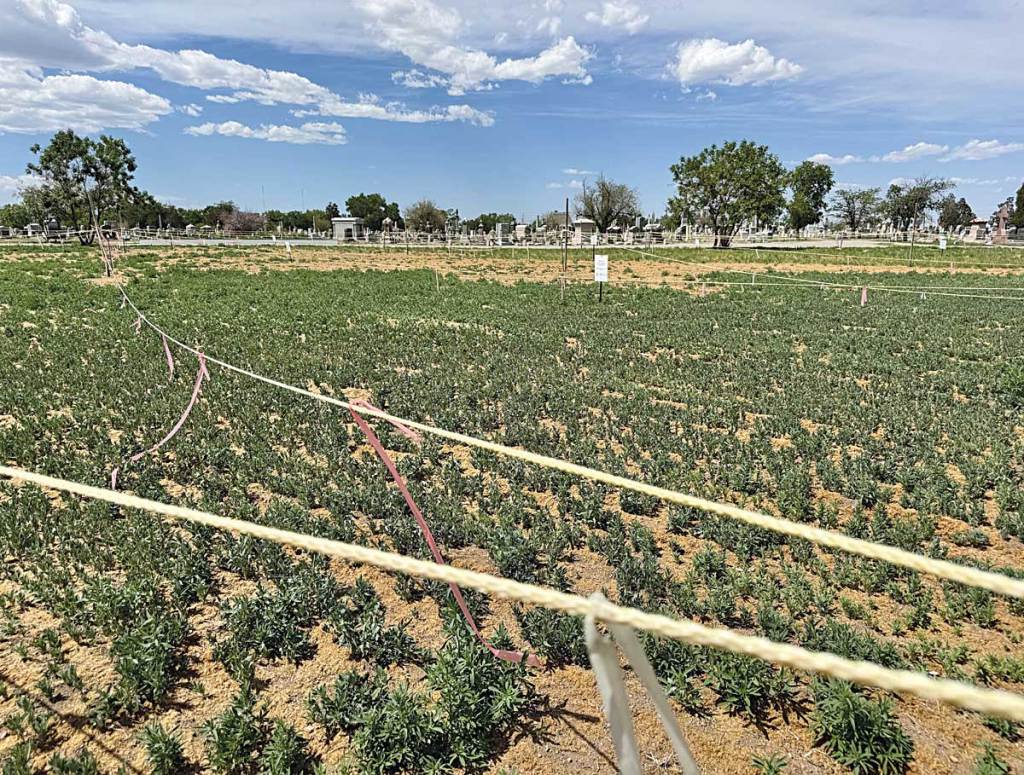
The fix was counterintuitive: Do less. Matrix set up an experiment in a headstone-free test plot between Riverside’s administration building and the rail line. It carved the plot into a patchwork and treated each one a little differently, tilling some deep, scratching some shallow, leaving some alone, feeding some with nutrients, leaving others at the bare fertility the ground already had. The question was not which single thing would work best, but what mix would. Nature is complicated.
In the fall, seeds for the same blend of native grasses went down across the entire plot: the short-grass prairie that had been here all along, accompanied, here and there, by wildflowers to see if they could take. The idea was that winter would crack the seed husks and a spring melt would wake them.
Winter? “We didn’t really get a winter,” Stratton admits, but no matter. Denver’s wet May made the experiment work, with surprising results. The test plots that were worked hardest, those that were dug deep and fertilized heavily, came up thick with a dense crowd of the very weeds Matrix was hoping to root out, woken by the tilling and fed by the fertilizer. The plots barely touched came up thinner, and right.
As Briggs says, “The area that’s doing the best is where we did the least.” Good news for the person who signs the front of the checks: Less labor, less soil to prep, less money.
“Low maintenance,” Eldridge is careful to say, “is not no maintenance.” But the takeaway was unmistakable: Riverside’s hallowed soil rewarded being left mostly alone.
Evan Semon
That, of course, upends everything a cemetery is supposed to teach you about lawn care. Since Riverside’s founding in 1876, manicured greenscapes in Colorado have been an argument with the land, won or lost each week. With the test plots, what Matrix proposed was to live and let live.
In January, Matrix graded the whole cemetery, dividing it into 43 blocks and scoring each on the weeds and what still grew there. The result was a map shaded like a stoplight, and it was overwhelmingly red: Roughly 85% of the ground scored “poor.” Just under 10 acres came back as the middling yellow. The “excellent” ground? About a third of an acre, with nothing scoring as “good.”
Luckily, the map is not a coroner’s report. It’s a work plan to carry what’s learned from the test plots through the rest of the grounds. Denver Water paid for the analysis, but carrying it out – a few acres a year, as the budget allows – falls to Fairmount, with Matrix advising and, in time, training the cemetery’s own crews to keep it going. Eldridge figures it will be five to 10 years before the whole of Riverside is on that trajectory. “By, let’s call it 2035,” he says, “Riverside looks much different than it does today.”
But different, how? “It doesn’t have to be bright green,” Stratton says. “It can still be beautiful and golden, with pops of color, and still look very alive.” A rendering on a flyer promoting a July 25 event at Riverside when the cemetery, Denver Water and Matrix Design Group will “share our vision for…bringing new life to its landscape for generations to come” hints at that future. You can almost see low, tawny grass moving in the wind as prairie aster, blanket flower and prairie clover rise above the headstones where the mower once tried to keep the weeds in check.
It’s not only plants, either, since a working prairie is busy in a way that a lawn can’t be. Kentucky bluegrass is often mowed into stillness, but a native stand hums: Pollinators work the flowers and insects navigate the grass as birds swoop in to eat both. Monitoring another restored site, Eldridge saw a butterfly settle on some beardtongues until a bird snatched it. “This is why we do it,” he says. Eldridge’s vision is not a Riverside devoid of the industry that gave rise to Fairmount Cemetery – Suncor’s refinery towers sit in the sightline, after all – but he figures that if you build the habitat, the life comes looking for it. The hope is for a cemetery with more traffic than just mourners: people who come for the wildflowers, people who come for the birds, and people who live in an area with pitifully little green to its name and just want somewhere pleasant to walk.
Evan Semón
Bringing a Cemetery Back to Life
There are, of course, vastly more efficient ways to deal with the dead than a 77-acre park. Cremation is cheaper than burial, and scattering ashes is usually free. There is no practical reason to set aside all this land, and the stone and the labor, for the benefit of “residents” who cannot see any of it. That’s the tell: A grave is not a storage unit. It is dug so that a name stays above ground and the living have somewhere to go to reconnect to the departed. That only works if people keep showing up. The dead don’t sustain a cemetery; the living do. Riverside became forlorn not only because the grass died, but because the grievers died, and their grievers died, and fewer and fewer folks wanted to be buried in a place that suggested that death might not lead to Eden with a sprinkler system.
For Riverside, beauty is a matter of solvency as much as sentiment. “Let’s fix this first,” Briggs says of the grounds, “and then people will want to come.”
For Stratton, who first walked Riverside after visiting Fairmount and felt, in her words, like “maybe I’m not supposed to be here,” the goal is experiential. “I want them to want to walk the whole cemetery,” she says.
As they do, perhaps they’ll be inspired to buy plots again until Riverside pays for itself. The wildflowers are an ecological project and a sales strategy: Here, the upside of the business calculus is a form of eternal life.
“We need to save their stories,” Briggs says of the people already at Riverside, “and share their stories so that they’re not forgotten.”
Whose stories? The State of Colorado’s first governor, John Routt, rests at Riverside, a stone’s throw away from Col. Champion Vaughan, the Denver Tribune editor in chief who “kept a 10-gallon container of whiskey under his desk and would arrive at work at the peak of his dignity, which as the day progressed changed in proportion to the decrease of whiskey in the container,” according to historian Annette L. Student. Vaughan called himself “colonel” on the strength of Civil War service no one has ever been able to verify.
Cemeteries are the great equalizer.
Briggs oversees Riverside’s lush, celebrity-filled sister, too, and lately she’s been looking at Fairmount differently. “One day this is going to look like Riverside if we don’t do something about it,” she says. Like life itself, water is promised to no one forever. The bill Riverside paid decades ago is going to be handed to the rest of the West – and so the cemetery that died first turns out to be the one furthest ahead. “We’re not restoring Riverside,” she insists. “We’re transforming it.”
“I think this part of the world is going to go back to what it probably looked like 100 years ago, 200 years ago, and that’s appropriate,” Salazar says.
Sprinklers deny the wilderness. Cemeteries deny death. And yet, drop all the denials and the ground is still there, the rain still falls, and the prairie grass still comes back on its own.
At 10 a.m. Saturday, July 25., Fairmount Cemetery Company, Denver Water,and Matrix Design Group will present a free program on the transformation of the cemetary at 5201 Brighton Blvd. RSVP here.