
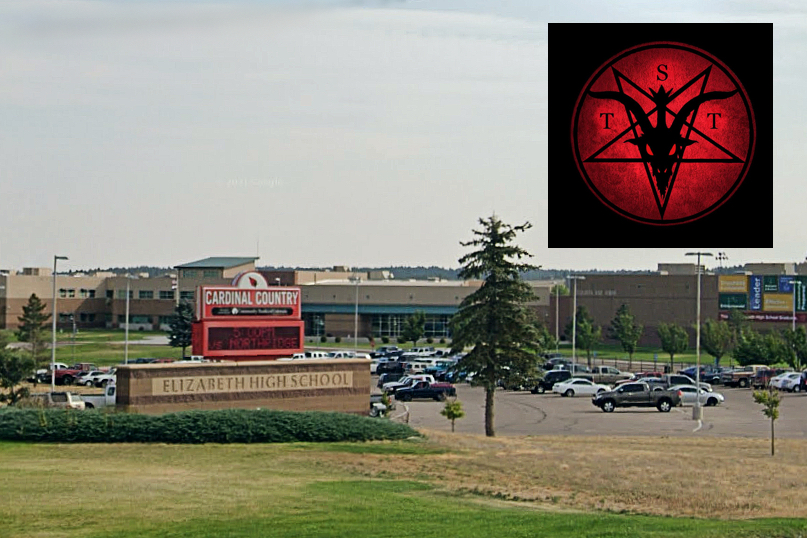
Google Maps/The Satanic Temple

Audio By Carbonatix
Hail Satan?
A young member of the Satanic Temple was granted a religious accommodation from the Elizabeth School District, arguing that the district’s digital hall pass system conflicts with her beliefs. The parents of the Elizabeth High School student had requested that she be exempted from the system, but their request was initially denied, according to TST. That’s when the Temple’s lawyers stepped in.
“This was a cut-and-dry case of a TST member’s bodily autonomy being violated by invasive digital controls,” says Eliphaz Costus, campaign director of the Temple’s Protect Children Project.
Using the digital hall pass system to monitor and restrict the time students spend in the restroom apparently goes against TST’s third tenet, which states, “One’s body is inviolable, subject to one’s own will alone.” The student will now be able to use physical hall passes to access the restroom at any time and for any duration, according to the school district.
Members of the Satanic Temple don’t actually believe in the devil or Hell. It is a non-theistic group that frequently advocates for the separation of church and state. There are approximately 12,000 registered members in Colorado, including both of the student’s parents, according to TST.
The Temple’s lawsuits have resulted in monuments of the Ten Commandments being removed from state capitols in Oklahoma and Arkansas, after they attempted to erect large Satanic statutes alongside them. TST has also attempted to fight abortion bans by asserting that they interfere with the religion’s abortion ritual practices.
According to TST, the Temple’s Protect Children Project is focused on shielding students from “abuses” by school officials, such as corporal punishment, solitary confinement and restricted bathroom access.
The Minga digital hall pass system in question has received backlash in some schools for violating student privacy. The surveillance technology is intended to reduce the time students spend roaming hallways by tracking when and why a student requests a hall pass, and issuing a countdown timer that notifies teachers when the student has been out of class for longer than allotted, like when using the bathroom.
Elizabeth High School adopted Minga at the beginning of the second semester this school year, according to the school district.
“The district believes that Minga is an important and necessary tool at the high school level,” says Jeff Maher, spokesperson for the Elizabeth School District. “At the same time, the district is deeply committed to honoring parental rights and to the principle that families — not schools — are the ultimate arbiters of the values by which their children are raised.”
According to TST, the district approved the student’s accommodation request after the Temple’s legal counsel sent a letter citing Mahmoud v. Taylor. The 2025 U.S. Supreme Court ruling found that schools must allow parents to opt their children out of instruction that conflicts with their religious beliefs, which, in that case, were books inclusive of the LGBTQ+ community.
This is the first time TST has had to intervene directly in a religious accommodation request in a Colorado public school, according to the Temple, but it has intervened numerous times on behalf of student members in other states.
“I appreciate TST advocating for me greatly,” the unnamed student said in a statement. “Their actions have helped reduce my stress in school and also feel more comfortable overall.”
The school district is already in the middle of a separate legal battle. In 2024, ACLU sued the district after it banned and removed at least nineteen books from school libraries. That lawsuit alleges viewpoint discrimination and politically-motivated censorship, claiming that the board targeted books about racism and LGBTQ+ people. The school board described the books as “offensive” and contrary to the board’s “conservative values.”
The banned books reportedly included The Hate U Give by Angie Thomas, The Bluest Eye by Toni Morrison, and #Pride: Championing LGBTQ Rights by Rebecca Felix. The board added dozens of other books — including 1984 by George Orwell and Anne Frank’s diary — to a “sensitive list” that would automatically notify a parent if their child checks one of the books out and allow the parent to block access.
Maher points to the book ban as an example of the district’s values, arguing that it aligns with the decision to provide religious accommodation for the Satanic student.
“The district’s governing philosophy is straightforward: ‘Children come to school with the values instilled in them at home, and they go home with those values,'” Maher says. “That philosophy is not merely rhetorical.”