
Lauren Antonoff

Audio By Carbonatix
Good luck finding a typical skier or snowboarder who doesn’t think lift tickets are too damn expensive. But rather than simply griping to their fellow riders about the expense, four outdoors enthusiasts have brought their concerns to the judicial system.
In an action filed on March 23 in United States District Court for the District of Colorado, Landin Goloja, Tyler Maybee, Caitlan Reynolds and Daniel Sheiner stand as the lead plaintiffs in a class-action lawsuit against Vail Resorts, Inc., owner of its namesake Colorado ski area and 41 others scattered across North America, Europe and Australia. Alterra Mountain Company, whose portfolio includes seventeen mountain destinations in the states and Canada as well as the Ikon Pass, is also a defendant in the lawsuit.
The central claim? According to DiCello Levitt LLP, which is representing the plaintiffs, “two dominant ski resort operators have each unlawfully inflated prices and suppressed competition through anti-competitive bundling practices tied to their multi-mountain season passes,” pointing the legal finger at Vail’s Epic Pass and Alterra’s Ikon Pass.
The words “monopoly” and “collusion” do not appear in the 74-page document. Instead, the arguments presented are primarily about dollars and cents. In a statement, DiCello Levitt partner Carrie Syme explains that “this case is about skiers and snowboarders who simply want fair access to the sport they love. Too many people are being priced out and left with fewer choices, while seeing the quality of the ski experience decline. What’s at stake is whether competition — and fairness — can be restored to the ski industry.”
In response to an inquiry about the suit, Alterra representative Kristin Rust declined to comment, citing active litigation. In contrast, a statement from Vail Resorts refutes the assertions in the complaint:
“We believe these claims are without merit,” a Vail Resorts spokesperson says. “We launched the Epic Pass in 2008 to make skiing and riding more accessible, reducing the price of a season pass by 60 percent. We’re proud that, eighteen years later, it’s still one of the best values in the industry, especially following our further 20 percent price reduction in 2021.”
The spokesperson adds: “As we acquired smaller resorts over the years, we also launched new, lower-priced pass products, such as the Epic Day Pass Local and Limited, for guests who only want to ski close to home. We will always give the best value to our pass holders who commit ahead of the season — but that said, we have also been intentional to price our lift tickets, sold in season, on a resort-by-resort basis, including numerous new discount opportunities this past season.”
According to the lawsuit, the charge for a day on the slopes has changed radically over time. When Vail and Storm Mountain, later renamed Steamboat Resort, opened within weeks of each other in 1963, daily lift tickets were $5 and $13.75, respectively. In contrast, the suit points out, these passes could go for more than $300 a pop during the 2025-2026 season.
In 2008, Vail Resorts came up with the Epic Pass as a way to inspire extra visits. Prior to its debut that year, Vail Resorts charged $1,850 for a joint season pass to Vail and Beaver Creek, another of its premier properties. The Epic Pass, which initially granted access to Vail, Breckenridge, Beaver Creek, Keystone and Lake Tahoe, Nevada’s Heavenly ski area, was considerably less: $579. But the price has gone up substantially since then, with the lawsuit citing a 37 percent increase from the 2021-2022 season, when the Epic Pass went for $793, to its present tag of $1,089.
As for the Ikon Pass, it came along in 2018, when it was set at $899. The required outlay has risen steadily since then: The suit puts the 2026-2027 cost at $1,399.
Daily lift tickets have followed a similar trajectory, as graphically depicted in this chart from the lawsuit:
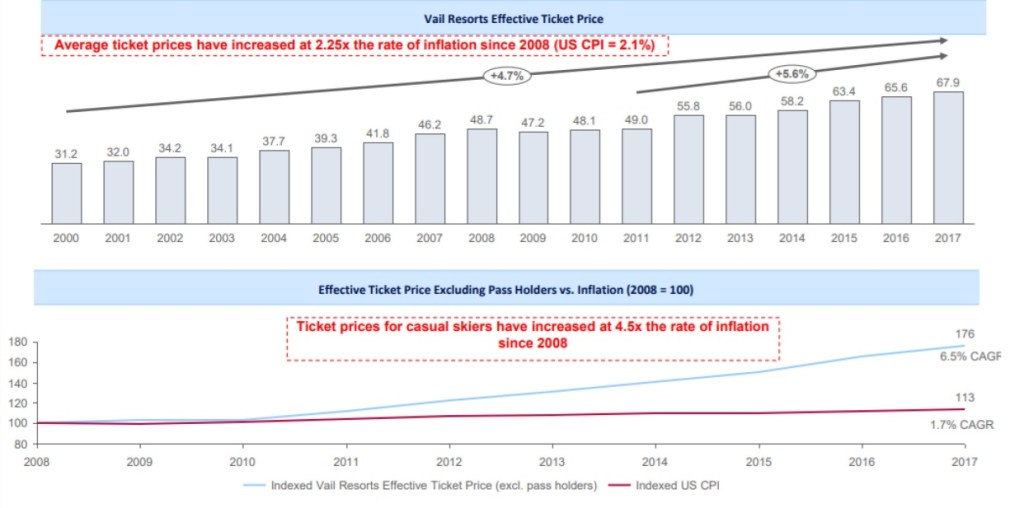
A chart from the class-action lawsuit.
Are such developments simply an example of how markets work in capitalism? Or do they shade into illegality? The lawsuit argues for the latter.
“This lack of competition has been to the detriment of Plaintiffs and members of the Class…and has caused them to pay supracompetitive prices for Lift Tickets and Mega Passes during the Class Period…. Plaintiffs bring this class action Complaint against Defendants for violations of federal and state antitrust laws and common law and seek to recover damages for the overpayment of Lift Tickets and Mega Passes, as well as other relief,” the lawsuit reads.
This year, relief at ski resorts has been in short supply. Thanks in part to lack of snow and unseasonably warm temperatures, many Colorado ski areas are closing early. The Colorado Ski Country USA website’s snow-report page notes that four resorts (Cooper, Howelsen Hill, Powderhorn and Sunlight) have already shut down operations, while others are on the brink of doing so: Silverton will pull the plug on March 28, and Purgatory, Monarch and Echo Mountain are slated to follow suit on March 29. Vail, for its part, has announced a final day of April 19.