
Hannah Metzger

Audio By Carbonatix
After weeks of fights and delays, the battle for Denver’s electric scooter contract ended on Wednesday, April 15.
The City Council Transportation & Infrastructure Committee advanced a three-year contract agreement with Veo to rent micromobility devices in Denver beginning in May. The contract still needs approval from the full council, but the vote effectively ended the possibility that current scooter vendors Lime and Bird will continue operating in the city.
“The existing vendors made some promises and here we are, nearly five years later, and those promises were not kept,” says Councilmember Chris Hinds, a leading proponent for scooter reforms. “We were literally giving the city to vendors that gave us nothing in return as far as accessibility, no financial contribution other than an access program. …What Veo is presenting is great.”
Lime and Bird’s contracts expire on May 16. The companies had been pushing for an extension since December, when the Denver Department of Transportation & Infrastructure announced it had selected Veo to take over the city’s scooter rentals.
The resistance contributed to city council delaying consideration of Veo’s contract twice. Thanks to the four-week setback, the contract won’t reach the full council for approval until April 27 — four days before Veo is scheduled to begin its rollout on May 1.
“Veo has been trusting in this process from the beginning. That’s why we’ve already hired, that’s why the vehicles are already ready to go,” says Alexander Keating, Veo’s vice president of policy and partnerships. “It’s a tight turnaround, but it’s something that we’re really prepared for.”
The vast majority of the opposition came from Lime, centered around its world-leading equity program that provides free scooter rides for low-income residents. Around 30,000 people have signed up for the access program over the years. Lime argued that, as a much smaller micromobility company, Veo is incapable of taking over the program.
For the last several weeks, Lime has packed committee rooms with dozens of supporters in neon green t-shirts and lined the council building’s hallways with hand-written signs pleading to keep the company in Denver. Wednesday’s meeting was quiet, however, with Lime’s army noticeably absent.
According to Hinds, the City Attorney’s Office concluded that Lime’s contract did not allow for an extension or a transitional period. The city would have had to create an entirely new contract agreement with the company. Even if it had received enough support from councilmembers to pass, which is uncertain, the process could not have been completed by the May 16 expiration date.
“All of us at Lime are deeply disappointed that our service in Denver will come to an end in May,” says Zach Williams, Lime’s regional head of government relations. “We’re so incredibly proud of the program that we’ve built here — especially our Lime Access program — and we’re grateful to the millions of Denverites and visitors who have trusted us over the past eight years. …We have already begun supporting our riders in transitioning to the new access program and are eager to support DOTI and the new provider to make the transition as smooth as possible.”
Keating is confident that Veo will be able to handle the transition. The current access program averages 7,000 to 8,000 active monthly users, according to the city; over 1,350 users have already pre-enrolled for Veo’s access program.

JR Goodwin/DRCOG
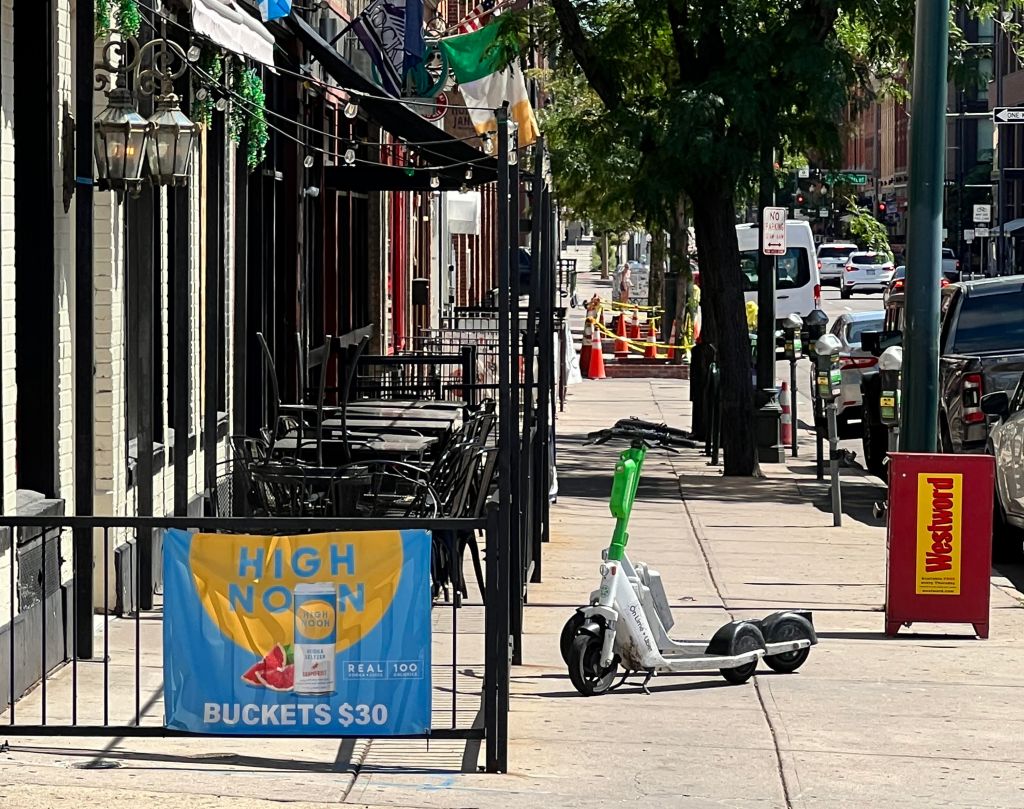
Supporters hope that Veo will improve scooter safety in the city. Despite years of pleas from residents and city leadership, Lime and Bird’s scooters continue to block sidewalks, facilitate illegal riding, and lead to increasingly frequent deaths and injuries. City council passed an ordinance last May requiring mandatory scooter parking zones in certain neighborhoods, technology that detects when users ride on sidewalks, and compliance tests that riders must pass before being able to rent the vehicles.
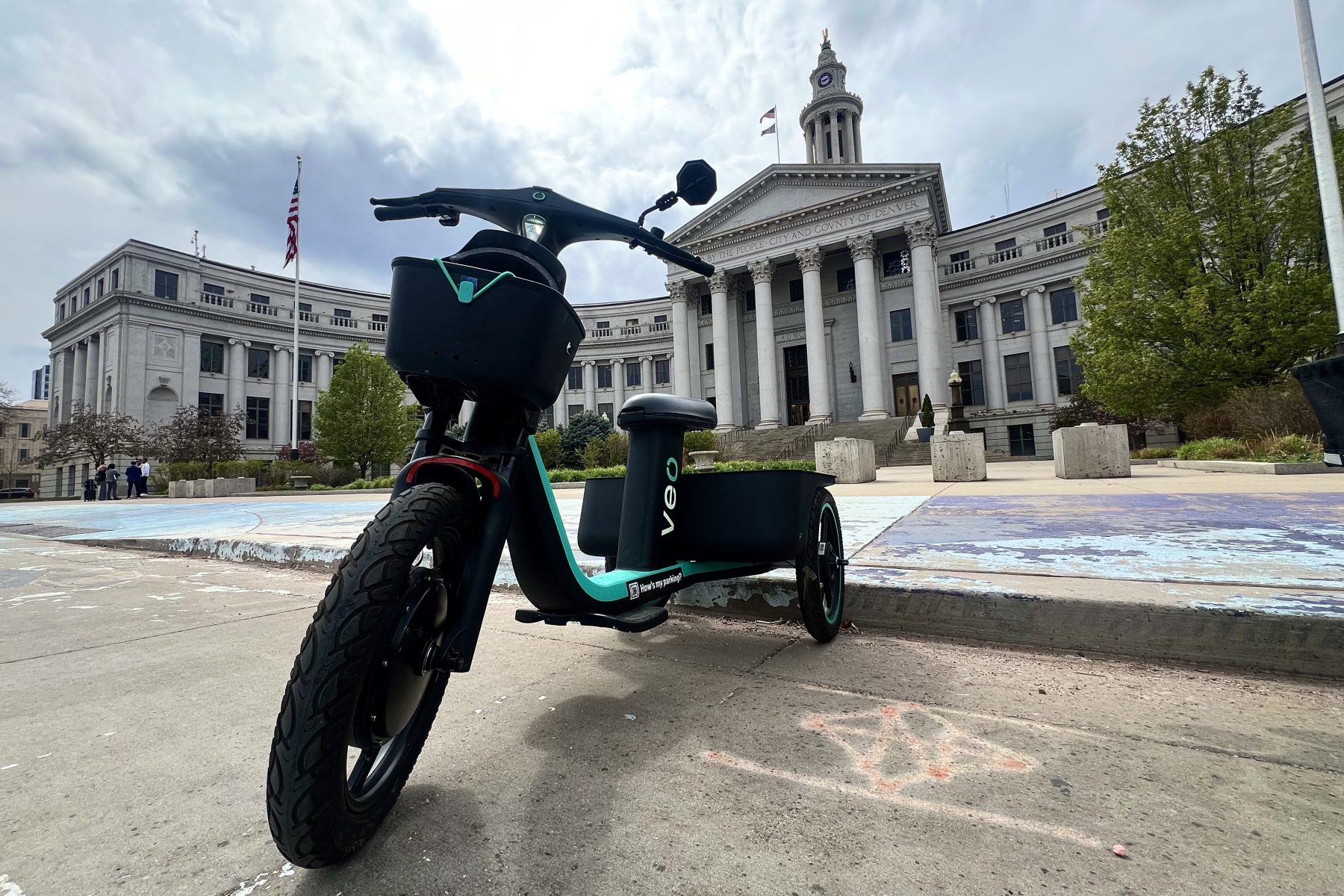
Veo’s vehicles are designed to comply with these new laws. They emit a voice warning if a rider is breaking local rules, have QR codes that passersby can use to report improper parking, and include technology that detects sidewalk riding and riding with multiple passengers.
“We’ve been working to get safety improvements, to get scooters off the sidewalks for three-and-a-half years,” says David Kurth, chair of the scooter subcommittee of the Upper Downtown Neighborhood Association. “We are very optimistic that a lot of the problems are going to be solved. We’re going to keep monitoring what Veo does and we’ll tell them if they’re not doing the right job.”
Kurth adds that the association is advocating for DOTI to update bike lane signage to include scooters and for Denver police to enforce riding laws. Denver police issued only nine citations for improper scooter use between 2018 and 2024, compared with the over 18.3 million e-scooter trips taken in that time frame.
Councilmembers unanimously advanced Veo’s contract out of committee on Wednesday, but not all were so optimistic.
“I would just say, ‘we’ll see,'” Councilmember Paul Kashmann said during the meeting. “These are the same assurances we got last time from our previous vendors. …Hopefully we’ll have better experience.”
Here are some of the changes Denver residents can expect with the scooter swap:
Equity Program
Lime provides low-income residents with three free rides per day, each lasting up to thirty minutes. Veo will offer low-income residents with sixty minutes of free rides per day, with no limit on the number of rides taken. After the sixty minutes, riders will be charged $0.15 per minute with no unlocking fee. So riders will have fewer total minutes of free rides per day, but more flexibility regarding how many free rides they can take.
The eligibility for Veo’s equity program will be the same as Lime’s, with individuals who participate in any local, state or federal assistance program, like Medicaid or SNAP, allowed to register. Users will be able to use their participation in the current Lime Access program as proof of eligibility to enroll in Veo’s program, also.
Users can begin the enrollment process for Veo’s access program now at veoride.com/denver. To ease the transition, Veo will allow users to access free rides throughout May without proving eligibility as a sort of honor-system grace period.
Rental Prices
Right now, Bird and Lime charge riders $0.44 per minute, plus a $1 unlocking fee. Veo will charge Denver residents $0.25 per minute and visitors $0.39 per minute, plus the same $1 unlocking fee. The prices are set in Veo’s licensing agreement, so the company will not be allowed to increase prices during the duration of its contract.
Trips that begin in “equity-focused neighborhoods” will be subject to additional rate discounts.
Scooters, Bikes and Trikes
Veo will deploy 9,000 vehicles of five different types, which the company claims is the most diverse fleet of dockless micromobility vehicles in the nation.
One-third of the fleet will be traditional standing e-scooters and one-third will be seated e-scooters, while one-sixth will be two-seated e-bikes, one-sixth will be cargo e-bikes and around fifty to one hundred vehicles will be cargo tricycles.
Veo is scheduled to begin operations on May 1, while Lime and Bird are scheduled to end operations on May 16. So there will be about two weeks of overlap during which Lime and Bird scooters will remain accessible, as Veo rolls out its fleet.
Riding Laws
Veo vehicles are fitted with technology to detect unlawful behavior, such as riding on sidewalks or riding with multiple people on board. A voice will emit from the vehicle if a rider does something wrong; for example, “Don’t ride on sidewalks,” or “Hard breaking detected, please ride safely.” It will also explain what’s happening if riders enter a geofenced zone that automatically slows the vehicle, like on 16th Street.
How the vehicles respond to sidewalk-riding or double-riding may depend on where in the city it occurs, Keating explains. Data tracking infractions will be sent to the city and can be used to increase enforcement in problem areas. For example, if a neighborhood sees excessive sidewalk-riding, the vehicles in that area can be programed to automatically stop or slow once they enter a sidewalk.
The specifics will be decided in the lead-up to the May 1 launch and in the following months as data comes in.
LoDoNA
Bad Riders Banned
Riders found to repeatedly violate scooter laws will be banned from renting Veo’s vehicles, according to Keating.
Generally, the company uses a three-strike system. After a first violation, they reach out to the rider and send education about the law. After a second, the rider receives a monetary fine. After a third, they are removed from the platform, though they can often be allowed back if they go through training.
In extreme cases, users can receive an automatic ban after only one infraction. For example, if someone rides while intoxicated or causes an injury crash, Keating says. Those instances would be based on police reports to Veo.
The details of these enforcement mechanisms are not laid out in the contract. Veo will work through the specifics with the city and neighborhood associations in the coming weeks.
Parking
Veo is required to build 150 new parking corrals throughout the city. If a user ends their ride in a mandatory parking zone, like Union Station, they’ll have to park in a designated corral. Under Veo’s contract, the mandatory parking zones must be implemented in the Lower Downtown neighborhood by November and in the Central Business District by May 2027, according to Wednesday’s committee discussion.
To prove they’re in the right spot, riders scan their vehicle’s QR code and then tap their phone to the parking corral. This tap-to-park system is more geographically precise than GPS, intending to ensure proper parking that does not block streets and sidewalks.
Each vehicle also has a QR code that reads “How’s my parking?”, allowing passersby to report improperly parked vehicles. Under the contract, Veo must respond to reported problem vehicles within two hours.
Other Changes
Unlike with Lime and Bird, Veo will have a financial partnership with the city. It will pay the city $250 per vehicle per year to operate in Denver, which the city will reinvest in micromobility operations.
The licensing agreement with Veo will last three years, instead of the five-year contracts Lime and Bird had.
The majority of Veo’s workforce will be W-2 employees instead of independent contractors, according to the company. It has hired 135 local employees as of Wednesday, Keating says.