Flickr/Michael Levine-Clark

Audio By Carbonatix
If you’re one of those daily commuters who leaves early for work and returns home in total darkness, we salute you. And so has Mother Nature these past few mornings, which have offered an amazing stretch of sunrises.
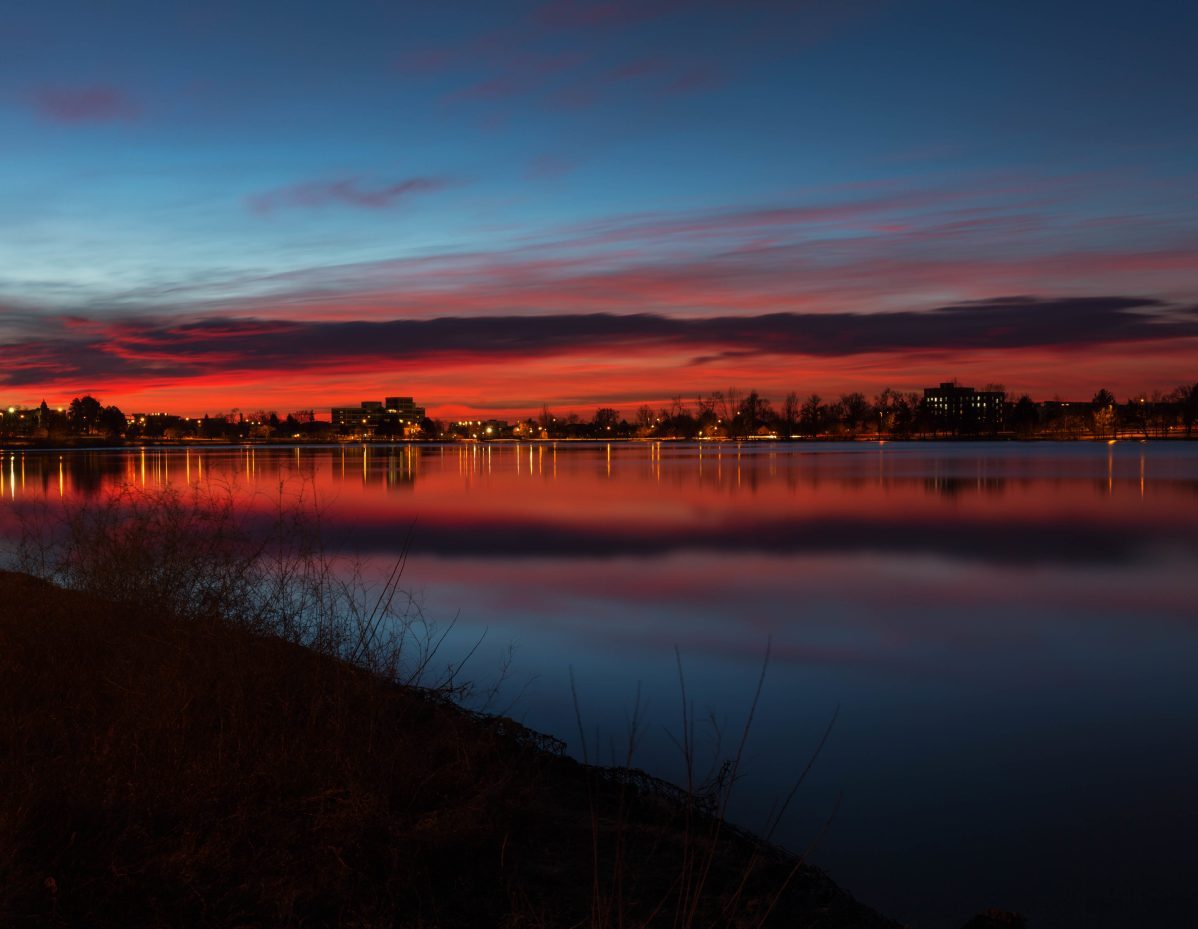
Colorado is a great state for stargazing, but anyone lucky enough to be awake during Denver-area sunrises this week has witnessed some spectacular sherbet skies. With sunrises currently hitting the metro at around 7 a.m., the latest of the year, most of us have never had a better chance to see vivid displays of blue, pink, purple, orange and red.
Denver is no stranger to beautiful sunrises and sunsets, but these past few have been something special, bursting through small cracks in bedroom curtains and living room blinds…or filling windshields with color. But what makes these latest mornings so special, and how can we predict them going forward?
Science Behind Denver Sunrises
Sunrises and sunsets are made particularly colorful when molecules and particles in the air obscure the path of light rays. This causes the light to scatter, giving the sky a wider spectrum of colors. (It’s also why cities with air and light pollution tend to have more colorful sunsets.)
Clouds, wind and pollution are the main causes of scattering, but light wavelengths and atmosphere play a part, too. For example, violet has shorter wavelengths than orange, red or yellow, so our eyes need very specific conditions to catch it. Blue is easier to see than violet, but still needs relatively clear conditions to come through, which is why the sky is so blue on a sunny day.
More light passes through the atmosphere when the sun is low on the horizon, creating scattering effects that allow our eyes to see more orange, red and yellow in the air, with patches of blue and morning darkness largely filling in the rest.
Add in a few Colorado mountain peaks, and you’ve got something special.
How to Predict a Beautiful Sunrise
Predicting the time of a sunrise is relatively easy and consistent for meteorologists, who use an equation that relies on factors such as latitude, longitude, the earth’s rotation and many other variables, while us regular folk can use NOAA’s Solar Calculator. It’s a little harder to forecast how magnificent a sunrise’s colors will be, but it’s not impossible.
Clouds and wind are the main contributors to light scattering, so we can use those forecasts as a gauge for tomorrow’s sunrise. The type of clouds and size of their coverage play an important part, too. Premium conditions include high and mid-level clouds, like cirrus and altocumulus, with patchy sky coverage and no low-level clouds to block the incoming sunlight. Wind speed and direction will obviously influence those clouds, as well.
There are a number of apps, weather trackers and solar calculators that will help you make a sunrise prediction — or you can simply wake up to a surprise, as we have this week.